
Meet Judelyn Padgett, a project manager at AUI headquarters.
Recent News
NA-ROAD Announces the 2026 Women and Girls in Astronomy Program Cohort
The Women and Girls in Astronomy Program (WGAP), led by Associated Universities, Inc. (AUI), under the North American Regional Office of Astronomy for Development (NA-ROAD), is proud to announce the selection of ten regional projects to receive funding through the 2026 cycle.
Twisted Physics: Astronomers Solve 30-Year-Old Stellar Mystery
Astronomers using the Atacama Large Millimeter/submillimeter Array (ALMA) have captured the first direct, high-resolution images of a magnetic field wrapped tightly around the outflow of gas streaming away from a forming star — evidence that solves a decades-old puzzle about how young stars sculpt the powerful jets that form them.
Painting the Giant: NSF Green Bank Telescope Gets Critical Makeover
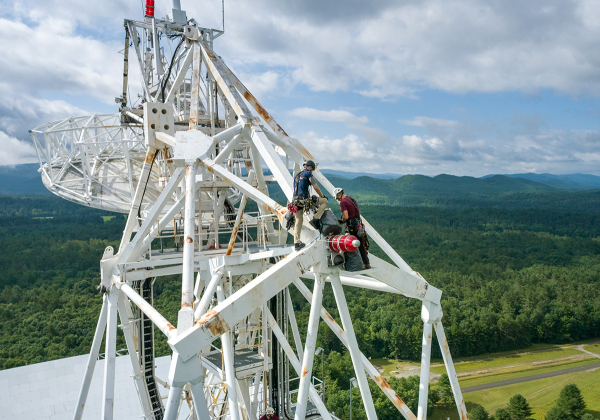
Image credit: Modjeski and Masters
Repainting of telescope feed arm marks a major milestone in a multi-year project to protect the world’s largest fully steerable radio telescope
The U.S. National Science Foundation Green Bank Telescope (NSF GBT), the world’s largest fully steerable radio telescope, will reach a major maintenance milestone this summer. This work is part of a multi-year repainting effort designed to protect this national scientific asset from the elements and extend the NSF GBT’s working life for future generations of researchers. “The repainting project is about staying ahead of any wear or damage and extending the life of the instrument. Without maintenance like this, the Green Bank Telescope wouldn’t be available for projects crucial to America’s leadership in aerospace, like the Artemis II mission. We tracked the spacecraft with NASA’s Deep Space Network and were available for back-up communications. While painting may not seem important, it’s vital to the future of the GBT,” said Anthony Remijan, Director of the NSF Green Bank Observatory.
Adds long-time Green Bank Observatory supporter West Virginia Senator Shelly Moore Capito, “The Green Bank Telescope is a cornerstone of scientific discovery in West Virginia and plays a critical role in keeping our country at the forefront of science and space exploration. This maintenance milestone reflects a commitment to preserving the telescope for future generations.”
During last summer’s maintenance season, crews of observatory staff and contractors successfully sandblasted and repainted the telescope’s upper feed arm. This towering steel structure holds important parts of the instrument, including the subreflector, high above the telescope’s 100-meter dish. “With the upper feed arm now renewed and protected by a modern three-layer coating system, we’ve taken a major step toward securing the Green Bank Telescope’s structural health,” added Remijan.
Routine touch-up painting of the NSF GBT has been part of the observatory’s summer maintenance for decades, although how this has been completed has changed over the years, expanding to include the use of contractors to complete the work more efficiently. A 2021 structural and coatings inspection by the engineering firm Modjeski and Masters recommended a full removal of the NSF GBT’s old coating and a complete repainting of the telescope using a modern three-coat system (of zinc, epoxy, and urethane), similar to those used on long-span steel bridges and other critical national infrastructure.
Since 2022, annual summer maintenance has focused on completing targeted repairs on the feed arm. Thanks to an award from the NSF in 2025, the Observatory launched and completed the first phase of painting that summer. This work included blast cleaning the upper feed arm to bare steel, repairs, and application of the new three-coat protective system, along with drone-assisted inspections that verified the areas in most need of restoration had been successfully treated.
This summer, thanks to another award from the NSF coming in at just under $5 million dollars, the lower portion of the feed arm will go through the same process as the top half did last year, with sand blasting to remove the aging paint, then repairs, and finally repainting. The repainting campaign is part of a broader, long-term infrastructure plan to keep the telescope safe, reliable, and scientifically productive well into the future. “The National Science Foundation recognizes the value and importance of the GBT. We hope to be able to continue funding this phased effort to keep the telescope in great condition, ensuring its capabilities for decades to come,” adds Harshal Gupta, NSF Program Officer for the Green Bank Observatory.
About NRAO and GBO
The National Radio Astronomy Observatory (NRAO) and the Green Bank Observatory are major facilities of the U.S. National Science Foundation, operated under cooperative agreement by Associated Universities, Inc.
This news article was originally published on the NRAO website on May 11, 2026.


Recent News
10 Questions: Judelyn Padgett
Meet Judelyn Padgett, a project manager at AUI headquarters.
NA-ROAD Announces the 2026 Women and Girls in Astronomy Program Cohort
The Women and Girls in Astronomy Program (WGAP), led by Associated Universities, Inc. (AUI), under the North American Regional Office of Astronomy for Development (NA-ROAD), is proud to announce the selection of ten regional projects to receive funding through the 2026 cycle.
Twisted Physics: Astronomers Solve 30-Year-Old Stellar Mystery
Astronomers using the Atacama Large Millimeter/submillimeter Array (ALMA) have captured the first direct, high-resolution images of a magnetic field wrapped tightly around the outflow of gas streaming away from a forming star — evidence that solves a decades-old puzzle about how young stars sculpt the powerful jets that form them.