
Astronomers using the Atacama Large Millimeter/submillimeter Array (ALMA) have captured the first direct, high-resolution images of a magnetic field wrapped tightly around the outflow of gas streaming away from a forming star — evidence that solves a decades-old puzzle about how young stars sculpt the powerful jets that form them.
Recent News
A Trillion Mile Cosmic Stream of Gas Feeds GW Orionis
A team of astronomers using the Atacama Large Millimeter/submillimeter Array (ALMA), of which the U.S. National Science Foundation National Radio Astronomy Observatory is a partner, has captured a massive stream of gas—one trillion miles, or .2 light years long—feeding the young triple-star system GW Orionis.
NSF NRAO radio observations help rule out a relativistic jet in rare stellar explosion
Astronomers studying a rare stellar explosion first spotted as a brief burst of X-rays used radio observations to help show that the dying star did not produce the powerful jet often associated with gamma-ray bursts.
NSF Green Bank Observatory Shares Images, Data From Artemis II Mission
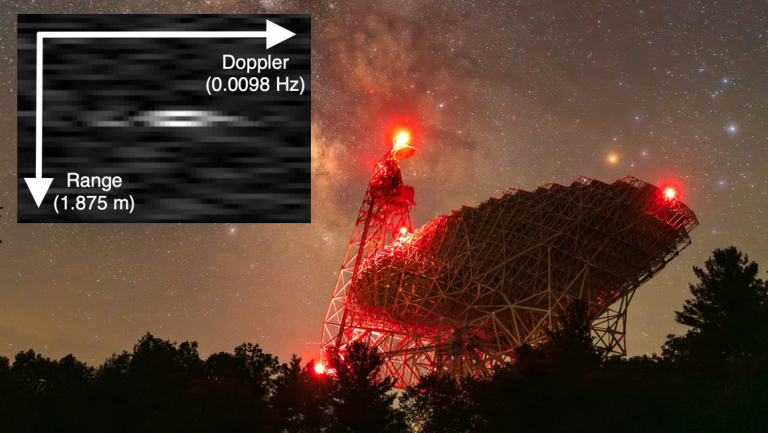
The pixels in the data in the upper left represent the Orion spacecraft. The vertical (range) axis indicates distance to the spacecraft with distance increasing downward in the image. The horizontal (Doppler) axis indicates a frequency shift from the expected return signal. This image of the Orion capsule was created while the spacecraft was over 213k miles (343k km) from Earth. Shared Will Armentrout, an NSF GBO scientist presenting to colleagues at the NSF GBO, “There are four people in those pixels.” Image credit: Data credit: JPL & NSF/AUI/NSF NRAO. Photo credit: NSF/AUI/NSF NRAO/J.Hellerman.
Radar signals received by world’s largest fully steerable radio telescope tracked spacecraft with NASA’s communications network for historic lunar test flight
The U.S. National Science Foundation Green Bank Telescope (NSF GBT) produced these data and images while supporting NASA’s Artemis II mission by helping to track the crewed Orion spacecraft throughout its historic journey around the Moon. The NSF GBT conducted five observations over the same number of days, for six hours each day, that the spacecraft was closest to the Moon, and farthest from the Earth at over 200,000 miles away.
“With the GBT, we were able to track the movement of the spacecraft within 0.2 millimeters per second of what NASA calculated in its projections,” shared Anthony Remijan, site director of the NSF Green Bank Observatory, “It’s like having a speedometer in your car that can track your speed within 0.0004 decimal places per hour.”
Besides supporting NASA’s Space Communications and Navigation (SCaN) program during the Artemis II mission, this work provided evidence of the important support the NSF GBT and the NSF National Radio Astronomy Observatory (NSF NRAO) can offer future space missions, for NASA and commercial aerospace companies. The NSF GBT provided radar support to NASA’s Double Asteroid Redirection Test (DART), and the NSF Very Long Baseline Array (NSF VLBA) provided precise tracking and data downlink of Intuitive Machines’ Nova-C lunar lander, Athena, during its mission to the Moon.
”It’s exciting when projects like this put our NSF facilities in national headlines,” adds Linnea Avallone, NSF Chief Officer for Research Facilities, “Being able to offer inter-agency support to our colleagues at NASA makes the most of all our capabilities.”
About NRAO
The Green Bank Observatory is a part of the National Radio Astronomy Observatory, a major facility of the U.S. National Science Foundation, operated under cooperative agreement by Associated Universities, Inc.
This news article was originally published on the NRAO website on May 6, 2026.


Recent News
Twisted Physics: Astronomers Solve 30-Year-Old Stellar Mystery
Astronomers using the Atacama Large Millimeter/submillimeter Array (ALMA) have captured the first direct, high-resolution images of a magnetic field wrapped tightly around the outflow of gas streaming away from a forming star — evidence that solves a decades-old puzzle about how young stars sculpt the powerful jets that form them.
A Trillion Mile Cosmic Stream of Gas Feeds GW Orionis
A team of astronomers using the Atacama Large Millimeter/submillimeter Array (ALMA), of which the U.S. National Science Foundation National Radio Astronomy Observatory is a partner, has captured a massive stream of gas—one trillion miles, or .2 light years long—feeding the young triple-star system GW Orionis.
NSF NRAO radio observations help rule out a relativistic jet in rare stellar explosion
Astronomers studying a rare stellar explosion first spotted as a brief burst of X-rays used radio observations to help show that the dying star did not produce the powerful jet often associated with gamma-ray bursts.