
Carlstrom will present his talk: “What Do We Know About The Big Bang?” to the public on three dates, along with a recording that will be shared on the NSF NRAO’s YouTube channel.
U.S. National Science Foundation, NSF National Radio Astronomy Observatory and U.S. Naval Observatory Partner on Pathfinder for Next Generation Very Large Array
Recent News
10 Questions: Desmond Wysenyuy
Meet Desmond Wysenyuy, program coordinator for the North American Regional Office of Astronomy for Development.
Cosmic Cocktail: Exotic Methanol Discovered in Planet-Building Zones
New results from the ALMA COMPASS Large Program (Complex Organic Molecules in Protostars with ALMA Spectral Surveys) show that young, still-forming stars are surrounded by a surprisingly sophisticated “chemical starter kit”, including organic molecules such as methanol that may one day enrich planets.
U.S. National Science Foundation, NSF National Radio Astronomy Observatory and U.S. Naval Observatory Partner on Pathfinder for Next Generation Very Large Array
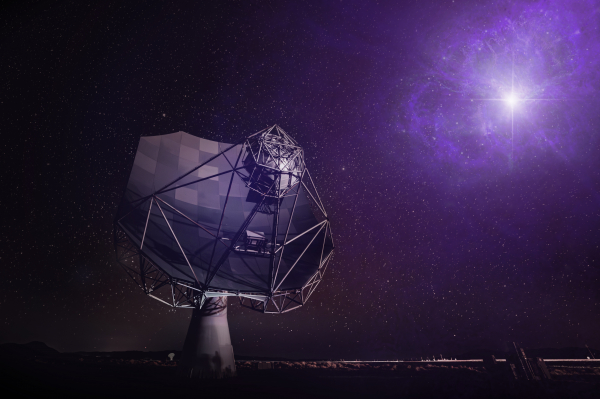
This image shows the first prototype ngVLA antenna, which recently tested its systems by observing and tracking the Crab Nebula, also known as Taurus A (3C144), the remnant of an exploded star. This composite image features astrophotography by Alin Sosnovic along with more detailed radio data of the Crab Nebula collected by the NSF VLA. Image credit: NSF/AUI/NSF NRAO/A.Sosnovici/M.Weiss
The U.S. National Science Foundation (NSF), the NSF National Radio Astronomy Observatory (NSF NRAO), and the U.S. Naval Observatory (USNO) are advancing a new collaboration to support the future of high-resolution radio astronomy and astrometry, with the development of a pathfinder instrument for the proposed Next Generation Very Large Array (ngVLA).
These joint efforts support the pathfinder for ngVLA technologies, focusing on very long baseline interferometry (VLBI) capabilities that enable ultra-sharp imaging of the Universe. Jointly funded by NSF and USNO, it expands a longstanding partnership that currently supports the NSF Very Long Baseline Array (NSF VLBA). This collaboration reflects the shared importance of high-resolution radio observations for both cutting-edge astrophysics and other important applications, including maintaining the International Celestial Reference Frame (ICRF), the fundamental reference system used for navigation and space science.
Planned as a distributed array, these pathfinder ngVLA antennas will be deployed across several existing NSF VLBA locations as well as new sites throughout the United States, with operations based in New Mexico. The facility is designed to support both astronomical discovery and precise measurements of Earth’s orientation in space.
While the pathfinder ngVLA will be able to operate as a standalone, complementary facility, it will also be an integral component of the full ngVLA in the future. The proposed ngVLA will consist of 266 antennas, with the core based at the existing NSF VLA in New Mexico, spreading across the Southwest and in key locations across North America. These efforts represent a strategic step toward enhancing the capabilities of the NSF VLA and NSF VLBA. Construction and early operations of the pathfinder ngVLA are anticipated before the end of the decade, marking a significant milestone in the evolution of U.S. leadership in radio astronomy.
About NRAO
The National Radio Astronomy Observatory (NRAO) is a major facility of the U.S. National Science Foundation, operated under cooperative agreement by Associated Universities, Inc.
This news article was originally published on the NRAO website on July 16, 2026.


Recent News
Professor John E. Carlstrom Delivers 2026 NSF NRAO Jansky Lectures
Carlstrom will present his talk: “What Do We Know About The Big Bang?” to the public on three dates, along with a recording that will be shared on the NSF NRAO’s YouTube channel.
10 Questions: Desmond Wysenyuy
Meet Desmond Wysenyuy, program coordinator for the North American Regional Office of Astronomy for Development.
Cosmic Cocktail: Exotic Methanol Discovered in Planet-Building Zones
New results from the ALMA COMPASS Large Program (Complex Organic Molecules in Protostars with ALMA Spectral Surveys) show that young, still-forming stars are surrounded by a surprisingly sophisticated “chemical starter kit”, including organic molecules such as methanol that may one day enrich planets.