
Meet Judelyn Padgett, a project manager at AUI headquarters.
Recent News
NA-ROAD Announces the 2026 Women and Girls in Astronomy Program Cohort
The Women and Girls in Astronomy Program (WGAP), led by Associated Universities, Inc. (AUI), under the North American Regional Office of Astronomy for Development (NA-ROAD), is proud to announce the selection of ten regional projects to receive funding through the 2026 cycle.
Twisted Physics: Astronomers Solve 30-Year-Old Stellar Mystery
Astronomers using the Atacama Large Millimeter/submillimeter Array (ALMA) have captured the first direct, high-resolution images of a magnetic field wrapped tightly around the outflow of gas streaming away from a forming star — evidence that solves a decades-old puzzle about how young stars sculpt the powerful jets that form them.
NSF NRAO radio observations help rule out a relativistic jet in rare stellar explosion
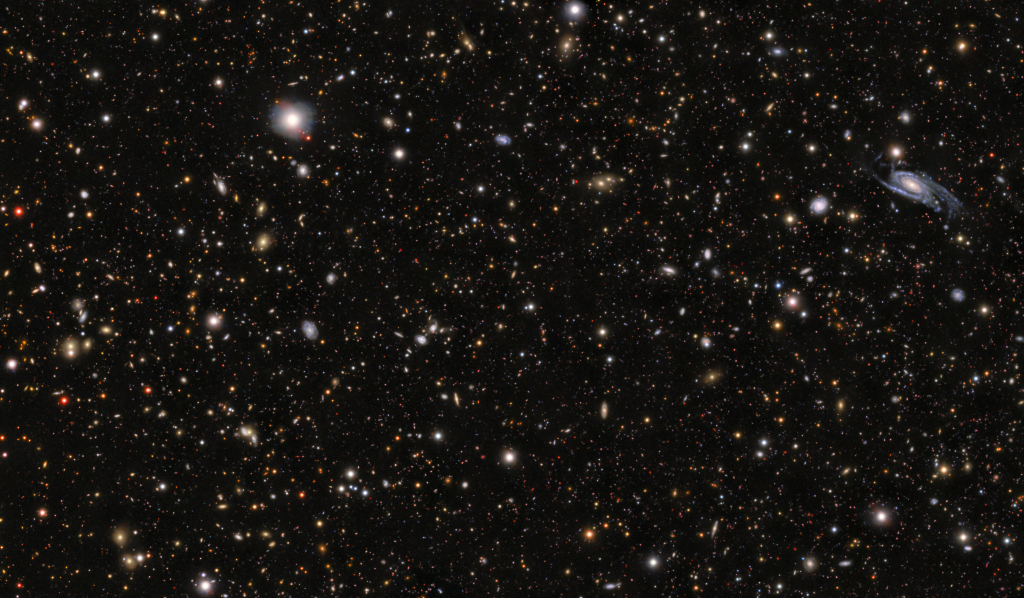
This image shows the field around the progenitor to supernova SN 2026gzf, detected by the Einstein Probe on 21 March 2026. The supernova progenitor appears as a bright blue dot within the galaxy located in the middle of the upper third at the center of this image. This image was created by stacking multiple images taken between May 2025 and January 2026 with the LSST Camera, mounted on NSF–DOE Vera C. Rubin Observatory, jointly funded by the U.S. National Science Foundation (NSF) and the U.S. Department of Energy’s Office of Science (DOE/SC). SN 2026gzf occurred within Rubin’s COSMOS Deep Drilling Field. Observations of this field, including this image, were recently made public as part of Rubin’s Early Data Preview 2 (EDP2) — the first data preview based on observations from the LSST Camera. EDP2 combines Rubin’s science validation observations collected between April 2025 and January 2026. Image credit: NSF–DOE Vera C. Rubin Observatory/NOIRLab/SLAC/AURA
Astronomers studying a rare stellar explosion first spotted as a brief burst of X-rays used radio observations to help show that the dying star did not produce the powerful jet often associated with gamma-ray bursts.
The event, known as EP260321a and later identified as supernova SN 2026gzf, gave researchers a rare look at the earliest stages of a massive star’s death. Optical and X-ray observations showed a shock breakout, the moment when the blast wave from the explosion pushed through the star’s surface, while radio observations from the U.S. National Science Foundation National Radio Astronomy Observatory (NSF NRAO) U.S. National Science Foundation Very Large Array (NSF VLA) found no clear sign of the strong radio afterglow expected if a jet had been aimed toward Earth.
That lack of radio emission was a key clue. In many of the most energetic explosions involving massive stars, a fast jet of material produces strong radio signals as it crashes into gas around the star. In this case, the radio data suggest a different outcome: the jet may have been weak, slowed down, or blocked before it could fully escape.
The paper describes EP260321a/SN 2026gzf as a broad-lined Type Ic supernova with an unusually faint shock breakout. The findings point to a more varied range of ways that massive stars can end their lives than astronomers had previously recognized.
The NSF NRAO radio observations were part of a broader worldwide campaign that followed the event from its earliest hours. Together with X-ray and optical measurements from other observatories, the radio data helped researchers better understand the explosion’s structure, the material around the star, and how the event unfolded.
Read the full release from NOIRLab.
About NRAO
The National Radio Astronomy Observatory is a facility of the U.S. National Science Foundation, operated under cooperative agreement by Associated Universities, Inc.
This news article was originally published on the NRAO website on August 5, 2026.


Recent News
10 Questions: Judelyn Padgett
Meet Judelyn Padgett, a project manager at AUI headquarters.
NA-ROAD Announces the 2026 Women and Girls in Astronomy Program Cohort
The Women and Girls in Astronomy Program (WGAP), led by Associated Universities, Inc. (AUI), under the North American Regional Office of Astronomy for Development (NA-ROAD), is proud to announce the selection of ten regional projects to receive funding through the 2026 cycle.
Twisted Physics: Astronomers Solve 30-Year-Old Stellar Mystery
Astronomers using the Atacama Large Millimeter/submillimeter Array (ALMA) have captured the first direct, high-resolution images of a magnetic field wrapped tightly around the outflow of gas streaming away from a forming star — evidence that solves a decades-old puzzle about how young stars sculpt the powerful jets that form them.