Meet Desmond Wysenyuy, program coordinator for the North American Regional Office of Astronomy for Development.
Recent News
Cosmic Cocktail: Exotic Methanol Discovered in Planet-Building Zones
New results from the ALMA COMPASS Large Program (Complex Organic Molecules in Protostars with ALMA Spectral Surveys) show that young, still-forming stars are surrounded by a surprisingly sophisticated “chemical starter kit”, including organic molecules such as methanol that may one day enrich planets.
Proctor Foundation for Art and Science Offers Stellar Guitar to Space Camp Auction
To celebrate the Inspiration4 Mission’s 5th Anniversary, mission pilot Dr. Sian Proctor is choosing to celebrate in a fitting way — raising funds to send community college students and faculty to Space Camp.
Professor John E. Carlstrom Delivers 2026 NSF NRAO Jansky Lectures
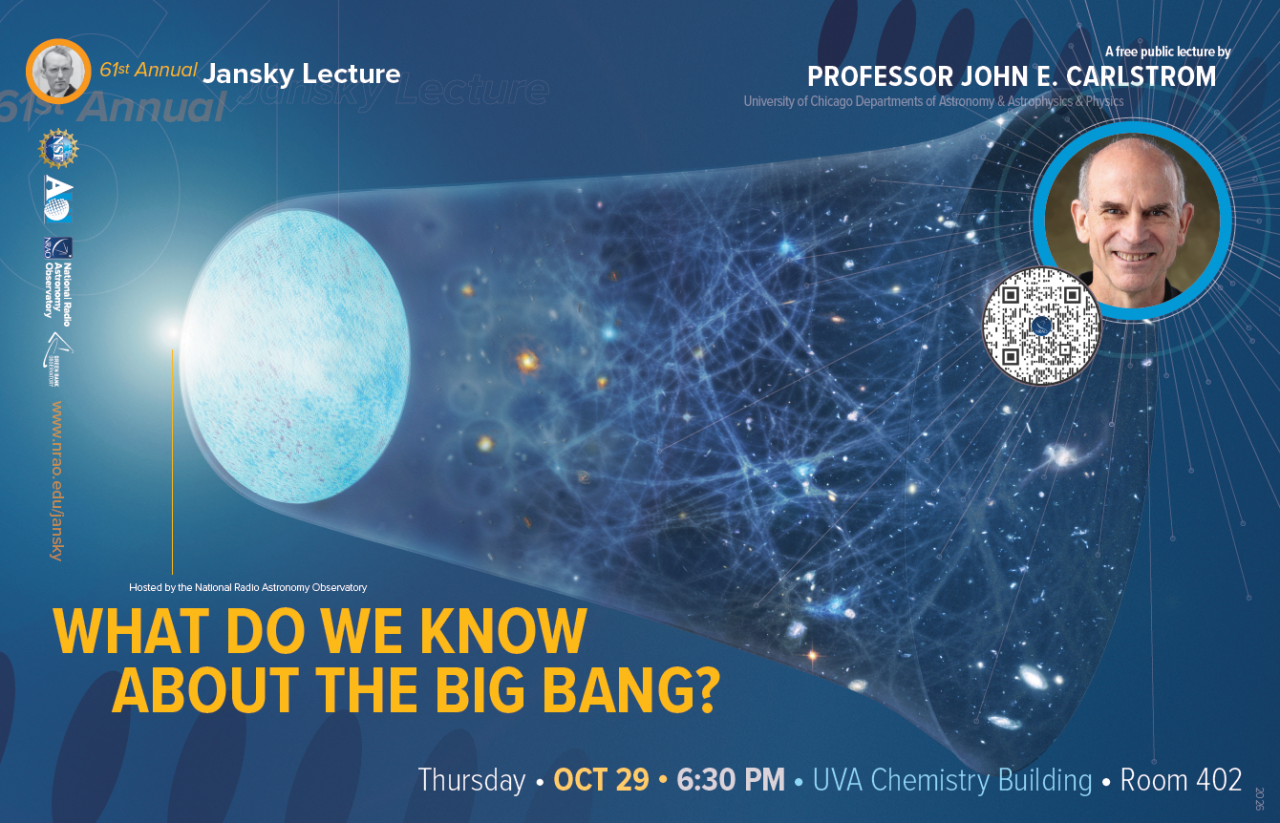
Image credit: NSF/AUI/NSF NRAO
Free Public Lectures To Be Held This Fall In Virginia, West Virginia, and New Mexico
The U.S. National Science Foundation National Radio Astronomy Observatory (NSF NRAO) has awarded the 2026 Karl G. Jansky Lectureship to Professor John E. Carlstrom. Carlstrom is an astrophysicist who studies the oldest light in the Universe. His work helps answer some of science’s biggest questions: how the universe began, how it grew, and what it’s made of.
The Jansky Lectureship is an honor established by the trustees of Associated Universities, Inc. to recognize outstanding contributions to the advancement of radio astronomy. The award is named after Karl G. Jansky, who was the first person to detect radio waves from a cosmic source. Since 1966, award winners have presented lectures at NSF NRAO locations including Charlottesville, Virginia; Green Bank, West Virginia; and Socorro, New Mexico.
Carlstrom will present his talk: “What Do We Know About The Big Bang?” to the public on three dates, along with a recording that will be shared on the NSF NRAO’s YouTube channel.
- Monday, October 26, 2026, 7pm ET, Green Bank Observatory, Science Center Auditorium,
- Thursday, October 29, 2026, 6:30pm ET, University of Virginia, Chemistry Building Room 402
- Friday, November 20, 2026, 7pm MT, New Mexico Tech, Workman 101
Carlstrom is best known for studying the cosmic microwave background, the faint afterglow of the Big Bang. To conduct his research, he designed and built many of his own instruments, and led the development of the South Pole Telescope in Antarctica. Learn more about Carlstrom’s science and many awards here.
About the NSF NRAO
The NSF National Radio Astronomy Observatory (NSF NRAO) is a facility of the U.S. National Science Foundation, operated under cooperative agreement by Associated Universities, Inc.
This news article was originally published on the NRAO website on October 7, 2026.


Recent News
10 Questions: Desmond Wysenyuy
Meet Desmond Wysenyuy, program coordinator for the North American Regional Office of Astronomy for Development.
Cosmic Cocktail: Exotic Methanol Discovered in Planet-Building Zones
New results from the ALMA COMPASS Large Program (Complex Organic Molecules in Protostars with ALMA Spectral Surveys) show that young, still-forming stars are surrounded by a surprisingly sophisticated “chemical starter kit”, including organic molecules such as methanol that may one day enrich planets.
Proctor Foundation for Art and Science Offers Stellar Guitar to Space Camp Auction
To celebrate the Inspiration4 Mission’s 5th Anniversary, mission pilot Dr. Sian Proctor is choosing to celebrate in a fitting way — raising funds to send community college students and faculty to Space Camp.