
Astronomers using the Atacama Large Millimeter/submillimeter Array (ALMA) have captured the first direct, high-resolution images of a magnetic field wrapped tightly around the outflow of gas streaming away from a forming star — evidence that solves a decades-old puzzle about how young stars sculpt the powerful jets that form them.
Recent News
A Trillion Mile Cosmic Stream of Gas Feeds GW Orionis
A team of astronomers using the Atacama Large Millimeter/submillimeter Array (ALMA), of which the U.S. National Science Foundation National Radio Astronomy Observatory is a partner, has captured a massive stream of gas—one trillion miles, or .2 light years long—feeding the young triple-star system GW Orionis.
NSF NRAO radio observations help rule out a relativistic jet in rare stellar explosion
Astronomers studying a rare stellar explosion first spotted as a brief burst of X-rays used radio observations to help show that the dying star did not produce the powerful jet often associated with gamma-ray bursts.
10 Questions: Evan Smith
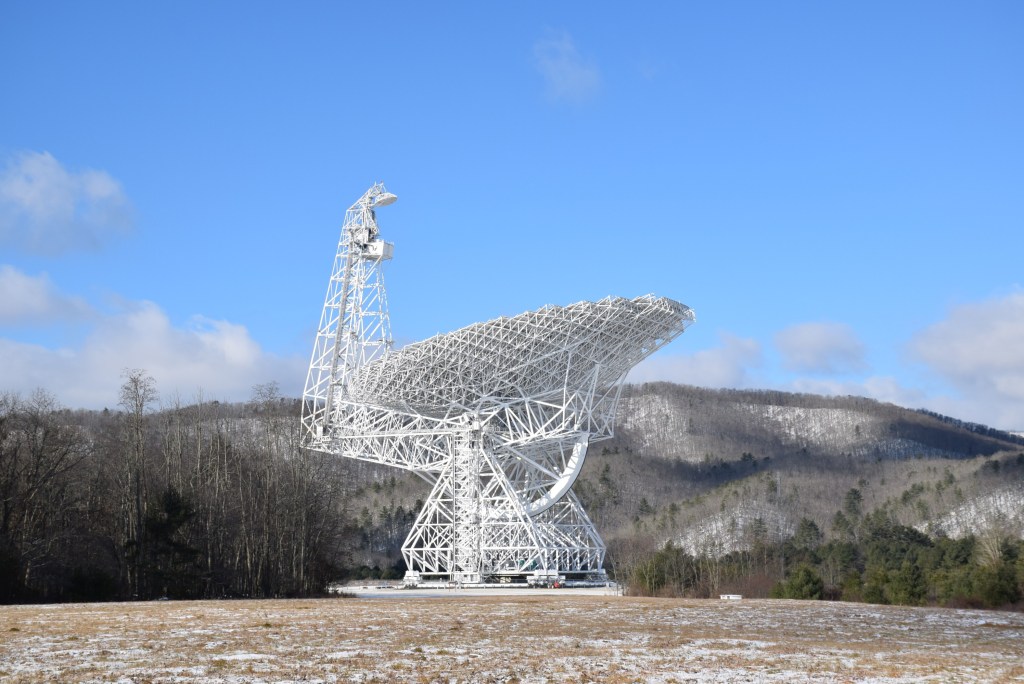
An inside look at unique careers in STEM
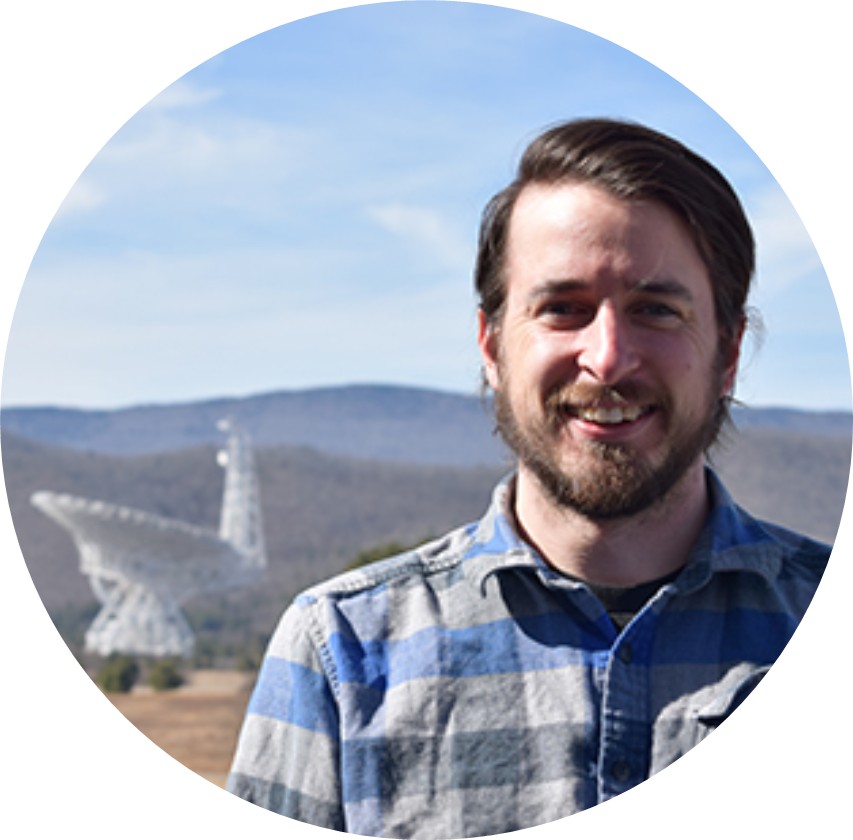
In each installment of our “10 Questions” blog series, readers will meet a staff member from AUI or one of its managed facilities, gaining insight into their career journey, what their role involves and what makes their work meaningful.
1. What is your role and what facility do you work at?
I am a data analyst at the Green Bank Observatory (GBO), nestled in the Appalachian Mountains of West Virginia and the National Radio Quiet Zone. We host the 100-meter Green Bank Telescope (GBT), which is the largest fully steerable telescope in the world and features an off-axis feed arm that increases dynamic range and provides extremely clear radio data.
2. What drew you to this field and how did you get started?
I got my start in radio astronomy with the Undergraduate ALFALFA Team, which hosted yearly workshops at the Arecibo Observatory in Puerto Rico. I went to this workshop in 2015 and finished a research project the next year. Even though I did not have any formal radio astronomy schooling, I took on a job at the Green Bank Observatory after graduating as a tour guide, then entered graduate school the year after at West Virginia University. I’ve always found the nuts and bolts of radio astronomy fascinating — the advanced techniques to turn really dim signals from outer space into real scientific results.
3. Can you describe a typical workday?
My job is focused on user and telescope support, and each day can vary. It is not uncommon for me to sit down at my desk in the morning with a plan for the day and then have to throw that plan out almost immediately. My jobs include teaching and enabling observers from all around the world to use the GBT, helping them understand their data, fixing issues with the telescope either in real-time or after the fact, ensuring the health of the scientific output of the GBT, and working on hardware and software improvements.
4. What do you enjoy most about your job and why?
GBO produces incredible science all the time, and it is very gratifying to both perform and enable that science every day. In addition to the fascinating results, the radio astronomy process is very interesting to me as well. Every day I am challenged to write complex software for analyzing data, push hardware to its limits, and search for complex answers to difficult logistical questions. I feel right at home tackling these challenges.
5. What is your favorite part about working at this facility?
I am surrounded by extremely talented experts from all sorts of backgrounds at GBO. I work with electronics engineers, software engineers, mechanics and scientists. Everyone is genuinely devoted to keeping the telescope running.
I am also heavily into outdoor activities, especially skiing, hiking, biking and camping, most of the time with my dog. Pocahontas County, West Virginia, is a huge destination for all of these activities.
6. What is something about your job that most people do not know?
The radio astronomy hardware and software I work with is incredibly advanced and complex and has a lot of benefits to science and society as a whole. Radio science has contributed to improvements in medical and scientific imaging, GPS navigation and planetary defense technology (i.e. NASA’s DART mission).
7. What is a goal or dream do you have for your career?
I would have to say these recent Artemis II observations are the most memorable. It was great to perform radar observations that require entire teams of people to tie together the spaceship command and two different telescopes (GBT and NASA JPL’s Deep Space Station 13) and get such precise results. It really shows how far radio astronomy has advanced and how strong of a connection we can have with the radar community.
8. What is one thing you’re excited about in the coming year at work?
I don’t have a specific goal, except to contribute significantly to the field of radio astronomy by developing new technologies and teaching the next generation.
9. What is the best career advice you have ever received?
I am excited for the next round of Artemis support, whenever that may come. I will also be hosting my third Summer REU student to investigate radio frequency interference mitigation and will be travelling to Pasadena for the American Astronomical Society meeting.
10. Why is it important for humanity to study the universe?
I can’t recall any specific advice given to me, but I have spent my entire career emulating my role models and superiors. Over the years, these have been people such as Aileen O’Donoghue, Richard Prestage, D.J. Pisano and Ryan Lynch.


Recent News
Twisted Physics: Astronomers Solve 30-Year-Old Stellar Mystery
Astronomers using the Atacama Large Millimeter/submillimeter Array (ALMA) have captured the first direct, high-resolution images of a magnetic field wrapped tightly around the outflow of gas streaming away from a forming star — evidence that solves a decades-old puzzle about how young stars sculpt the powerful jets that form them.
A Trillion Mile Cosmic Stream of Gas Feeds GW Orionis
A team of astronomers using the Atacama Large Millimeter/submillimeter Array (ALMA), of which the U.S. National Science Foundation National Radio Astronomy Observatory is a partner, has captured a massive stream of gas—one trillion miles, or .2 light years long—feeding the young triple-star system GW Orionis.
NSF NRAO radio observations help rule out a relativistic jet in rare stellar explosion
Astronomers studying a rare stellar explosion first spotted as a brief burst of X-rays used radio observations to help show that the dying star did not produce the powerful jet often associated with gamma-ray bursts.