
To celebrate the Inspiration4 Mission’s 5th Anniversary, mission pilot Dr. Sian Proctor is choosing to celebrate in a fitting way — raising funds to send community college students and faculty to Space Camp.
NSF NRAO Leads Future of U.S. Radio Astronomy with First Light from Next Generation Very Large Array Prototype
Recent News
10 Questions: Judelyn Padgett
Meet Judelyn Padgett, a project manager at AUI headquarters.
NA-ROAD Announces the 2026 Women and Girls in Astronomy Program Cohort
The Women and Girls in Astronomy Program (WGAP), led by Associated Universities, Inc. (AUI), under the North American Regional Office of Astronomy for Development (NA-ROAD), is proud to announce the selection of ten regional projects to receive funding through the 2026 cycle.
NSF NRAO Leads Future of U.S. Radio Astronomy with First Light from Next Generation Very Large Array Prototype
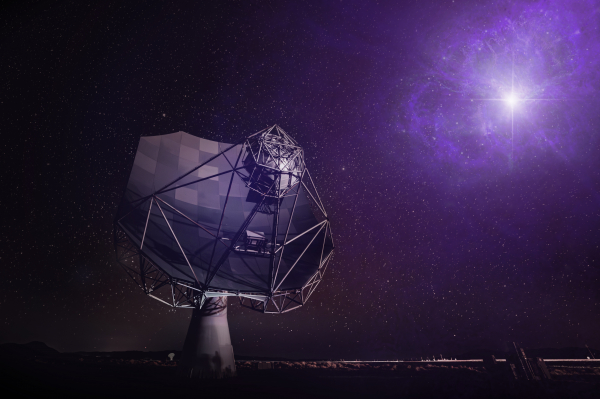
The prototype ngVLA antenna tested its systems by observing and tracking the Crab Nebula, also known as Taurus A (3C144), the remnant of an exploded star. This composite image features astrophotography by Alin Sosnovic along with more detailed radio data of the Crab Nebula collected by the NSF VLA. Image credit: NSF/AUI/NSF NRAO/A.Sosnovic/M.Weiss.
The U.S. National Science Foundation National Radio Astronomy Observatory (NSF NRAO) Next Generation Very Large Array (ngVLA) prototype antenna has achieved first light by taking observations independently, and in collaboration with the NSF Very Large Array. First light marks the prototype antenna’s transition from construction into astronomical testing.
“First light from the ngVLA prototype antenna is a real world demonstration of the engineering progress required to build America’s—and the World’s—next great radio astronomy facility,” said Tony Beasley, Director of NSF NRAO and AUI Vice President for Radio Astronomy Operations. “This milestone reflects the leadership and expertise we’ve tapped into amongst NRAO staff, our contractors, and the U.S. and international scientific community.”
The ngVLA prototype antenna is located at the NSF Very Large Array (NSF VLA) on the Plains of San Agustin in New Mexico. This prototype tested the design for the proposed 244-antenna array spanning over 5,000 miles across North America. The proposed array’s design will improve on the sensitivity and spatial resolution—with 10 times the effective collecting area and resolution—over the current NSF VLA and the Atacama Large Millimeter/submillimeter Array at the same wavelengths.
“This prototype antenna will prove useful for a wide range of projects because it provides high precision at a relatively low cost,” says NSF program director Nigel Sharp in the NSF Directorate for Mathematical and Physical Sciences, which funded the research and development of the ngVLA prototype antenna. “The ngVLA has the potential to yield powerful new capabilities as the flagship instrument for radio astronomy — and its technological success will enable benefits for other fields of science and even new commercial applications.”
The prototype passed several tests to prove its functionality, by observing and tracking several cosmic sources, including the Sun and the Crab Nebula, the remnant of an exploded star. Then, working with the 27 antennas of the NSF Very Large Array, it observed Perseus A, an extraordinarily bright, active galactic nucleus (AGN) located some 230 million light years away from Earth. “We used the ngVLA prototype as the ‘28th antenna’ with the full VLA,” shared Chris Carilli, an NSF NRAO scientist who helped conduct these test observations with another NSF NRAO scientist, Paul Demorest. Added Demorest, “We were pretty excited to see it work right out of the box—it’s now the newest element in one of the world’s most powerful radio telescopes!”
It’s not just astronomy that benefits from the ngVLA. A project of this size will have a significant impact on New Mexico’s economy, from construction jobs, to long-term operational positions, tourism, and STEM education opportunities. NRAO is currently opening new offices in Albuquerque, in addition to headquarters in Socorro on the campus of New Mexico Tech.
In the coming months, NSF NRAO engineers will fine tune the mechanics of the prototype with more testing and calibration, as scientists make plans for future targets and scientific opportunities.
About NRAO
The National Radio Astronomy Observatory (NRAO) is a major facility of the U.S. National Science Foundation, operated under cooperative agreement by Associated Universities, Inc.
This news article was originally published on the NRAO website on May 18, 2026.


Recent News
Proctor Foundation for Art and Science Offers Stellar Guitar to Space Camp Auction
To celebrate the Inspiration4 Mission’s 5th Anniversary, mission pilot Dr. Sian Proctor is choosing to celebrate in a fitting way — raising funds to send community college students and faculty to Space Camp.
10 Questions: Judelyn Padgett
Meet Judelyn Padgett, a project manager at AUI headquarters.
NA-ROAD Announces the 2026 Women and Girls in Astronomy Program Cohort
The Women and Girls in Astronomy Program (WGAP), led by Associated Universities, Inc. (AUI), under the North American Regional Office of Astronomy for Development (NA-ROAD), is proud to announce the selection of ten regional projects to receive funding through the 2026 cycle.