
The U.S. National Science Foundation National Radio Astronomy Observatory (NSF NRAO) invites the public to the U.S. National Science Foundation Very Large Array (NSF VLA) for its annual Spring Open House on Saturday, April 18, 2026, from 9:00 a.m. to 4:00 p.m.
The NSF Very Large Array Helps Reveal Record-Breaking Stream of Super-Heated Gas from Nearby Galaxy
Recent News
ALMA Detects Extremely Abundant Alcohol in Interstellar Comet 3I/ATLAS
New research reveals that 3I/ATLAS is packed with an unusually large amount of the organic molecule methanol – more than almost all known comets in our own solar system.
10 Questions: Anica Miller-Rushing
Meet Anica Miller-Rushing, STEM education research associate for AUI’s Office of Education and Public Engagement.
The NSF Very Large Array Helps Reveal Record-Breaking Stream of Super-Heated Gas from Nearby Galaxy
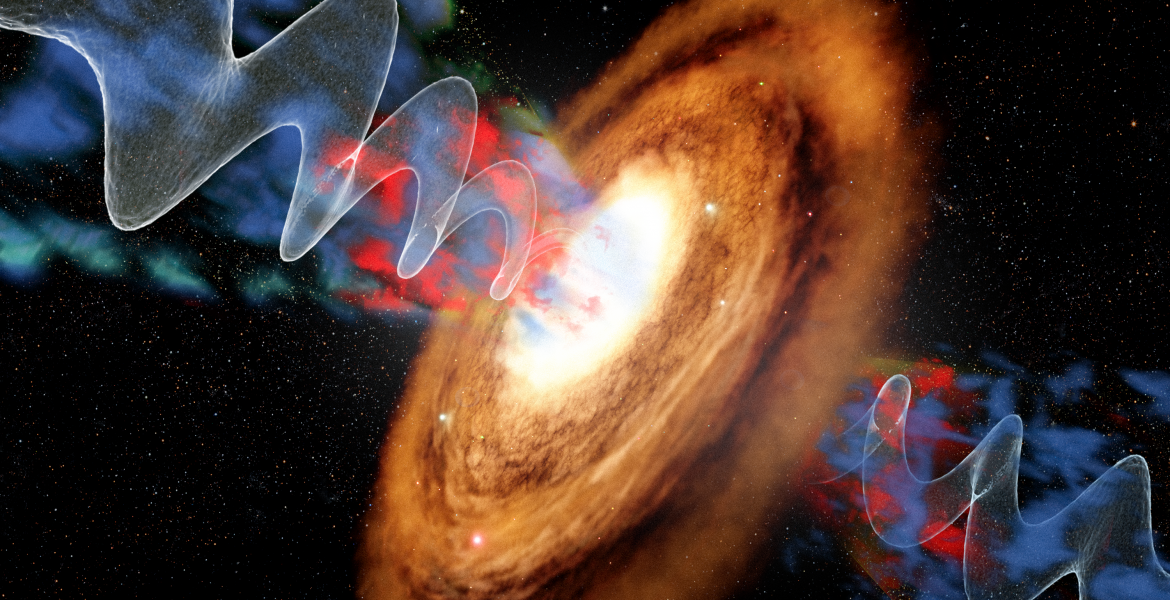
Astronomers using the U.S. National Science Foundation Very Large Array (NSF VLA), together with the NASA James Webb Space Telescope and other observatories, have identified an enormous, galaxy-scale stream of super-heated gas erupting from the nearby galaxy VV 340a. New radio images from the NSF VLA trace a pair of powerful plasma jets launched by the galaxy’s central supermassive black hole, which appear to be driving hot coronal gas out of the galaxy and shutting down future star formation.
VV 340a lies relatively close in cosmic terms, giving astronomers an unprecedented, multiwavelength look at how radio jets from a feeding black hole can carve through a galaxy’s disk, stir up its gas, and limit its ability to grow new stars. In VV 340a, the jets extend on kiloparsec scales and follow a helical path, clear evidence that they slowly change direction over time in a process known as jet precession. This is the first time astronomers have seen a precessing, kiloparsec-scale radio jet in a disk galaxy driving such a massive, coherent outflow of coronal gas.
Operated by the U.S. National Science Foundation National Radio Astronomy Observatory (NSF NRAO) the NSF VLA is one of the world’s most versatile and powerful radio observatories and was essential for revealing the structure and impact of VV 340a’s jets. This result was presented on Thursday, January 8, 2026 at the 247th American Astronomical Society Conference. Read the full press release.
About NRAO
The National Radio Astronomy Observatory is a facility of the U.S. National Science Foundation, operated under cooperative agreement by Associated Universities, Inc.
Media Contact:
Corrina C. Jaramillo Feldman
Sr. Public Information Officer
VLA, VLBA, ngVLA
[email protected]
(505) 366-7267
This news article was originally published on the NRAO website on January 8, 2026.


Recent News
NSF NRAO to Host Spring 2026 VLA Open House
The U.S. National Science Foundation National Radio Astronomy Observatory (NSF NRAO) invites the public to the U.S. National Science Foundation Very Large Array (NSF VLA) for its annual Spring Open House on Saturday, April 18, 2026, from 9:00 a.m. to 4:00 p.m.
ALMA Detects Extremely Abundant Alcohol in Interstellar Comet 3I/ATLAS
New research reveals that 3I/ATLAS is packed with an unusually large amount of the organic molecule methanol – more than almost all known comets in our own solar system.
10 Questions: Anica Miller-Rushing
Meet Anica Miller-Rushing, STEM education research associate for AUI’s Office of Education and Public Engagement.