
Meet Judelyn Padgett, a project manager at AUI headquarters.
Recent News
NA-ROAD Announces the 2026 Women and Girls in Astronomy Program Cohort
The Women and Girls in Astronomy Program (WGAP), led by Associated Universities, Inc. (AUI), under the North American Regional Office of Astronomy for Development (NA-ROAD), is proud to announce the selection of ten regional projects to receive funding through the 2026 cycle.
Twisted Physics: Astronomers Solve 30-Year-Old Stellar Mystery
Astronomers using the Atacama Large Millimeter/submillimeter Array (ALMA) have captured the first direct, high-resolution images of a magnetic field wrapped tightly around the outflow of gas streaming away from a forming star — evidence that solves a decades-old puzzle about how young stars sculpt the powerful jets that form them.
New Event Horizon Telescope Results Trace M87 Jet Back to Its Black Hole
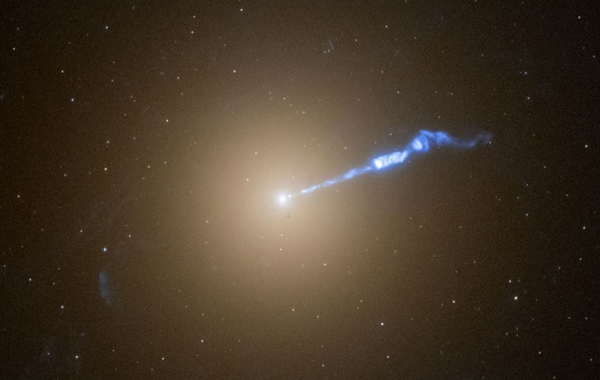
A Hubble Space Telescope image of the giant elliptical galaxy M87 with its blowtorch-like jet. The visible part of this giant stream of particles spans around 3000 light-years. Image credit: NASA, ESA, STScI, Alec Lessing (Stanford University), Michael Shara (AMNH); Acknowledgment: Edward Baltz (Stanford University); Image Processing: Joseph DePasquale (STScI)
Expanded telescope baselines, anchored by ALMA, uncover fresh clues to how the supermassive black hole in M87 launched a 3,000‑light‑year‑long cosmic jet
Astronomers using the Atacama Large Millimeter/submillimeter Array (ALMA) and other radio telescopes in the Event Horizon Telescope (EHT) network have taken a major step toward pinpointing where the powerful jet from the supermassive black hole in galaxy M87 is launched. Their new study connects the black hole’s famous ring of light to a compact region that marks the likely base of the jet, bringing scientists closer to understanding how black holes power some of the brightest beacons in the universe.
The giant elliptical galaxy M87, located about 55 million light-years from Earth, hosts a supermassive black hole with a mass roughly six billion times that of our Sun. This black hole powers a bright, narrow jet of particles that blasts out of the galaxy’s core and stretches for about 3,000 light-years into space.
To study regions this small so far away, astronomers link radio telescopes around the globe into a virtual Earth-sized telescope known as the Event Horizon Telescope (EHT). ALMA, of which the U.S. National Science Foundation National Radio Astronomy Observatory (NSF NRAO) is a partner, is one of the most sensitive and critical stations in this network, boosting the EHT’s ability to detect fine details in the gas and jet close to the black hole.
Using EHT observations of M87 from 2021, the team compared how bright the radio emission appears on different spatial scales. They found that the glowing ring around the black hole cannot by itself explain all of its radio light, and an additional compact source, about 0.09 light-years from the black hole, matches the expected location of the jet’s base.
New intermediate connections between observatories, including baselines involving ALMA and other key stations, were essential for revealing structures that link the black hole’s immediate surroundings to the larger-scale jet. Earlier EHT campaigns in 2017 and 2018 lacked these intermediate baselines, but the expanded array now allows astronomers to bridge the gap between the ring and the jet and to test detailed computer models of how jets are launched.
Future EHT observations that include ALMA and additional telescopes, such as the Large Millimeter Telescope in Mexico, will sharpen this view even further. Researchers aim not only to infer the jet base from this data, but to directly image the region where matter near the black hole is funneled into the jet, providing powerful new tests of black hole physics.
This news was adapted from a press release created by the Max Planck Institute for Radio Astronomy.
About NRAO
The National Radio Astronomy Observatory (NRAO) is a facility of the U.S. National Science Foundation, operated under cooperative agreement by Associated Universities, Inc.
About ALMA
The Atacama Large Millimeter/submillimeter Array (ALMA), an international astronomy facility, is a partnership of the European Southern Observatory (ESO), the U.S. National Science Foundation (NSF) and the National Institutes of Natural Sciences (NINS) of Japan in cooperation with the Republic of Chile. ALMA is funded by ESO on behalf of its Member States, by NSF in cooperation with the National Research Council of Canada (NRC) and the National Science and Technology Council (NSTC) in Taiwan and by NINS in cooperation with the Academia Sinica (AS) in Taiwan and the Korea Astronomy and Space Science Institute (KASI).
ALMA construction and operations are led by ESO on behalf of its Member States; by the National Radio Astronomy Observatory (NRAO), managed by Associated Universities, Inc. (AUI), on behalf of North America; and by the National Astronomical Observatory of Japan (NAOJ) on behalf of East Asia. The Joint ALMA Observatory (JAO) provides the unified leadership and management of the construction, commissioning and operation of ALMA.
This news article was originally published on the NRAO website on January 28, 2026.


Recent News
10 Questions: Judelyn Padgett
Meet Judelyn Padgett, a project manager at AUI headquarters.
NA-ROAD Announces the 2026 Women and Girls in Astronomy Program Cohort
The Women and Girls in Astronomy Program (WGAP), led by Associated Universities, Inc. (AUI), under the North American Regional Office of Astronomy for Development (NA-ROAD), is proud to announce the selection of ten regional projects to receive funding through the 2026 cycle.
Twisted Physics: Astronomers Solve 30-Year-Old Stellar Mystery
Astronomers using the Atacama Large Millimeter/submillimeter Array (ALMA) have captured the first direct, high-resolution images of a magnetic field wrapped tightly around the outflow of gas streaming away from a forming star — evidence that solves a decades-old puzzle about how young stars sculpt the powerful jets that form them.