
A new study connects the black hole’s famous ring of light to a compact region that marks the likely base of the jet, bringing scientists closer to understanding how black holes power some of the brightest beacons in the universe.
Recent News
Magnetic Superhighways Discovered in a Starburst Galaxy’s Winds
Using the Atacama Large Millimeter/submillimeter Array (ALMA), an international team of astronomers has mapped a magnetic highway driving a powerful galactic wind into the nearby galaxy merger of Arp 220, revealing for the first time that its fast, molecular outflows are strongly magnetized and likely helping to drive metals, dust, and cosmic rays into the space around the galaxy.
Making Scientific Breakthroughs Possible in 2025
2025 was an incredibly productive year for AUI, marked by significant advances across astronomy, energy, advanced therapeutics, and STEM education and workforce development.
Texas Tech University System and NSF NRAO Forge Cosmic Alliance in West Texas
Partnership paves the way for Next Generation radio telescope and science education at 3 Rivers Ranch
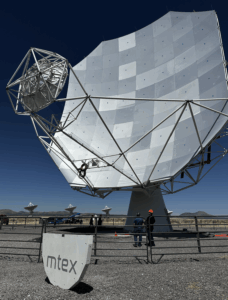 The U.S. National Science Foundation National Radio Astronomy Observatory (NSF NRAO) and the Texas Tech University System (TTU System) have signed a Memorandum of Understanding (MOU) to collaborate on the establishment of a critical site for a proposed, cutting-edge telescope, the Next Generation Very Large Array (ngVLA). If 3 Rivers Ranch is chosen as the final project site, this collaboration will support groundbreaking astronomical research, science education, and public outreach for people of all ages and backgrounds.
The ngVLA is a trailblazing astronomical project designed to advance our understanding of the Universe. A prototype antenna has been constructed onsite at the Very Large Array in New Mexico as a proof of concept and will soon begin scientific testing. The ngVLA is expected to enable new discoveries in planet formation, black holes, astrochemistry, and star formation while also inspiring the next generation of scientists and engineers.
Texas will play a central role in the ngVLA, hosting five antennas in West Texas. One of the proposed sites is at the TTU System’s 3 Rivers Ranch near Crowell, Texas, approximately two hours east of Lubbock. This location is already a hub for astronomy research and education, featuring a small optical observatory and plans for additional scientific instrumentation.
“We are proud to partner with the National Science Foundation’s National Radio Astronomy Observatory on this incredible project at 3 Rivers Ranch and are excited about the discoveries we will make together,” said TTU System Chancellor Tedd L. Mitchell, M.D. “The Texas Tech University System and its five distinct and distinguished universities are known for being at the forefront of innovation, technology and research, and we look forward to the opportunities this collaboration will create for our students, faculty members and the communities we serve.”
Under this MOU, the NSF NRAO will have the opportunity to utilize the 3 Rivers Ranch to construct and operate this ngVLA antenna site, with the possibility of future science education and public outreach activities related to the ngVLA. The collaboration will provide students, researchers, and the public with unique opportunities to engage with cutting-edge astronomical research.
“NRAO is excited to be working with the TTU System to advance scientific discovery and education in Texas—and beyond,” shares Dr. Eric Murphy, NSF NRAO ngVLA Project Scientist.
About NRAO
The National Radio Astronomy Observatory (NRAO) is a facility of the U.S. National Science Foundation, operated under cooperative agreement by Associated Universities, Inc.
About the Texas Tech University System
Established in 1996, the Texas Tech University System is one of the top public university systems in the nation, consisting of five universities – Texas Tech University, Texas Tech University Health Sciences Center, Angelo State University, Texas Tech University Health Sciences Center El Paso and Midwestern State University.
Headquartered in Lubbock, Texas, the TTU System is a more than $3 billion enterprise focused on advancing higher education, health care, research and outreach with approximately 21,000 employees and 64,000 students, more than 400,000 alums, a statewide economic impact of $19.2 billion and an endowment valued at $3 billion. In its short history, the TTU System has grown tremendously and is nationally acclaimed, operating at 21 academic locations in 17 cities (15 in Texas, two international).
In addition, the TTU System is one of only nine in the nation to offer programs for undergraduate, medical, law, nursing, pharmacy, dental and veterinary education, among other academic areas.
This news article was originally published on the NRAO website on June 11, 2025.


Recent News
New Event Horizon Telescope Results Trace M87 Jet Back to Its Black Hole
A new study connects the black hole’s famous ring of light to a compact region that marks the likely base of the jet, bringing scientists closer to understanding how black holes power some of the brightest beacons in the universe.
Magnetic Superhighways Discovered in a Starburst Galaxy’s Winds
Using the Atacama Large Millimeter/submillimeter Array (ALMA), an international team of astronomers has mapped a magnetic highway driving a powerful galactic wind into the nearby galaxy merger of Arp 220, revealing for the first time that its fast, molecular outflows are strongly magnetized and likely helping to drive metals, dust, and cosmic rays into the space around the galaxy.
Making Scientific Breakthroughs Possible in 2025
2025 was an incredibly productive year for AUI, marked by significant advances across astronomy, energy, advanced therapeutics, and STEM education and workforce development.