
A new study connects the black hole’s famous ring of light to a compact region that marks the likely base of the jet, bringing scientists closer to understanding how black holes power some of the brightest beacons in the universe.
Recent News
Magnetic Superhighways Discovered in a Starburst Galaxy’s Winds
Using the Atacama Large Millimeter/submillimeter Array (ALMA), an international team of astronomers has mapped a magnetic highway driving a powerful galactic wind into the nearby galaxy merger of Arp 220, revealing for the first time that its fast, molecular outflows are strongly magnetized and likely helping to drive metals, dust, and cosmic rays into the space around the galaxy.
Making Scientific Breakthroughs Possible in 2025
2025 was an incredibly productive year for AUI, marked by significant advances across astronomy, energy, advanced therapeutics, and STEM education and workforce development.
Stars That Die Off the Beaten Path
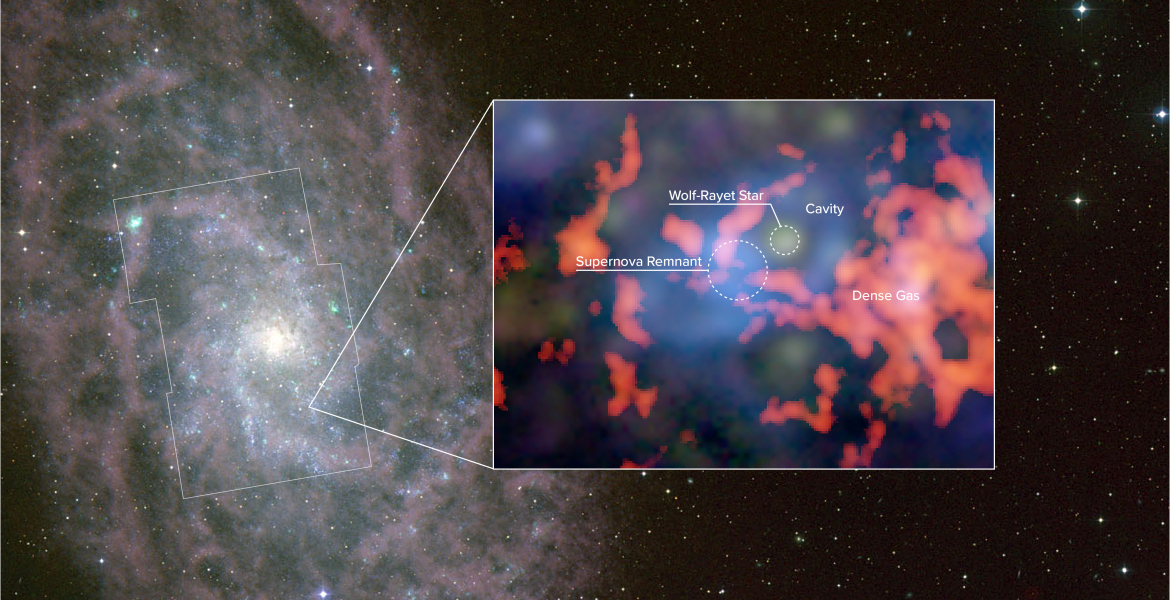
This artist’s impression of the M33 galaxy, with data inset from ALMA and the NSF VLA, shows the supernova remnant astronomers believe to be caused by a supernova explosion some 10,000 years ago. This new reserach suggests that the Wolf-Rayet may explode as a supernova in the next 0.5-1 million years. Credit: NSF/AUI/NRAO/B.Saxton
By tracking thousands of massive, dying stars in nearby galaxy M33, astronomers have drawn the first large‑scale map of potential supernova blast sites
Astronomers have created a detailed forecast of where they expect to observe future stellar explosions in a nearby galaxy, opening a new window into how exploding stars shape the cosmos. Focusing on M33, a spiral galaxy about 2.7 million light‑years away, this research combined new maps of cold atomic hydrogen gas from the U.S. National Science Foundation Very Large Array (NSF VLA) with millimeter‑wave observations of molecular gas from the Atacama Large Millimeter/submillimeter Array (ALMA).
Massive stars end their lives in titanic supernova explosions. These blasts influence how galaxies grow by stirring gas, driving winds, and seeding space with heavy elements. How much impact a single explosion has depends on where it happens: a blast inside a dense cloud of gas behaves very differently than one in a relatively empty region. Until now, astronomers have had few opportunities to observe this problem, because supernovae are rare, and typically too far away to study in detail.
This new study offers a solution to this problem, by shifting telescopes to observe future supernova sites instead. The team mapped the gas, at various wavelengths, around thousands of evolved, massive stars in M33. These are stars that are expected to explode as core‑collapse supernovae within a few million years. On top of these gas maps, the team overlaid catalogs of three types of objects: red supergiants, Wolf–Rayet stars, and supernova remnants. Red supergiants are bloated, dying massive stars that are known progenitors of most Type II supernovae, while Wolf–Rayet stars are hotter, more massive, and shorter‑lived, and are linked to stripped‑envelope explosions and some gamma‑ray bursts. Supernova remnants mark locations where massive stars have already exploded in the past 10,000–100,000 years.
By shifting their focus, these astronomers have assembled the first large, quantitative census of the environments in which massive stars will eventually end their existence. “What we found was surprising,” shares Sumit Sarbadhicary, of Johns Hopkins University, and lead author of this research. “A large fraction of these future supernovae are expected to explode outside of the dense molecular clouds.” Only about 30–40 percent of red supergiants and a similar fraction of supernova remnants sit in regions where molecular hydrogen is detected, while the remaining majority lie in lower‑density, primarily atomic gas. Even among the youngest, most massive Wolf–Rayet stars, roughly 45 percent show no detectable molecular gas at their exact locations.
At the same time, almost all of these stars do reside somewhere within the broader disk of cold gas: more than 90% are found in regions with detectable atomic hydrogen. This means that many supernovae will not explode inside of dense, star‑forming clouds, but in the surrounding, more diffuse intercloud medium. In those environments, supernova blast waves can travel farther before cooling, changing how and where they inject energy and momentum into the galaxy.
When the team sorted stars by their estimated birth masses, a clear trend emerged: the higher the mass of the star, the denser its surrounding gas. More massive red supergiants, and especially Wolf–Rayet stars, are statistically more likely to be found close to peaks in the molecular gas distribution than their lower‑mass counterparts. This is consistent with the idea that the most massive, shortest‑lived stars explode before they have time to drift far from their birth clouds or before those clouds have fully dispersed.
Still, the study finds that even these massive stars often inhabit complex surroundings. In one detailed zoom using ultra‑high‑resolution ALMA data, a Wolf–Rayet star that appears to sit in a dense cloud at coarse resolution is actually embedded in a small, roughly 10‑light‑year‑wide cavity carved out of the molecular gas. That cavity was likely created by intense radiation, stellar winds, or a previous supernova, and it will strongly influence how the Wolf–Rayet star’s own explosion interacts with nearby gas.
The data used in this research is part of the Local Group L-Band Survey, a radio survey at 1-2 GHz of Local Group galaxies, including Triangulum (referenced here), Andromeda, and four other dwarf galaxies (NGC 6822, WLM, IC 1613 and IC10). Team members essential to gathering and assembling this data include Eric Koch of the NSF NRAO, Adam Leroy of Ohio State University, and Erik Rosolowsky of the University of Alberta, Canada. The maps created in this survey will become the most sensitive maps of atomic hydrogen in these galaxies, with preliminary versions being used in Sarbadhicary’s current paper.
Because large computer simulations of galaxies must approximate where supernovae occur, this new census offers a way to check these projections against reality. Galaxy simulations (including those used in research projects like FIRE, Illustris, TIGRESS, SILCC) are the only way in which astronomers can study millions, and billions, of years of galaxy evolution. However, the simulations must to approximate the physics at the scales of individual stars and molecular clouds. Observations such as these will be vital, and much needed, for these simulations to benchmark the sub-scale (or subgrid) physics from stars, in order to accurately capture how these stars disperse gas, drive winds and regulate the overall star-formation in galaxies. The Local Group L-Band Survey will capture the highest resolution maps of gas around stars to understand this longstanding mystery of how efficiently stars form and disperse the cold gas reservoir in galaxies.
This comparison flagged how simulations treat radiation, winds, clustering, and runaway stars, suggesting they may need refinement to better match observed environments. The team argues that similar comparisons, extended to more galaxies and higher‑resolution gas maps, can help narrow down which feedback models most faithfully reproduce how real supernovae sculpt the interstellar medium.
“As this research continues, we’re aiming to expand this collection by sampling another 80 star-forming galaxies,” adds Sarbadhicary. “We also have upcoming maps of M33 from ALMA, led by team members Eric Koch and Erik Rosolowsky, that will be significantly sharper than the present study, revealing even more detailed, complex environments like the Wolf-Rayet star mentioned earlier.” By treating evolved massive stars and recent remnants as signposts of present and future explosion sites, astronomers continue to grow their understanding of how those explosions will continue to shape galaxies like M33, and our own Milky Way. Sarbadhicary and the nearby galaxy research community are directing their efforts to produce the sharpest maps of interstellar gas with instruments like NSF VLA, ALMA, and NASA’s JWST, and in future with the NSF NRAO’s proposed Next Generation Very Large Array. Stars form from gas, but stars also destroy. These maps are crucial to understand how this curious contradiction, yet vital process, drives the evolution of galaxies.
About ALMA
The Atacama Large Millimeter/submillimeter Array (ALMA), an international astronomy facility, is a partnership of the European Southern Observatory (ESO), the U.S. National Science Foundation (NSF) and the National Institutes of Natural Sciences (NINS) of Japan in cooperation with the Republic of Chile. ALMA is funded by ESO on behalf of its Member States, by NSF in cooperation with the National Research Council of Canada (NRC) and the National Science and Technology Council (NSTC) in Taiwan and by NINS in cooperation with the Academia Sinica (AS) in Taiwan and the Korea Astronomy and Space Science Institute (KASI).
ALMA construction and operations are led by ESO on behalf of its Member States; by the National Radio Astronomy Observatory (NRAO), managed by Associated Universities, Inc. (AUI), on behalf of North America; and by the National Astronomical Observatory of Japan (NAOJ) on behalf of East Asia. The Joint ALMA Observatory (JAO) provides the unified leadership and management of the construction, commissioning and operation of ALMA.
About NRAO
The National Radio Astronomy Observatory (NRAO) is a facility of the U.S. National Science Foundation, operated under cooperative agreement by Associated Universities, Inc.
This news article was originally published on the NRAO website on January 6, 2026.


Recent News
New Event Horizon Telescope Results Trace M87 Jet Back to Its Black Hole
A new study connects the black hole’s famous ring of light to a compact region that marks the likely base of the jet, bringing scientists closer to understanding how black holes power some of the brightest beacons in the universe.
Magnetic Superhighways Discovered in a Starburst Galaxy’s Winds
Using the Atacama Large Millimeter/submillimeter Array (ALMA), an international team of astronomers has mapped a magnetic highway driving a powerful galactic wind into the nearby galaxy merger of Arp 220, revealing for the first time that its fast, molecular outflows are strongly magnetized and likely helping to drive metals, dust, and cosmic rays into the space around the galaxy.
Making Scientific Breakthroughs Possible in 2025
2025 was an incredibly productive year for AUI, marked by significant advances across astronomy, energy, advanced therapeutics, and STEM education and workforce development.