
A new study connects the black hole’s famous ring of light to a compact region that marks the likely base of the jet, bringing scientists closer to understanding how black holes power some of the brightest beacons in the universe.
Recent News
Magnetic Superhighways Discovered in a Starburst Galaxy’s Winds
Using the Atacama Large Millimeter/submillimeter Array (ALMA), an international team of astronomers has mapped a magnetic highway driving a powerful galactic wind into the nearby galaxy merger of Arp 220, revealing for the first time that its fast, molecular outflows are strongly magnetized and likely helping to drive metals, dust, and cosmic rays into the space around the galaxy.
Making Scientific Breakthroughs Possible in 2025
2025 was an incredibly productive year for AUI, marked by significant advances across astronomy, energy, advanced therapeutics, and STEM education and workforce development.
Radio Telescopes Uncover ‘Invisible’ Gas Around Record-Shattering Cosmic Explosion
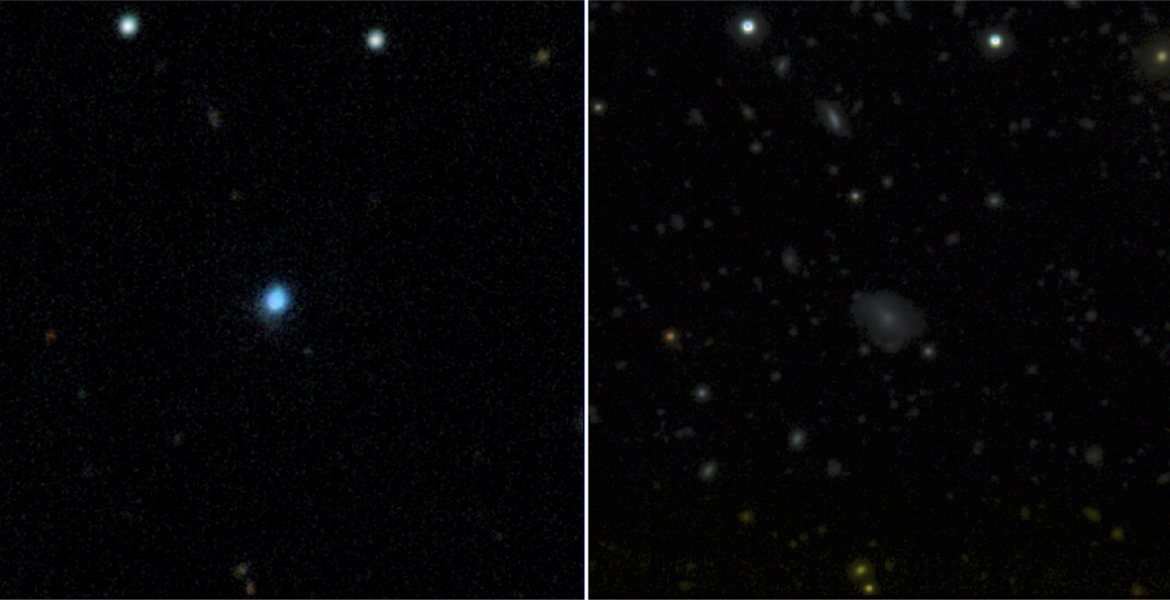
A new, extremely luminous fast blue optical transient, AT2024wpp, flares as a bright blue point of light in the left panel, located just off the edge of its faint host galaxy, while the right panel shows the same region of sky after the outburst faded. Image credit: Astrophysics Research Institute, Liverpool John Moores University/Daniel Perley
Astronomers using the U.S. National Science Foundation National Radio Astronomy Observatory (NSF NRAO) instruments, the U.S. National Science Foundation Very Large Array (NSF VLA) and the Atacama Large Millimeter/submillimeter Array (ALMA), have revealed a dense cocoon of gas around one of the most extreme cosmic explosions ever seen, showing that a ravenous black hole ripped apart a massive star and then lit up its surroundings with powerful X-rays. This new event, designated AT2024wpp and nicknamed “the Whippet,” is the brightest known member of a mysterious class of blasts called Luminous Fast Blue Optical Transients (LFBOTs) and offers the clearest evidence yet that at least some of these fleeting explosions mark the sudden destruction of a star by a black hole companion.
Over the past decade, astronomers have been tracking a puzzling medley of fast, ultra-bright explosions that flare and then fade in a matter of days, outshining 100 billion Suns and then vanishing before most telescopes can react. AT2024wpp, spotted in September 2024, is the most luminous of these LFBOTs ever observed, briefly radiating energy more rapidly than any explosion powered by the collapse of a single star and rivaled only by the most extreme gamma-ray bursts and tidal disruption events.
The outburst was first flagged by the Zwicky Transient Facility at Palomar Observatory, when co-investigator Anna Ho noticed a sudden surge of brightness from a distant galaxy. Follow-up observations with the Liverpool Telescope and NASA’s Swift satellite confirmed that the source was extremely hot, very blue, and producing bright X-rays, classic hallmarks of an LFBOT, while spectroscopic observations with the W. M. Keck Observatory showed that its total energy output far exceeded that of a normal supernova. Despite its enormous power, early ultraviolet and optical spectra from the Hubble Space Telescope and ground-based observatories showed almost no chemical fingerprints; there were none of the usual patterns of lines from common atoms and ions that typically betray a dense environment. That was a surprise, because one leading idea for LFBOTs predicted explosions plowing into thick shells of gas shed by massive stars shortly before they die, which should leave strong spectral imprints.
The critical breakthrough came from radio and millimeter observations with the NSF VLA and ALMA, which traced a shock wave racing outward at roughly one-fifth the speed of light into an unexpectedly dense pocket of gas surrounding the blast site. These data showed that there is a great deal of dense material very close to the explosion, but relatively little farther out. This is the opposite of what the optical and ultraviolet observations alone would suggest. The apparent contradiction is resolved if the explosion produced such intense X-ray radiation that it stripped nearly all electrons from the nearby gas. In this scenario, the material around AT2024wpp is still there in large quantities, but it is so highly ionized that it stops leaving visible chemical fingerprints in ultraviolet and optical light.
Radio telescopes like the NSF VLA and ALMA, however, are sensitive to energetic electrons that have been freed from atoms, allowing astronomers to “see” the dense gas even after X-rays have effectively erased its usual spectral signatures. The radio data also show that the shock wave suddenly faded after about half a year, indicating that it had reached the edge of the dense bubble blown by the star before its destruction. Putting together observations from across the spectrum, the team concluded that AT2024wpp was powered by a massive black hole spiraling into and devouring a massive stellar companion. As the doomed star lost its outer layers, it created a thick shell of gas around the system. Once the core was torn apart, its debris formed a hot disk feeding the black hole and launching a powerful wind that crashed into this pre-existing material, lighting it up from radio to X-rays.
The accretion process generated the intense X-ray radiation needed to ionize the gas and hide its chemical signatures, while the expanding shock produced the bright radio and millimeter emission detected by the NSF VLA and ALMA. Later observations from Keck, Magellan, and the Very Large Telescope revealed faint hydrogen and helium signatures emerging as the event faded, including helium moving at more than 6,000 kilometers per second, hinting that some dense structure, possibly a stream from the torn-apart stellar core or even a third star in the system, survived the initial blast.
You can read the full release from the Astrophysics Research Institute at Liverpool John Moores University.
About NRAO
The National Radio Astronomy Observatory is a facility of the U.S. National Science Foundation, operated under cooperative agreement by Associated Universities, Inc.
Media Contact:
Corrina C. Jaramillo Feldman
Sr. Public Information Officer
VLA, VLBA, ngVLA
[email protected]
(505) 366-7267
This news article was originally published on the NRAO website on January 8, 2026.


Recent News
New Event Horizon Telescope Results Trace M87 Jet Back to Its Black Hole
A new study connects the black hole’s famous ring of light to a compact region that marks the likely base of the jet, bringing scientists closer to understanding how black holes power some of the brightest beacons in the universe.
Magnetic Superhighways Discovered in a Starburst Galaxy’s Winds
Using the Atacama Large Millimeter/submillimeter Array (ALMA), an international team of astronomers has mapped a magnetic highway driving a powerful galactic wind into the nearby galaxy merger of Arp 220, revealing for the first time that its fast, molecular outflows are strongly magnetized and likely helping to drive metals, dust, and cosmic rays into the space around the galaxy.
Making Scientific Breakthroughs Possible in 2025
2025 was an incredibly productive year for AUI, marked by significant advances across astronomy, energy, advanced therapeutics, and STEM education and workforce development.