
Astronomers using the Atacama Large Millimeter/submillimeter Array (ALMA) have captured the first direct, high-resolution images of a magnetic field wrapped tightly around the outflow of gas streaming away from a forming star — evidence that solves a decades-old puzzle about how young stars sculpt the powerful jets that form them.
Recent News
A Trillion Mile Cosmic Stream of Gas Feeds GW Orionis
A team of astronomers using the Atacama Large Millimeter/submillimeter Array (ALMA), of which the U.S. National Science Foundation National Radio Astronomy Observatory is a partner, has captured a massive stream of gas—one trillion miles, or .2 light years long—feeding the young triple-star system GW Orionis.
NSF NRAO radio observations help rule out a relativistic jet in rare stellar explosion
Astronomers studying a rare stellar explosion first spotted as a brief burst of X-rays used radio observations to help show that the dying star did not produce the powerful jet often associated with gamma-ray bursts.
NSF NRAO to Host Spring 2026 VLA Open House
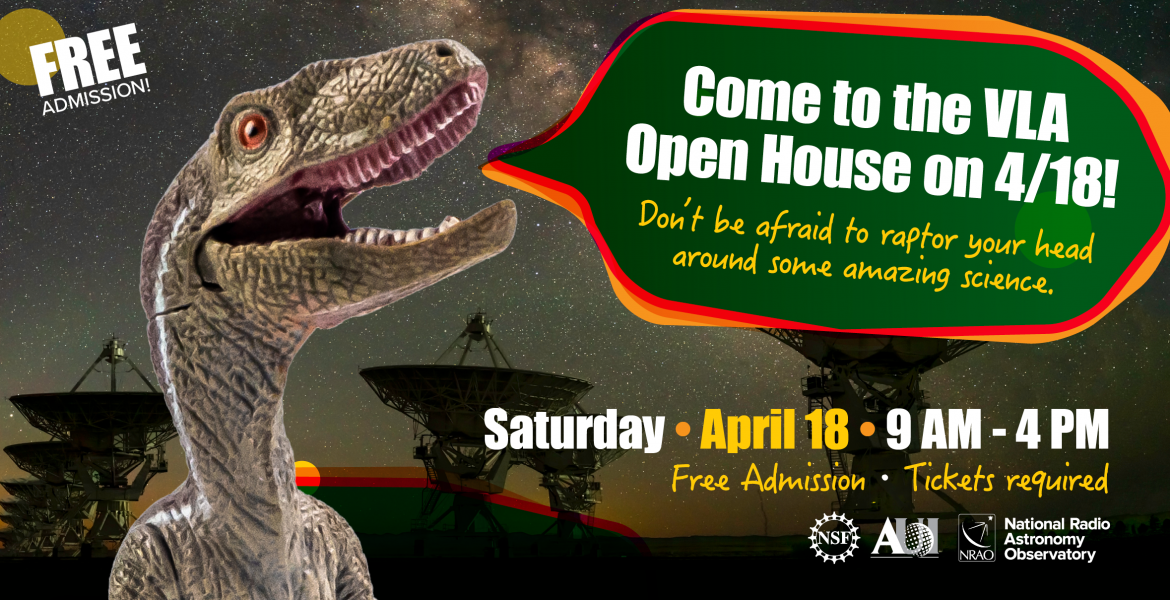
Image credit: NRAO/AUI/NSF
The U.S. National Science Foundation National Radio Astronomy Observatory (NSF NRAO) invites the public to the U.S. National Science Foundation Very Large Array (NSF VLA) for its annual Spring Open House on Saturday, April 18, 2026, from 9:00 a.m. to 4:00 p.m. This free, family-friendly event offers a rare chance to explore one of the world’s most iconic astronomical observatories through guided tours, talks by experts, hands-on learning activities, and more.
Advance entry tickets are required. Reserve tickets online.
Visitors will enjoy guided tours from NSF NRAO scientists and engineers, offered every half hour between 10:00 a.m. and 3:00 p.m. Educational activities include crowd favorites from past years along with new experiences such as a gravity well demonstration and a scavenger hunt for special open house stickers—available only to those who complete the challenge. Children and adults alike will have the opportunity to learn about radio astronomy directly from the people building and operating the NSF VLA and its next-generation projects.
In addition to tours, guests can attend science talks held throughout the day in the NSF VLA Visitor Center auditorium:
- Pieter Kotze, Systems Engineer Sr. (10:00 a.m.) – The Next Generation Very Large Array
- Joe McMullin, Assistant Director, New Mexico Operations (11:00 a.m. & 2:00 p.m.) – “Radio Astronomy in New Mexico.”
- Jill Malusky, News & Public Information Manager, (12:00 p.m. & 3:00 p.m.) – ‘The Very Large Co‑Star: NRAO Telescopes on Screen”
Several food trucks will be on-site throughout the day:
Portable restrooms will also be available on-site for visitor convenience.
Event Details:
Date: Saturday, April 18, 2026
Time: 9:00 a.m. – 4:00 p.m.
Location: Karl G. Jansky Very Large Array, 50 miles west of Socorro, NM (off U.S. Route 60)
Cost: Free admission with advance ticket reservation
This year, the VLA Spring Open House also happens to fall on “Velociraptor Awareness Day.” 
 Dino fans welcome!
About NRAO
The National Radio Astronomy Observatory is a major facility of the U.S. National Science Foundation, operated under cooperative agreement by Associated Universities, Inc.
This news article was originally published on the [source] website on Month day, year.


Recent News
Twisted Physics: Astronomers Solve 30-Year-Old Stellar Mystery
Astronomers using the Atacama Large Millimeter/submillimeter Array (ALMA) have captured the first direct, high-resolution images of a magnetic field wrapped tightly around the outflow of gas streaming away from a forming star — evidence that solves a decades-old puzzle about how young stars sculpt the powerful jets that form them.
A Trillion Mile Cosmic Stream of Gas Feeds GW Orionis
A team of astronomers using the Atacama Large Millimeter/submillimeter Array (ALMA), of which the U.S. National Science Foundation National Radio Astronomy Observatory is a partner, has captured a massive stream of gas—one trillion miles, or .2 light years long—feeding the young triple-star system GW Orionis.
NSF NRAO radio observations help rule out a relativistic jet in rare stellar explosion
Astronomers studying a rare stellar explosion first spotted as a brief burst of X-rays used radio observations to help show that the dying star did not produce the powerful jet often associated with gamma-ray bursts.