
Carlstrom will present his talk: “What Do We Know About The Big Bang?” to the public on three dates, along with a recording that will be shared on the NSF NRAO’s YouTube channel.
Recent News
10 Questions: Desmond Wysenyuy
Meet Desmond Wysenyuy, program coordinator for the North American Regional Office of Astronomy for Development.
Cosmic Cocktail: Exotic Methanol Discovered in Planet-Building Zones
New results from the ALMA COMPASS Large Program (Complex Organic Molecules in Protostars with ALMA Spectral Surveys) show that young, still-forming stars are surrounded by a surprisingly sophisticated “chemical starter kit”, including organic molecules such as methanol that may one day enrich planets.
VLBA Maps Turbulent ‘Weather’ in the Milky Way
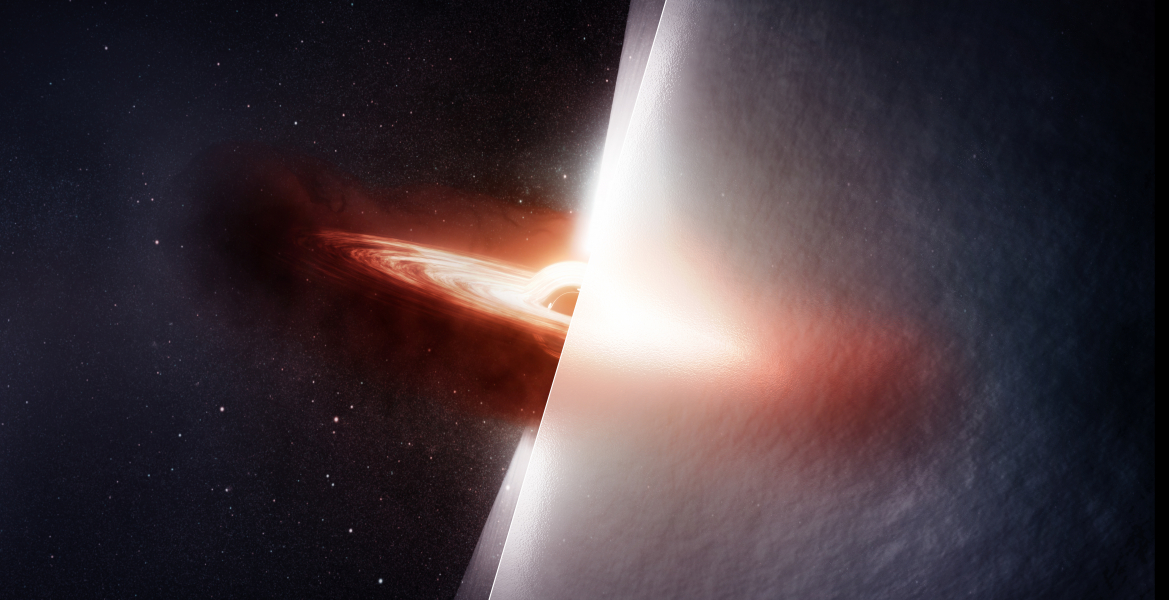
Radio light from quasar TXS 2005+403 travels roughly 10 billion light-years to reach Earth, traversing the Cygnus region, one of the most turbulent and scattering environments in the Milky Way Galaxy. On the left, this artist’s conception shows the quasar as it truly appears, with a bright accretion disk and jets blasting into the galaxy like a beacon through the darkness. On the right, we see how turbulent gas distorts scientists’ view of the quasar in much the same way heat haze from a fire warps our view of the objects behind it. In a new study led by astronomers from the Center for Astrophysics | Harvard & Smithsonian (CfA), scientists have for the first time directly detected how interstellar turbulence distorts light from a distant quasar, revealing the structure of that turbulence. Image Credit: Melissa Weiss/CfA
Decade of radio observations of distant quasar TXS 2005+403 reveals first direct VLBI signature of interstellar turbulence, sharpening tools for future black hole imaging
Astronomers using the U.S. National Science Foundation’s Very Long Baseline Array (NSF VLBA), operated by the NSF National Radio Astronomy Observatory (NSF NRAO), have made the first clear, radio-wavelength detection of how turbulent gas in our own Galaxy distorts light from a distant quasar. By analyzing nearly a decade of NSF VLBA observations of the quasar TXS 2005+403, an international team led by the Center for Astrophysics | Harvard & Smithsonian (CfA) directly measured the tiny, turbulence-driven “ripples” imprinted on the quasar’s radio signal as it passes through a particularly chaotic region of the Milky Way.
TXS 2005+403 is a bright, compact blazar located about 10 billion light-years away behind the Cygnus region, where plasma clouds create some of the strongest known interstellar scattering in the sky. At radio frequencies between about 1 and 5 GHz, the NSF VLBA’s continent-scale network of ten antennas reveals that the quasar’s image is not just blurred by this material but also peppered with fine substructure. These persistent, patchy distortions can only be explained by refractive scattering from turbulent plasma on scales roughly comparable to the size of our solar system. The NSF VLBA detections, which span observations from 2010 to 2019, show that this turbulent “screen” in front of the quasar is remarkably stable over time, making TXS 2005+403 an exceptional radio laboratory for probing interstellar turbulence.
These results will help astronomers better understand how energy cascades through the ionized gas between the stars and how that turbulent gas affects some of the sharpest images in astronomy, including those of the Milky Way’s central black hole made by the Event Horizon Telescope. By characterizing how turbulence scatters radio waves along this line of sight, ongoing NSF VLBA campaigns through 2026 aim to refine models of the Cygnus scattering screen and improve techniques for correcting such distortions in future high‑resolution radio images. To learn more about the broader implications of this work for black hole imaging and interstellar physics, read the full press release from the Center for Astrophytrophysics | Harvard & Smithsonian.
About NRAO
The National Radio Astronomy Observatory is a major facility of the U.S. National Science Foundation, operated under cooperative agreement by Associated Universities, Inc.
This news article was originally published on the NRAO website on May 14, 2026.


Recent News
Professor John E. Carlstrom Delivers 2026 NSF NRAO Jansky Lectures
Carlstrom will present his talk: “What Do We Know About The Big Bang?” to the public on three dates, along with a recording that will be shared on the NSF NRAO’s YouTube channel.
10 Questions: Desmond Wysenyuy
Meet Desmond Wysenyuy, program coordinator for the North American Regional Office of Astronomy for Development.
Cosmic Cocktail: Exotic Methanol Discovered in Planet-Building Zones
New results from the ALMA COMPASS Large Program (Complex Organic Molecules in Protostars with ALMA Spectral Surveys) show that young, still-forming stars are surrounded by a surprisingly sophisticated “chemical starter kit”, including organic molecules such as methanol that may one day enrich planets.