
Scheduled for April 18, the workshop offers participants the rare opportunity to capture stunning images of the cosmos from one of the world’s most remarkable and bespoke astronomical settings.
NSF NRAO Radio Telescopes Help Reveal Cloud-9, a Starless Dark-Matter “Failed Galaxy” Near M94
Recent News
NSF NRAO to Host Spring 2026 VLA Open House
The U.S. National Science Foundation National Radio Astronomy Observatory (NSF NRAO) invites the public to the U.S. National Science Foundation Very Large Array (NSF VLA) for its annual Spring Open House on Saturday, April 18, 2026, from 9:00 a.m. to 4:00 p.m.
ALMA Detects Extremely Abundant Alcohol in Interstellar Comet 3I/ATLAS
New research reveals that 3I/ATLAS is packed with an unusually large amount of the organic molecule methanol – more than almost all known comets in our own solar system.
NSF NRAO Radio Telescopes Help Reveal Cloud-9, a Starless Dark-Matter “Failed Galaxy” Near M94
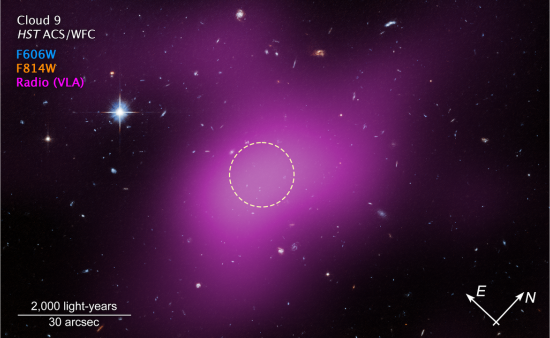
An annotated composite image of Cloud-9, a Reionization-Limited H I Cloud (RELHIC), as captured by the Hubble Space Telescope’s ACS (Advanced Camera for Surveys) and the ground-based U.S. National Science Foundation Very Large Array (NSF VLA) radio telescope. The image shows a scale bar, compass arrows, and color key for reference. The scale bar is labeled in light-years along the top, which is the distance that light travels in one Earth-year. (It takes 2,000 years for light to travel a distance equal to the length of the scale bar.) One light-year is equal to about 5.88 trillion miles or 9.46 trillion kilometers. The scale bar is also labeled in arcseconds, which is a measure of angular distance on the sky. One arcsecond is equal an angular measurement of 1/3600 of one degree. There are 60 arcseconds in an arcminute and 60 arcminutes in a degree. (The full Moon has an angular diameter of about 30 arcminutes.) The actual size of an object that covers one arcsecond on the sky depends on its distance from the telescope. The north and east compass arrows show the orientation of the image on the sky. Note that the relationship between north and east on the sky (as seen from below) is flipped relative to direction arrows on a map of the ground (as seen from above). This image shows wavelengths of light, including radio waves, that have been translated into visible-light colors. The color key shows the two ACS filters used to collect the light, along with the NSF VLA’s radio-wave contribution. A color key shows F606W in blue, F814W in orange, and Radio NSF VLA in magenta. Image credit: NASA, ESA, NSF VLA, Gagandeep Anand (STScI), Alejandro Benitez-Llambay (University of Milano-Bicocca), Joseph DePasquale (STScI)
Astronomers using a powerful combination of radio and optical telescopes have confirmed that a peculiar gas cloud near the spiral galaxy M94 is a “failed” galaxy; a dark-matter-dominated halo filled with gas but entirely lacking stars. The object, dubbed Cloud-9, now stands as the leading candidate for a long-predicted class of systems known as Reionization-Limited H I Clouds, or RELHICs, which are relics of early galaxy formation that never managed to ignite stars. Located on the outskirts of M94, about 14 million light-years from Earth, Cloud-9 offers a rare local laboratory for studying the smallest dark matter halos thought to form in the universe. This research was presented by Rachael Beaton of the Space Telescope Science Institute at a press conference at the 247th meeting of the American Astronomical Society on January 5th, 2026, in Phoenix, Arizona.
Cloud-9 was first discovered in a survey with the Five-hundred-meter Aperture Spherical Telescope (FAST) in China and then confirmed and characterized with follow-up radio observations from the U.S. National Science Foundation National Radio Astronomy Observatory (NSF NRAO) Green Bank Telescope (GBT) in West Virginia and the U.S. National Science Foundation Very Large Array (NSF VLA) in New Mexico. NSF NRAO’s facilities measured a compact, dynamically cold cloud of neutral hydrogen about 4,900 light-years across, containing roughly one million times the mass of the Sun in gas and sharing the same recession velocity as M94, indicating a physical association. High-resolution NSF VLA maps revealed Cloud-9’s highly spherical structure and subtle distortions in its gas, suggesting possible interaction with the nearby galaxy and helping to anchor the case that the cloud is embedded in a massive dark matter halo.
To test whether Cloud-9 hides even a faint dwarf galaxy, astronomers obtained deep images with the Hubble Space Telescope’s Advanced Camera for Surveys and found no trace of a stellar population. The Hubble data rule out any associated dwarf galaxy more massive than a few thousand solar masses in stars, reinforcing the interpretation of Cloud-9 as a starless dark matter halo in equilibrium with the cosmic ultraviolet background and providing strong support for a cornerstone prediction of the standard Lambda–Cold Dark Matter cosmological model. The full Hubble feature story, including imagery, team quotes, and links to the Astrophysical Journal Letters paper, is available in the NASA press release and the STSCI press release.
About NRAO
The National Radio Astronomy Observatory is a facility of the U.S. National Science Foundation, operated under cooperative agreement by Associated Universities, Inc.
This news article was originally published on the NRAO website on January 5, 2026.


Recent News
Astrophotography Workshop Announced at Iconic Very Large Array
Scheduled for April 18, the workshop offers participants the rare opportunity to capture stunning images of the cosmos from one of the world’s most remarkable and bespoke astronomical settings.
NSF NRAO to Host Spring 2026 VLA Open House
The U.S. National Science Foundation National Radio Astronomy Observatory (NSF NRAO) invites the public to the U.S. National Science Foundation Very Large Array (NSF VLA) for its annual Spring Open House on Saturday, April 18, 2026, from 9:00 a.m. to 4:00 p.m.
ALMA Detects Extremely Abundant Alcohol in Interstellar Comet 3I/ATLAS
New research reveals that 3I/ATLAS is packed with an unusually large amount of the organic molecule methanol – more than almost all known comets in our own solar system.