
Astronomers using the Atacama Large Millimeter/submillimeter Array (ALMA) were surprised to discover the very earliest phases of giant planet formation between the dense layers of gas and dust in the “Gomez’s Hamburger” system, referred to as GoHam.
NSF NRAO at 248th American Astronomical Society Meeting, Science Featured in Six Press Conferences
Recent News
Professor John E. Carlstrom Delivers 2026 NSF NRAO Jansky Lectures
Carlstrom will present his talk: “What Do We Know About The Big Bang?” to the public on three dates, along with a recording that will be shared on the NSF NRAO’s YouTube channel.
10 Questions: Desmond Wysenyuy
Meet Desmond Wysenyuy, program coordinator for the North American Regional Office of Astronomy for Development.
NSF NRAO at 248th American Astronomical Society Meeting, Science Featured in Six Press Conferences
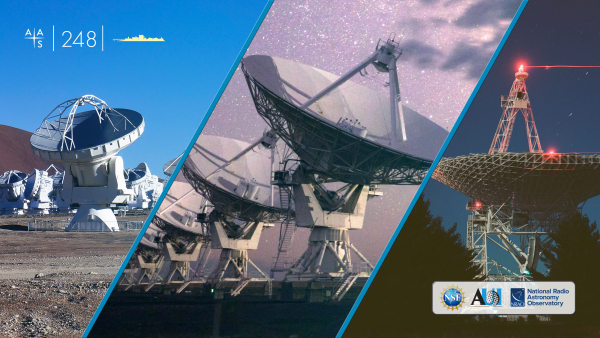
Image credit: U.S. National Science Foundation/NSF National Radio Astronomy Observatory
From tidal disruption events and turbulent galactic centers to Europa and Io, new observations with ALMA, the NSF VLA, and the NSF GBT radar reveal how gas, dust, and ice behave under the most extreme conditions
Astronomers using the U.S. National Science Foundation National Radio Astronomy Observatory (NSF NRAO) instruments are unveiling new scientific research that probes some of the most extreme environments in the Universe—from black holes shredding stars to dust-enshrouded starbursts and the icy surfaces of Jupiter’s moons. These results, from the NSF Jansky Very Large Array (NSF VLA), the Atacama Large Millimeter/submillimeter Array (ALMA), and the NSF Green Bank Telescope (NSF GBT), highlight how multi-wavelength and radar observations are transforming our understanding of how gas, dust, and solids behave under intense gravity, pressure, and radiation. This news will be shared in press conferences at the 248th American Astronomical Society (AAS) meeting in Pasadena, June 14th-18th. These press conferences will be held in person and livestreamed at the AAS press office YouTube.
Tidal Disruption Events and Black Hole Outflows
Press Conference Monday, 15 June, from 2:15 to 3:15 pm PDT
Kate Alexander (University of Arizona) presents new radio observations of tidal disruption events (TDEs) that reveal a wider diversity of jets and outflows than previously recognized. By monitoring the synchrotron emission produced where fast TDE-driven outflows slam into the surrounding interstellar medium, the team can measure key physical properties such as energy, size, and expansion velocity, while also tracing the density structure around otherwise dormant supermassive black holes on parsec scales.
Results from the first NSF VLA Large Program dedicated to TDEs show that radio evolution in these events correlates with their behavior at other wavelengths, pointing to the accretion flow onto the black hole as a key driver of radio outflows. As new wide-field surveys increase the sample of known TDEs, these correlations are expected to sharpen, offering deeper insight into the physics of how jets and outflows form in these extreme transients.
Hidden Star Clusters in Circumnuclear Rings
Press Conference Wednesday, 17 June, from 10:15 to 11:15 am PDT
Sajia Shahrin Neha (University of Kentucky) and collaborators use combined ALMA (in which the NSF NRAO is a partner) and NSF VLA continuum imaging to uncover and characterize young massive cluster (YMC) candidates embedded in circumnuclear star-forming rings of nearby barred spiral galaxies NGC 3351 and NGC 1097. By decomposing cluster-scale radio spectral energy distributions into free–free, synchrotron, and thermal dust components, they constrain thermal fractions, ionizing photon outputs, and cold dust content.
Stellar Feedback in a Nearby Luminous Infrared Galaxy
Press Conference Wednesday, 17 June, from 10:15 to 11:15 am PDT
Debosmita Pathak (The Ohio State University) presents the first measurements of pre-supernova stellar feedback pressures in roughly 1,600 young clusters within NGC 3256, the closest luminous infrared galaxy, using data from the GOALS survey and a combination of JWST, HST, MUSE, and ALMA (in which the NSF NRAO is a partner). The team measures contributions from radiation pressure, warm gas, stellar winds, and other components in a heavily dust-obscured, late-stage merger.
Quiescent Gas in the Galactic Center’s Extreme Environment
Press Conference Tuesday, 16 June, from 10:15 to 11:15 am PDT
Rojita Buddhacharya (Center for Astrophysics | Harvard & Smithsonian) reports on ACES (the ALMA CMZ Exploration Survey, in which the NSF NRAO is a partner), a multi-scale effort to map the physical and kinematic structure of gas in the Central Molecular Zone (CMZ) of the Milky Way—the inner 100 parsecs around our Galaxy’s central supermassive black hole. Despite hosting dense gas, young clusters, and extreme conditions, the CMZ’s star formation rate is significantly lower than predicted by standard dense-gas scaling relations.
Diagnosing Dust in Io’s Volcanic Plumes (Ground-Based IR and mm Facilities)
Press Conference Tuesday, 16 June, from 2:15 to 3:15 pm PDT
Neal Turner (JPL/Caltech) explores how ground-based observations can diagnose the solid particles within Io’s towering volcanic plumes. By modeling how rising magma fragments into particles in the vent, how those particles move within the plume, and how sunlight and thermal radiation propagate through the material, the team predicts distinct mid-infrared signatures for mafic versus ultra-mafic magma compositions that are accessible to facilities such as the European Southern Observatory’s VLT Interferometer.
The study also investigates how millimeter-wave interferometry with ALMA ( in which the NSF NRAO is a partner) can constrain the plume particles’ size distribution up to sub-millimeter scales. Determining magma composition and particle size distributions would illuminate Io’s interior structure, tidal heating, and resurfacing rates, and help inform strategies for safely flying spacecraft through plumes to directly sample their material.
Radar Views of Europa’s Icy Shell
Press Conference Tuesday, 16 June, from 2:15 to 3:15 pm PDT
Tunhui Xie (University of California, Los Angeles) presents the most comprehensive radar dataset to date on Europa, acquired with the Goldstone 3.5-cm Solar System Radar in 2011–2024 and the NSF Green Bank Telescope in a bistatic configuration. These observations yield disk-integrated radar albedo values in two circular polarizations and a circular polarization ratio consistent with earlier work on the icy Galilean satellites.
Learn more about the AAS 248th meeting.
About NRAO and GBO
The National Radio Astronomy Observatory (NRAO) and the Green Bank Observatory are major facilities of the U.S. National Science Foundation, operated under cooperative agreement by Associated Universities, Inc.
About ALMA
The Atacama Large Millimeter/submillimeter Array (ALMA), an international astronomy facility, is a partnership of the European Southern Observatory (ESO), the U.S. National Science Foundation (NSF) and the National Institutes of Natural Sciences (NINS) of Japan in cooperation with the Republic of Chile. ALMA is funded by ESO on behalf of its Member States, by NSF in cooperation with the National Research Council of Canada (NRC) and the National Science and Technology Council (NSTC) in Taiwan and by NINS in cooperation with the Academia Sinica (AS) in Taiwan and the Korea Astronomy and Space Science Institute (KASI).
ALMA construction and operations are led by ESO on behalf of its Member States; by the National Radio Astronomy Observatory (NRAO), managed by Associated Universities, Inc. (AUI), on behalf of North America; and by the National Astronomical Observatory of Japan (NAOJ) on behalf of East Asia. The Joint ALMA Observatory (JAO) provides the unified leadership and management of the construction, commissioning and operation of ALMA.
This news article was originally published on the NRAO website on June 12, 2026.


Recent News
Cosmic “Hamburger” Has the Secret Ingredients (For Giant Planet Formation, That Is)
Astronomers using the Atacama Large Millimeter/submillimeter Array (ALMA) were surprised to discover the very earliest phases of giant planet formation between the dense layers of gas and dust in the “Gomez’s Hamburger” system, referred to as GoHam.
Professor John E. Carlstrom Delivers 2026 NSF NRAO Jansky Lectures
Carlstrom will present his talk: “What Do We Know About The Big Bang?” to the public on three dates, along with a recording that will be shared on the NSF NRAO’s YouTube channel.
10 Questions: Desmond Wysenyuy
Meet Desmond Wysenyuy, program coordinator for the North American Regional Office of Astronomy for Development.