
Carlstrom will present his talk: “What Do We Know About The Big Bang?” to the public on three dates, along with a recording that will be shared on the NSF NRAO’s YouTube channel.
NSF Facilities Partner to Transform Data Processing for Next-Generation Radio Astronomy
Recent News
10 Questions: Desmond Wysenyuy
Meet Desmond Wysenyuy, program coordinator for the North American Regional Office of Astronomy for Development.
Cosmic Cocktail: Exotic Methanol Discovered in Planet-Building Zones
New results from the ALMA COMPASS Large Program (Complex Organic Molecules in Protostars with ALMA Spectral Surveys) show that young, still-forming stars are surrounded by a surprisingly sophisticated “chemical starter kit”, including organic molecules such as methanol that may one day enrich planets.
NSF Facilities Partner to Transform Data Processing for Next-Generation Radio Astronomy
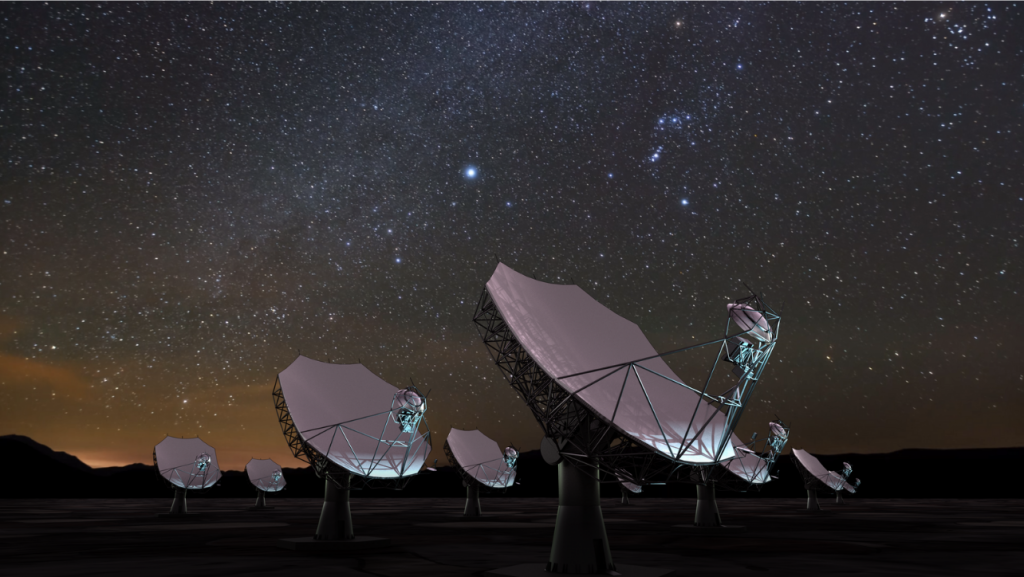
Artist’s interpretation of the ngVLA on the Plains of San Agustin. Credit: NSF/AUI/NSF NRAO
NSF NRAO, NSF LCCF partnership will deliver state-of-the-art system to handle unprecedented volume of data produced by ngVLA telescope
The U.S. National Science Foundation National Radio Astronomy Observatory (NSF NRAO) has entered into a groundbreaking partnership with the NSF Leadership-Class Computing Facility (NSF LCCF), led by the Texas Advanced Computing Center, to pioneer a transformative data processing system for the next era of radio astronomy.
The partnership is in direct response to the astronomical data volumes anticipated from the upcoming Next Generation Very Large Array (ngVLA) project, which is expected to produce up to 40 petabytes (PB) of data each month—orders of magnitude greater than any of the current NRAO telescopes. . This scale will place NRAO at the forefront of data-intensive scientific exploration not just in astronomy, but across the broader scientific community.
“Radio astronomy is on the brink of a data revolution,” said Tony Beasley, Director of the NRAO. “Our next-generation facility will open new windows on the Universe, but the ability to manage, process, and analyze these immense data streams is essential to delivering the scientific breakthroughs we seek. Teaming up with the NSF LCCF, led by our partners at TACC, ensures our scientists will have access to computation and infrastructure on par with the world’s largest research efforts and technology companies.”
To meet these challenges, NSF NRAO is developing an advanced radio astronomy data processing system designed to harness and make sense of the flood of information expected from ngVLA. Unlike anything NRAO has undertaken before, this data ecosystem will operate on the scale of the world’s top supercomputing centers, incorporating high-performance computing, state-of-the-art data transport systems, cutting edge scalable and parallelizable algorithms, and advanced data management solutions.
TACC, an NSF Major Research Equipment and Facilities Construction (MREFC) site, is leading the U.S. NSF Leadership-Class Computing Facility, a next-generation powerhouse set to transform computational research when it launches in 2026. In partnership with NRAO astronomers, TACC experts are engineering end-to-end workflows for seamless data movement, storage, and computation. This effort includes a comprehensive conceptual design and close collaboration with NRAO’s software team to accurately forecast and meet their future computing demands.
“As observational astronomy enters the exascale era, computing and data continue to grow in importance for scientific discovery,” said Dan Stanzione, Executive Director of TACC. “The NSF Leadership-Class Computing Facility is pleased to assist with defining the cyberinfrastructure workflows needed by NSF’s largest radio astronomy instruments. In helping to assess the needed capacities and tradeoffs, the LCCF will be able to assist ngVLA to address some of the universe’s deepest mysteries.”
Currently no astronomy facility has operated at this magnitude of sustained data flow. The planned infrastructure will allow NRAO to enable next-generation discoveries for astronomers across the country.
For more details about this partnership and updates on the project’s progress, please visit NRAO News and TACC.
About NRAO
The National Radio Astronomy Observatory is a facility of the U.S. National Science Foundation, operated under cooperative agreement by Associated Universities, Inc.
This news article was originally published on the NRAO website on August 26, 2025.


Recent News
Professor John E. Carlstrom Delivers 2026 NSF NRAO Jansky Lectures
Carlstrom will present his talk: “What Do We Know About The Big Bang?” to the public on three dates, along with a recording that will be shared on the NSF NRAO’s YouTube channel.
10 Questions: Desmond Wysenyuy
Meet Desmond Wysenyuy, program coordinator for the North American Regional Office of Astronomy for Development.
Cosmic Cocktail: Exotic Methanol Discovered in Planet-Building Zones
New results from the ALMA COMPASS Large Program (Complex Organic Molecules in Protostars with ALMA Spectral Surveys) show that young, still-forming stars are surrounded by a surprisingly sophisticated “chemical starter kit”, including organic molecules such as methanol that may one day enrich planets.