
The U.S. National Science Foundation National Radio Astronomy Observatory (NSF NRAO) invites the public to the U.S. National Science Foundation Very Large Array (NSF VLA) for its annual Spring Open House on Saturday, April 18, 2026, from 9:00 a.m. to 4:00 p.m.
Recent News
ALMA Detects Extremely Abundant Alcohol in Interstellar Comet 3I/ATLAS
New research reveals that 3I/ATLAS is packed with an unusually large amount of the organic molecule methanol – more than almost all known comets in our own solar system.
10 Questions: Anica Miller-Rushing
Meet Anica Miller-Rushing, STEM education research associate for AUI’s Office of Education and Public Engagement.
New Discovery Challenges Evolution of Galaxy Clusters
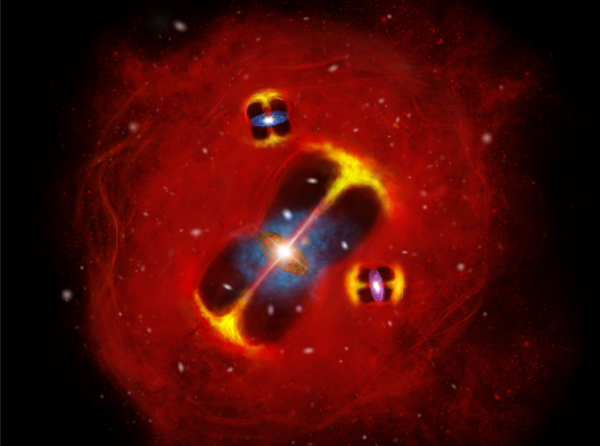
Artist’s impression of the forming cluster SPT2349-56: radio jets from active galaxies embedded in a hot intracluster atmosphere (red), illustrating a large thermal reservoir of gas in the nascent cluster. Image credit: Lingxiao Yuan
Peering back in time, around 12 billion years, astronomers using the Atacama Large Millimeter/submillimeter Array (ALMA) have found the most distant and direct evidence of scorching gas in a forming galaxy cluster, SPT2349-56. The hot plasma, seen when the Universe was just 1.4 billion years old, is far hotter and more pressurized than current theories predicted for such an early system.
The team used an unusual observation technique called the thermal Sunyaev–Zel’dovich (tSZ) effect. Rather than looking for light from the gas itself, the tSZ effect reveals a small shadow cast by hot electrons found in galaxy clusters against the faint afterglow from the Big Bang in the cosmic microwave background.
“We didn’t expect to see such a hot cluster atmosphere so early in cosmic history,” said lead author Dazhi Zhou, a PhD candidate at the University of British Columbia, “In fact, at first I was skeptical about the signal because it was too strong to be real. After months of checks and tests, we confirmed that the intracluster gas in this young cluster is hotter and more energetic than many present-day clusters.”
Before this new result, astronomers assumed that at early cosmic epochs, galaxy clusters were still too immature to have fully developed and heated their intracluster gas. No hot cluster atmospheres had been directly detected in the first 3 billion years of cosmic history.
“SPT2349-56 changes everything we thought we understood,” said co-author Scott Chapman, a professor at Dalhousie University and affiliate professor at the University of British Columbia, who conducted the research while at the National Research Council of Canada (NRC), “Our measurements show a superheated cluster atmosphere only 1.4 billion years after the Big Bang, at a time when we thought the intracluster gas should still be relatively cool and slowly settling in. It suggests that the birth of massive clusters could be much more violent and efficient at heating the gas than our models assumed.”
SPT2349-56 is already famous as one of the most extreme infant clusters known. Its compact core, about the size of the halo surrounding the Milky Way, hosts several actively growing supermassive black holes and more than 30 starburst galaxies that together build stars thousands of times faster than our Galaxy. According to this study, powerful outbursts from these black holes, seen as bright radio galaxies, could be a natural way to inject the enormous amount of energy needed to overheat the intracluster gas so early.
This new discovery suggests that in the Universe’s first billion years, energetic processes, like bursts from supermassive black holes and intense starbursts, could dramatically heat the surrounding gas in growing clusters. This overheating stage could be crucial for transforming these young cool galaxy clusters into the sprawling hot clusters seen today. It also suggests current models need to update ideas on how galaxies and their environments grow up.
This is the earliest direct detection of hot cluster gas ever reported, pushing the limits of how far back astronomers can study these environments. The discovery that massive reservoirs of hot plasma exist so early forces scientists to rethink the sequence and speed of galaxy cluster evolution. It also opens new questions about how supermassive black holes and galaxy formation shape the cosmos.
“SPT2349-56 is a very strange and exciting laboratory. We see intense star formation, energetic supermassive black holes and this overheated atmosphere all packed into a young, compact cluster, ” added Zhou, “There is still a huge observational gap between this violent early stage and the calmer clusters we see later on. Mapping how their atmospheres evolve over cosmic time will be a very exciting direction for future work. ”
About ALMA
The Atacama Large Millimeter/submillimeter Array (ALMA), an international astronomy facility, is a partnership of the European Southern Observatory (ESO), the U.S. National Science Foundation (NSF) and the National Institutes of Natural Sciences (NINS) of Japan in cooperation with the Republic of Chile. ALMA is funded by ESO on behalf of its Member States, by NSF in cooperation with the National Research Council of Canada (NRC) and the National Science and Technology Council (NSTC) in Taiwan and by NINS in cooperation with the Academia Sinica (AS) in Taiwan and the Korea Astronomy and Space Science Institute (KASI).
ALMA construction and operations are led by ESO on behalf of its Member States; by the National Radio Astronomy Observatory (NRAO), managed by Associated Universities, Inc. (AUI), on behalf of North America; and by the National Astronomical Observatory of Japan (NAOJ) on behalf of East Asia. The Joint ALMA Observatory (JAO) provides the unified leadership and management of the construction, commissioning and operation of ALMA.
This news article was originally published on the NRAO website on January 7, 2026.


Recent News
NSF NRAO to Host Spring 2026 VLA Open House
The U.S. National Science Foundation National Radio Astronomy Observatory (NSF NRAO) invites the public to the U.S. National Science Foundation Very Large Array (NSF VLA) for its annual Spring Open House on Saturday, April 18, 2026, from 9:00 a.m. to 4:00 p.m.
ALMA Detects Extremely Abundant Alcohol in Interstellar Comet 3I/ATLAS
New research reveals that 3I/ATLAS is packed with an unusually large amount of the organic molecule methanol – more than almost all known comets in our own solar system.
10 Questions: Anica Miller-Rushing
Meet Anica Miller-Rushing, STEM education research associate for AUI’s Office of Education and Public Engagement.