Carlstrom will present his talk: “What Do We Know About The Big Bang?” to the public on three dates, along with a recording that will be shared on the NSF NRAO’s YouTube channel.
New Director of North American ALMA Science Center Named Fellow of the American Association for the Advancement of Science
Recent News
10 Questions: Desmond Wysenyuy
Meet Desmond Wysenyuy, program coordinator for the North American Regional Office of Astronomy for Development.
Cosmic Cocktail: Exotic Methanol Discovered in Planet-Building Zones
New results from the ALMA COMPASS Large Program (Complex Organic Molecules in Protostars with ALMA Spectral Surveys) show that young, still-forming stars are surrounded by a surprisingly sophisticated “chemical starter kit”, including organic molecules such as methanol that may one day enrich planets.
New Director of North American ALMA Science Center Named Fellow of the American Association for the Advancement of Science
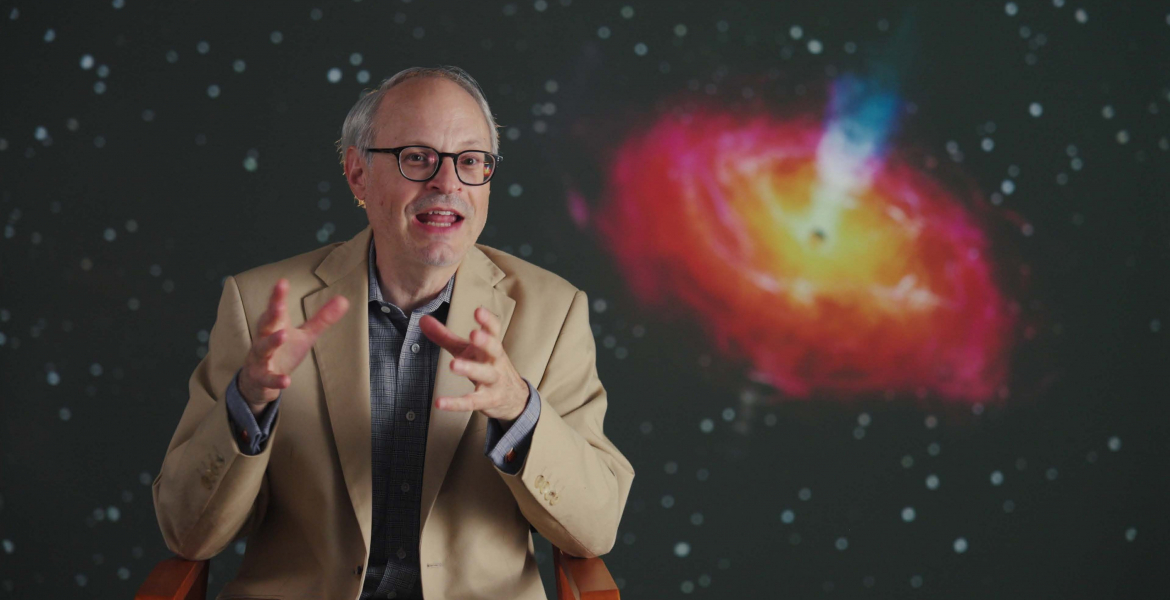
Recognition honors leadership in astronomy and support for scientific collaboration nationwide
The American Association for the Advancement of Science (AAAS) has named Joe Pesce a 2026 AAAS Fellow. Pesce is the recently appointed Assistant Director of the U.S. National Science Foundation National Radio Astronomy Observatory’s (NSF NRAO) North American ALMA Science Center (NAASC.) The NSF NRAO is a partner in ALMA, the Atacama Large Millimeter/submillimeter Array.
As a 2026 AAAS Fellow Pesce is recognized for his leadership in advancing astrophysical research and his commitment to fostering collaboration and innovation within the U.S. astronomical community.
Election as an AAAS Fellow is a lifetime distinction bestowed upon members by their peers. It honors extraordinary achievements in advancing science or its applications for the benefit of society. Fellows are nominated by their scientific peers and elected by the AAAS Council, an honor representing dedication to both scientific excellence and public service.
Pesce’s contributions span decades of astrophysical research, education, and administration. In his previous career as an NSF program director in the Division of Astronomical Sciences, he has played a central role in supporting U.S. observatories, research programs, and partnerships that expand human understanding of the universe. His work has championed equitable access to research opportunities and strengthened the infrastructure that supports discovery across multiple wavelengths of astronomy.
“I am deeply honored to be recognized by my colleagues through AAAS,” said Pesce. “Science thrives when we work together across disciplines and institutions, and I’m grateful to have been part of a community that’s expanding our cosmic perspective while supporting the next generation of scientists.”
Pesce joins a distinguished group of scientists, engineers, and innovators being named AAAS Fellows this year across all fields of science, technology, and education. For more information about the 2026 class of AAAS Fellows, visit the AAS website.
About NRAO
The National Radio Astronomy Observatory (NRAO) is a facility of the U.S. National Science Foundation, operated under cooperative agreement by Associated Universities, Inc.
About ALMA
The Atacama Large Millimeter/submillimeter Array (ALMA), an international astronomy facility, is a partnership of the European Southern Observatory (ESO), the U.S. National Science Foundation (NSF) and the National Institutes of Natural Sciences (NINS) of Japan in cooperation with the Republic of Chile. ALMA is funded by ESO on behalf of its Member States, by NSF in cooperation with the National Research Council of Canada (NRC) and the National Science and Technology Council (NSTC) in Taiwan and by NINS in cooperation with the Academia Sinica (AS) in Taiwan and the Korea Astronomy and Space Science Institute (KASI).
ALMA construction and operations are led by ESO on behalf of its Member States; by the National Radio Astronomy Observatory (NRAO), managed by Associated Universities, Inc. (AUI), on behalf of North America; and by the National Astronomical Observatory of Japan (NAOJ) on behalf of East Asia. The Joint ALMA Observatory (JAO) provides the unified leadership and management of the construction, commissioning and operation of ALMA.
This news article was originally published on the NRAO website on April 7, 2026.


Recent News
Professor John E. Carlstrom Delivers 2026 NSF NRAO Jansky Lectures
Carlstrom will present his talk: “What Do We Know About The Big Bang?” to the public on three dates, along with a recording that will be shared on the NSF NRAO’s YouTube channel.
10 Questions: Desmond Wysenyuy
Meet Desmond Wysenyuy, program coordinator for the North American Regional Office of Astronomy for Development.
Cosmic Cocktail: Exotic Methanol Discovered in Planet-Building Zones
New results from the ALMA COMPASS Large Program (Complex Organic Molecules in Protostars with ALMA Spectral Surveys) show that young, still-forming stars are surrounded by a surprisingly sophisticated “chemical starter kit”, including organic molecules such as methanol that may one day enrich planets.