
Carlstrom will present his talk: “What Do We Know About The Big Bang?” to the public on three dates, along with a recording that will be shared on the NSF NRAO’s YouTube channel.
NASA’s Chandra and the Very Large Array See Surprisingly Strong Black Hole Jet at Cosmic “Noon”
Recent News
10 Questions: Desmond Wysenyuy
Meet Desmond Wysenyuy, program coordinator for the North American Regional Office of Astronomy for Development.
Cosmic Cocktail: Exotic Methanol Discovered in Planet-Building Zones
New results from the ALMA COMPASS Large Program (Complex Organic Molecules in Protostars with ALMA Spectral Surveys) show that young, still-forming stars are surrounded by a surprisingly sophisticated “chemical starter kit”, including organic molecules such as methanol that may one day enrich planets.
NASA’s Chandra and the Very Large Array See Surprisingly Strong Black Hole Jet at Cosmic “Noon”
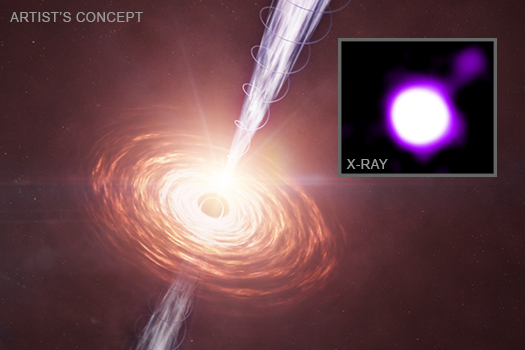
Credit: X-ray: NASA/CXC/CfA/J. Maithil et al.; Illustration: NASA/CXC/SAO/M. Weiss; Image Processing: NASA/CXC/SAO/N. Wolk
A black hole has blasted out a surprisingly powerful jet in the distant universe, according to a new study from NASA’s Chandra X-ray Observatory. This jet exists early enough in the cosmos that it is being illuminated by the leftover glow from the big bang itself.
Astronomers used Chandra and the U.S. National Science Foundation Karl G. Jansky Very Large Array (NSF VLA) to study this black hole and its jet at a period they call “cosmic noon,” which occurred about three billion years after the universe began. During this time most galaxies and supermassive black holes were growing faster than at any other time during the history of the universe.
Scientists can use this jet to probe questions about how black holes helped shape their surroundings during this critical era in cosmic history. This science was presented at the 246th American Astronomical Society Conference in Anchorage, Alaska on Monday, June 9, 2025, 10:15 AM AK. You can read the full release from Chandra.
About NRAO
The National Radio Astronomy Observatory (NRAO) is a facility of the U.S. National Science Foundation, operated under cooperative agreement by Associated Universities, Inc.
This news article was originally published on the NRAO website on June 11, 2025.


Recent News
Professor John E. Carlstrom Delivers 2026 NSF NRAO Jansky Lectures
Carlstrom will present his talk: “What Do We Know About The Big Bang?” to the public on three dates, along with a recording that will be shared on the NSF NRAO’s YouTube channel.
10 Questions: Desmond Wysenyuy
Meet Desmond Wysenyuy, program coordinator for the North American Regional Office of Astronomy for Development.
Cosmic Cocktail: Exotic Methanol Discovered in Planet-Building Zones
New results from the ALMA COMPASS Large Program (Complex Organic Molecules in Protostars with ALMA Spectral Surveys) show that young, still-forming stars are surrounded by a surprisingly sophisticated “chemical starter kit”, including organic molecules such as methanol that may one day enrich planets.