
A new study using the U.S. National Science Foundation’s Very Large Array and the Atacama Large Millimeter/submillimeter Array shows compelling new evidence that Betelgeuse’s atmosphere is being actively perturbed by the aforementioned close-in stellar companion.
Recent News
Cosmic “Hamburger” Has the Secret Ingredients (For Giant Planet Formation, That Is)
Astronomers using the Atacama Large Millimeter/submillimeter Array (ALMA) were surprised to discover the very earliest phases of giant planet formation between the dense layers of gas and dust in the “Gomez’s Hamburger” system, referred to as GoHam.
Professor John E. Carlstrom Delivers 2026 NSF NRAO Jansky Lectures
Carlstrom will present his talk: “What Do We Know About The Big Bang?” to the public on three dates, along with a recording that will be shared on the NSF NRAO’s YouTube channel.
Astronomers Track a Flaring Dwarf-Star Duo with Exceptional Precision
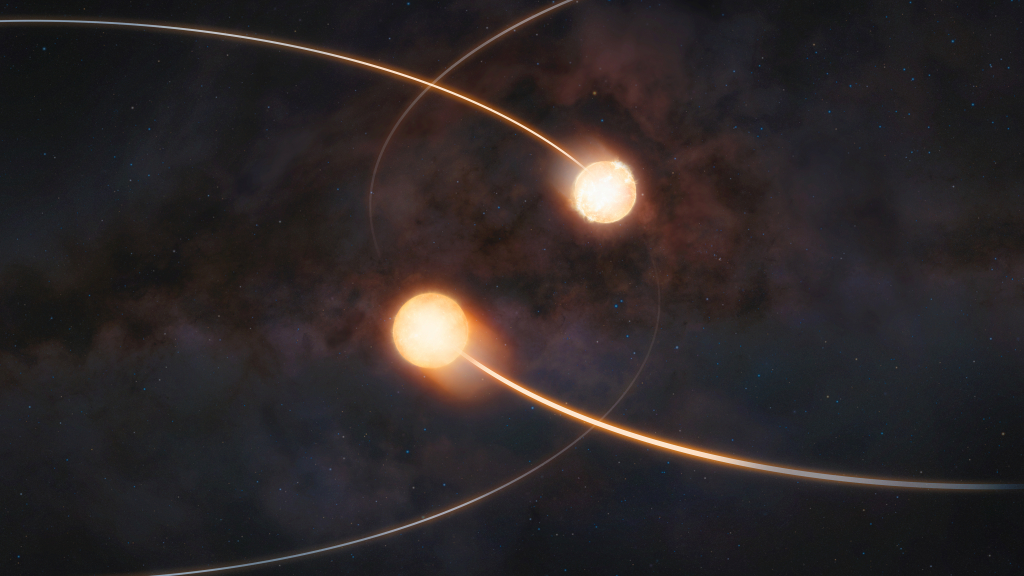
Artist concept of the DG CVn binary star system, showing two young, active red dwarf stars orbiting each other. Radio observations with the National Science Foundation’s Very Long Baseline Array (NSF VLBA) allowed astronomers to precisely measure the stars’ masses, distance, and orbit. Image credit: NSF/AUI/NSF NRAO/M. Weiss
Long-term Radio Observations with NSF VLBA Reveal the Masses, Orbit and Distance of Two Active Red Dwarf Stars, Offering New Insight Into the Potential for Planets in Binary Systems
Astronomers have measured the orbit, masses, and distance of a pair of small, active stars with extraordinary precision, using the U.S. National Science Foundation’s Very Long Baseline Array (NSF VLBA), operated by the U.S. National Science Foundation National Radio Astronomy Observatory (NSF NRAO). The observations provide a remarkably detailed picture of DG CVn, a binary system in which two red dwarf stars orbit each other about 59 light-years from Earth.
A team led by Paul Boven, a network system engineer at the Joint Institute for Very Long Baseline Interferometry ERIC (JIVE), Leiden Observatory PhD student, and lead author of the study, discovered that, surprisingly, both stars in DG CVn emit detectable radio waves, allowing astronomers to track their individual motions across the sky. By combining observations spanning 18 years, including new NSF VLBA observations made between 2023 and 2025, they were able to determine the stars’ orbit and masses with unusual accuracy.
Two Active Red Dwarfs
Most stars, including our Sun, produce relatively faint amounts of natural radio emission. Some red dwarfs, which are smaller and less massive than the Sun, are an exception. When these stars rotate rapidly, the churning motion inside them can generate powerful magnetic fields and intense activity, including flares that can produce strong radio and X-ray emission. DG CVn is a young system, between 30 and 150 million years old, and at least one of its stars is a rare and particularly active, fast-rotating flare star. Previous observations have shown that its radio emission can increase dramatically following powerful X-ray outbursts. The system also harbors a complex periodic variable (CPV) star which shows persistent periodic variations in its optical lightcurve. A question which remains is which of the two stars is exhibiting either behavior.
The system originally attracted attention as part of a search for planets around nearby stars. Astronomers were looking for a star’s subtle back-and-forth motion that could reveal the gravitational pull of an orbiting planet. Instead, DG CVn showed much larger and more complicated motion than expected. That motion was eventually traced to the stars orbiting each other. “We were really lucky to hear about this object when we had developed tools with which we could explain these motions,” said Boven. “But the real surprise came when we also detected the second radio-loud dwarf in the observations we did to confirm our model. It really allowed us to measure the system very precisely.”
Following the Stars Across 18 Years
The researchers combined archival NSF VLBA and U.S. National Science Foundation Green Bank Telescope (NSF GBT) observations from 2007 to 2010 with seven new NSF VLBA observing sessions conducted between 2023 and 2025. Together, the observations produced 27 precise measurements of the positions of the two stars. The NSF VLBA is a network of 10 radio telescopes spread across North America. Working together, the antennas act like a single telescope thousands of miles across, allowing astronomers to measure the positions of radio-emitting objects with extraordinary precision. Because the stars are so close together in the sky, they are difficult to distinguish with conventional optical observations. The NSF VLBA’s ability to pinpoint the locations of their radio emission allowed the researchers to follow the motion of each star separately. “DG CVn is a beautiful example of what precise radio astrometry can reveal,” said Jay Blanchard, NSF NRAO astronomer and co-author. “By following these two stars over many years, we can see their orbital motion directly and use that motion to determine properties that would otherwise be extremely difficult to measure.”
Weighing the Stars and Mapping Their Orbit
These observations show that the two stars orbit each other once every 4.511 years, following a stretched, elliptical path. At their closest approach, the stars come within about 0.59 times the distance between Earth and the Sun. The more massive star, DG CVn A, has about 39% of the Sun’s mass, while DG CVn B has about 36%. The system is relatively nearby, at 59.3 light-years from Earth. The astronomers determined this distance using a technique called parallax, which measures the tiny apparent shift in a nearby star’s position as Earth moves around the Sun. Knowing both the distance to the system and the way the two stars move around each other allowed the researchers to calculate their masses with exceptional accuracy. The results provide one of the most precise dynamical measurements yet for a binary system of this type.
A Close Encounter for Planet-Forming Disks
The stars’ close, repeated encounters may also have influenced how their planetary systems formed. Stars are born surrounded by disks of gas and dust, which can provide the raw material for planets. Because the two stars in DG CVn pass within about 0.59 astronomical units of each other, their gravitational interactions would have significantly limited the size of those disks as the system formed. That close orbit makes long-period planets orbiting either individual star unlikely. The researchers estimate that a planet orbiting one of the stars would need to complete an orbit in less than about 23 days to remain stable. A planet orbiting both stars would need an orbit lasting at least about 36 years. These constraints provide clues about how binary stars can influence the formation and survival of planets.
A Window Into Future Planet Searches
The study demonstrates the power of very long baseline interferometry, or VLBI, a technique that combines radio telescopes separated by large distances to make extremely precise measurements of an astronomical object’s position. The same technique can be used to look for the tiny motion of a star caused by an orbiting planet. As a planet travels around its star, its gravity causes the star to move slightly in response, creating a small “reflex” motion. Measuring that motion can reveal the presence of a planet. The researchers say that future radio facilities, including the Next Generation Very Large Array (ngVLA) and the Square Kilometre Array (SKA) could make these types of measurements possible for many more stars. Such observations could help astronomers distinguish between the effects of binary companions and planets orbiting nearby stars. “And in the future, we hope to make measurements precise enough to detect planets in orbit around such radio-loud dwarfs,” said Huib van Langevelde, JIVE chief scientist and Leiden Observatory professor. “We think that when the ngVLA and the SKA become part of the VLBI network, we can do even more precise measurements, for many more, more distant stars.”
About the NSF NRAO
The NSF National Radio Astronomy Observatory is a facility of the U.S. National Science Foundation, operated under cooperative agreement by Associated Universities, Inc.
This news article was originally published on the [source] website on Month day, year.


Recent News
What Lurks Within the Shadows of Betelgeuse?
A new study using the U.S. National Science Foundation’s Very Large Array and the Atacama Large Millimeter/submillimeter Array shows compelling new evidence that Betelgeuse’s atmosphere is being actively perturbed by the aforementioned close-in stellar companion.
Cosmic “Hamburger” Has the Secret Ingredients (For Giant Planet Formation, That Is)
Astronomers using the Atacama Large Millimeter/submillimeter Array (ALMA) were surprised to discover the very earliest phases of giant planet formation between the dense layers of gas and dust in the “Gomez’s Hamburger” system, referred to as GoHam.
Professor John E. Carlstrom Delivers 2026 NSF NRAO Jansky Lectures
Carlstrom will present his talk: “What Do We Know About The Big Bang?” to the public on three dates, along with a recording that will be shared on the NSF NRAO’s YouTube channel.