
Astronomers using the Atacama Large Millimeter/submillimeter Array (ALMA) have captured the first direct, high-resolution images of a magnetic field wrapped tightly around the outflow of gas streaming away from a forming star — evidence that solves a decades-old puzzle about how young stars sculpt the powerful jets that form them.
Recent News
A Trillion Mile Cosmic Stream of Gas Feeds GW Orionis
A team of astronomers using the Atacama Large Millimeter/submillimeter Array (ALMA), of which the U.S. National Science Foundation National Radio Astronomy Observatory is a partner, has captured a massive stream of gas—one trillion miles, or .2 light years long—feeding the young triple-star system GW Orionis.
NSF NRAO radio observations help rule out a relativistic jet in rare stellar explosion
Astronomers studying a rare stellar explosion first spotted as a brief burst of X-rays used radio observations to help show that the dying star did not produce the powerful jet often associated with gamma-ray bursts.
International Astronomical Union (IAU) General Assembly
Every year, astronomers from all around the globe gather for a couple of weeks at the IAU General Assembly to discuss their discoveries and observations, and to exchange ideas and challenges facing astronomy. This year the assembly is taking place in Honolulu, Hawaii. I had the privilege to give opening remarks this past Tuesday. As I said in my remarks, “it is a great honor to represent the Obama Administration at this historic event.”
NSF is one of the world’s leading institutions in astronomy. For decades, NSF-funded researchers have been exploring the most intriguing mysteries of the heavens. We hope to continue doing so!

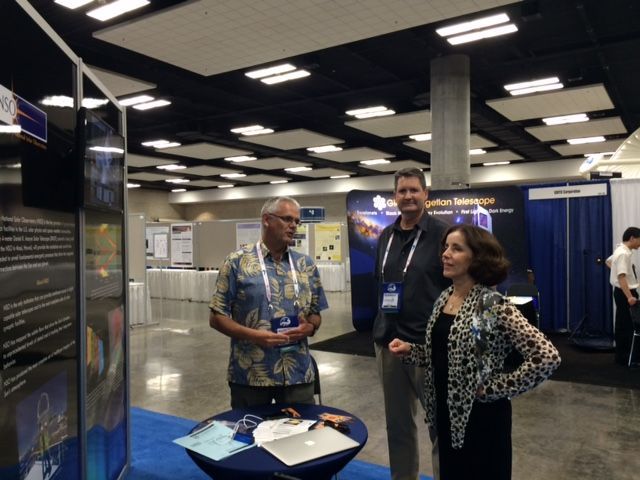
Great catching up with the National Solar Observatory (NSO) and NSF solar astronomy program officer Dave Boboltz. One of NSO’s major projects is the NSF-funded Daniel K. Inouye Solar Telescope on Haleakala, Hawaii. This telescope will provide new insights into solar phenomena, including solar storms. Photo credit: NSF

With the recent announcement about Breakthrough Listen, I enjoyed talking with National Radio Astronomy Observatory’s Tony Beasley about how NSF-funded radio astronomy will play a key role. Photo credit: NSF
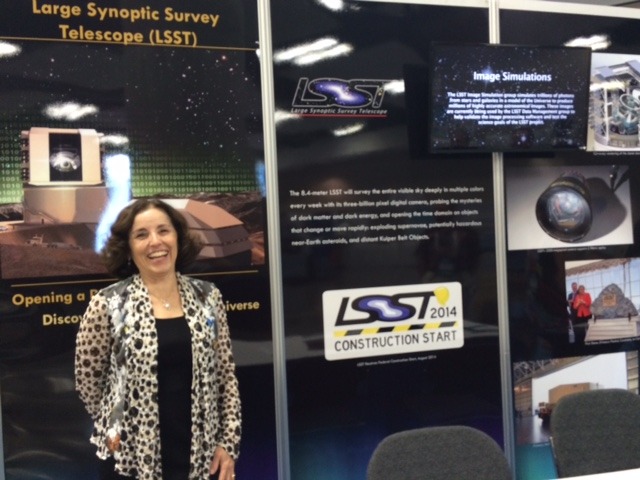
The Large Synoptic Survey Telescope in Chile has the world’s largest digital camera. Photo credit: NSF
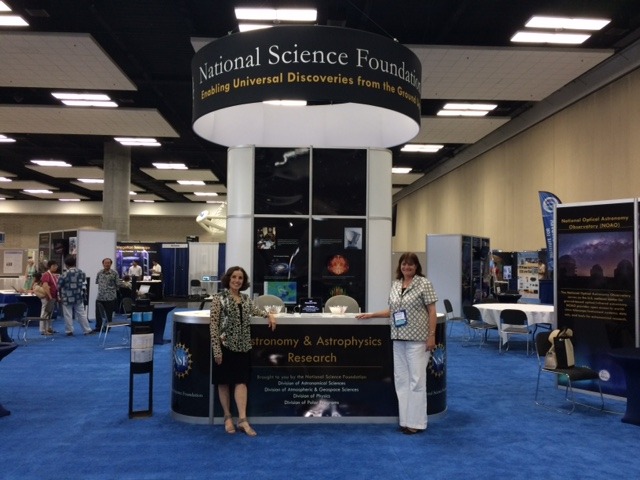
NSF booth at the assembly. I’m with Patricia Knezek, NSF deputy division director for the Division of Astronomical Sciences. Photo credit: NSF
Follow and engage in the online conversation using #IAU2015 and #NSFastronomy.


Recent News
Twisted Physics: Astronomers Solve 30-Year-Old Stellar Mystery
Astronomers using the Atacama Large Millimeter/submillimeter Array (ALMA) have captured the first direct, high-resolution images of a magnetic field wrapped tightly around the outflow of gas streaming away from a forming star — evidence that solves a decades-old puzzle about how young stars sculpt the powerful jets that form them.
A Trillion Mile Cosmic Stream of Gas Feeds GW Orionis
A team of astronomers using the Atacama Large Millimeter/submillimeter Array (ALMA), of which the U.S. National Science Foundation National Radio Astronomy Observatory is a partner, has captured a massive stream of gas—one trillion miles, or .2 light years long—feeding the young triple-star system GW Orionis.
NSF NRAO radio observations help rule out a relativistic jet in rare stellar explosion
Astronomers studying a rare stellar explosion first spotted as a brief burst of X-rays used radio observations to help show that the dying star did not produce the powerful jet often associated with gamma-ray bursts.