
Carlstrom will present his talk: “What Do We Know About The Big Bang?” to the public on three dates, along with a recording that will be shared on the NSF NRAO’s YouTube channel.
Recent News
10 Questions: Desmond Wysenyuy
Meet Desmond Wysenyuy, program coordinator for the North American Regional Office of Astronomy for Development.
Cosmic Cocktail: Exotic Methanol Discovered in Planet-Building Zones
New results from the ALMA COMPASS Large Program (Complex Organic Molecules in Protostars with ALMA Spectral Surveys) show that young, still-forming stars are surrounded by a surprisingly sophisticated “chemical starter kit”, including organic molecules such as methanol that may one day enrich planets.
Astrophotography Workshop Announced at Iconic Very Large Array
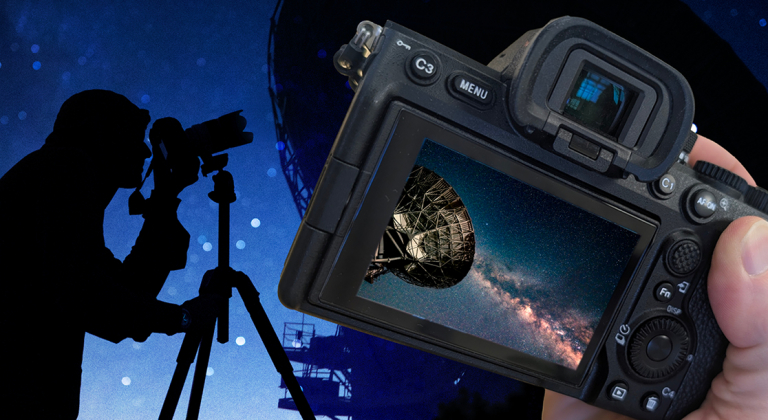
Image credit: NSF/AUI/NSF NRAO/J. Hellerman
Photography enthusiasts and stargazers alike are invited to experience an unforgettable evening of learning and exploration at the U.S. National Science Foundation Very Large Array (NSF VLA) located 25 miles west of Magdalena, New Mexico. This is the U.S. National Science Foundation National Radio Astronomy Observatory (NSF NRAO)’s first-ever Astrophotography Workshop, and it will take place on April 18, 2026. This workshop offers participants the rare opportunity to capture stunning images of the cosmos from one of the world’s most remarkable and bespoke astronomical settings.
The four-hour workshop, priced at $100 per participant, is designed for photographers of all skill levels who are eager to improve their night sky photography techniques. The event will begin with a two-hour instructional session, where attendees will learn essential skills such as proper camera settings for low-light conditions, composition strategies, and focusing methods for capturing stars, constellations, and the Milky Way.
Following the classroom portion, participants will transition into a two-hour guided, hands-on photography session among the NSF VLA’s iconic radio telescope dishes – including the ngVLA prototype antenna which has yet to be photographed under the night sky! With expert guidance, attendees will apply their new knowledge in real time, photographing the night sky in a uniquely dramatic and inspiring environment.
“The Very Large Array offers an unparalleled backdrop for astrophotography,” said Jeff Hellerman, NSF NRAO photographer and event organizer. “This workshop will give participants both the technical foundation and the hands-on experience needed to confidently capture the beauty of the night sky – in one of the most unique places on the planet.”
Located on the Plains of San Agustin in central New Mexico, the NSF Very Large Array is internationally renowned for its role in groundbreaking astronomical discoveries and its striking visual presence. Its remote location also provides exceptionally dark skies, making it an ideal setting for night photography.
Participants are required to bring their own DSLR or mirrorless camera and a sturdy tripod. Space is limited to just 20 participants to ensure personalized instruction.
For more information or to reserve a spot, please visit the registration page.
About NRAO
The National Radio Astronomy Observatory is a major facility of the U.S. National Science Foundation, operated under cooperative agreement by Associated Universities, Inc.
This news article was originally published on the NRAO website on MArch 24, 2026.


Recent News
Professor John E. Carlstrom Delivers 2026 NSF NRAO Jansky Lectures
Carlstrom will present his talk: “What Do We Know About The Big Bang?” to the public on three dates, along with a recording that will be shared on the NSF NRAO’s YouTube channel.
10 Questions: Desmond Wysenyuy
Meet Desmond Wysenyuy, program coordinator for the North American Regional Office of Astronomy for Development.
Cosmic Cocktail: Exotic Methanol Discovered in Planet-Building Zones
New results from the ALMA COMPASS Large Program (Complex Organic Molecules in Protostars with ALMA Spectral Surveys) show that young, still-forming stars are surrounded by a surprisingly sophisticated “chemical starter kit”, including organic molecules such as methanol that may one day enrich planets.