
Astronomers using the Atacama Large Millimeter/submillimeter Array (ALMA) were surprised to discover the very earliest phases of giant planet formation between the dense layers of gas and dust in the “Gomez’s Hamburger” system, referred to as GoHam.
Recent News
Professor John E. Carlstrom Delivers 2026 NSF NRAO Jansky Lectures
Carlstrom will present his talk: “What Do We Know About The Big Bang?” to the public on three dates, along with a recording that will be shared on the NSF NRAO’s YouTube channel.
10 Questions: Desmond Wysenyuy
Meet Desmond Wysenyuy, program coordinator for the North American Regional Office of Astronomy for Development.
Double the Disks, Double the Discovery: New Insights into Planet Formation in DF Tau
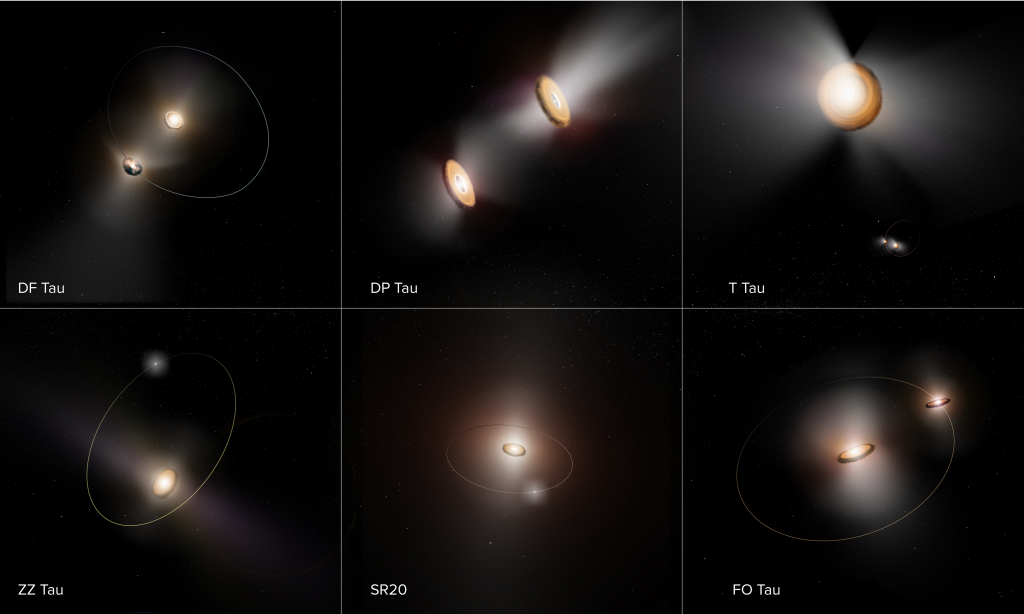
Planet-forming Disks in Young Multiple Star Systems. Credit: U.S. National Science Foundation/NSF National Radio Astronomy Observatory, B. Saxton
ALMA observations reveal unexpected new ways planets may form
Tucked away in a star-forming region in the Taurus constellation, a pair of circling stars are displaying some unexpected differences in the circumstellar disks of dust and gas that surround them. A new study led by researchers at Lowell Observatory, combining data from the Atacama Large Millimeter/submillimeter Array (ALMA) and Keck Observatory, has unveiled intriguing findings about planet formation in this binary star system, known as DF Tau, along with other systems in this region.
DF Tau consists of two young stars with nearly equal masses, orbiting each other every 48 years. Since both stars likely formed together, with the same composition in the same environment, astronomers would expect them to share other things in common, like having similar circumstellar disks. But this is not the case—while the brighter, primary star has an active inner disk, the secondary star’s inner disk appears to have almost completely disappeared. These unexpected differences challenge current theories of disk evolution and planet formation.
Just like a potter’s wheel is used to shape clay into various forms, a circumstellar disk provides the materials and environment needed for planets to form. Over time, the dust and gas in the disk will clump together, eventually forming planets, moons, and other celestial bodies. The disks won’t last forever — as a star matures, and planets form, the disk gradually disappears. So what caused the unusual dissipation observed in the circumstellar disk of the secondary star?
High-resolution ALMA imaging, combined with optical and infrared data from other telescopes, allowed researchers to study, analyze, and compare the properties of the stars and their individual disks. This binary has a relatively small, tight orbit, which means gravity truncates the outer parts of the disk, but it is unlikely that the current binary orbit could alter the inner disk. Instead, other processes may be at work.
“The dispersal of circumstellar disks is a complicated process with many unknowns. By looking at systems that form together, we can control one major variable: time. DF Tau and other systems in our survey tell us that disk evolution isn’t strictly a function of time, other processes are at play,” shares Taylor Kutra of Lowell Observatory, lead author of this research.
Binary systems like DF Tau, and other sources in this ALMA survey, offer a natural laboratory to study how circumstellar disks evolve. Understanding these processes is essential for refining models of planet formation because disk evolution sets the timescale on which planet formation occurs. This research highlights the diversity of disk behaviors and underscores the need for further studies to unravel the factors influencing their lifespans and structures. These findings not only deepen our understanding of binary star systems but also shed light on the broader mechanisms shaping planetary systems across the galaxy.
About ALMA
The Atacama Large Millimeter/submillimeter Array (ALMA), an international astronomy facility, is a partnership of ESO, the U.S. National Science Foundation (NSF) and the National Institutes of Natural Sciences (NINS) of Japan in cooperation with the Republic of Chile. ALMA is funded by ESO on behalf of its Member States, by NSF in cooperation with the National Research Council of Canada (NRC) and the National Science and Technology Council (NSTC) in Taiwan and by NINS in cooperation with the Academia Sinica (AS) in Taiwan and the Korea Astronomy and Space Science Institute (KASI).
ALMA construction and operations are led by ESO on behalf of its Member States; by the National Radio Astronomy Observatory (NRAO), managed by Associated Universities, Inc. (AUI), on behalf of North America; and by the National Astronomical Observatory of Japan (NAOJ) on behalf of East Asia. The Joint ALMA Observatory (JAO) provides the unified leadership and management of the construction, commissioning and operation of ALMA.
About NRAO
The National Radio Astronomy Observatory (NRAO) is a facility of the U.S. National Science Foundation, operated under cooperative agreement by Associated Universities, Inc.
This news article was originally published on the NRAO website on January 16, 2025.


Recent News
Cosmic “Hamburger” Has the Secret Ingredients (For Giant Planet Formation, That Is)
Astronomers using the Atacama Large Millimeter/submillimeter Array (ALMA) were surprised to discover the very earliest phases of giant planet formation between the dense layers of gas and dust in the “Gomez’s Hamburger” system, referred to as GoHam.
Professor John E. Carlstrom Delivers 2026 NSF NRAO Jansky Lectures
Carlstrom will present his talk: “What Do We Know About The Big Bang?” to the public on three dates, along with a recording that will be shared on the NSF NRAO’s YouTube channel.
10 Questions: Desmond Wysenyuy
Meet Desmond Wysenyuy, program coordinator for the North American Regional Office of Astronomy for Development.