
Carlstrom will present his talk: “What Do We Know About The Big Bang?” to the public on three dates, along with a recording that will be shared on the NSF NRAO’s YouTube channel.
Recent News
10 Questions: Desmond Wysenyuy
Meet Desmond Wysenyuy, program coordinator for the North American Regional Office of Astronomy for Development.
Cosmic Cocktail: Exotic Methanol Discovered in Planet-Building Zones
New results from the ALMA COMPASS Large Program (Complex Organic Molecules in Protostars with ALMA Spectral Surveys) show that young, still-forming stars are surrounded by a surprisingly sophisticated “chemical starter kit”, including organic molecules such as methanol that may one day enrich planets.
NSF NRAO Leads Critical Spectrum Studies to Safeguard Radio Astronomy
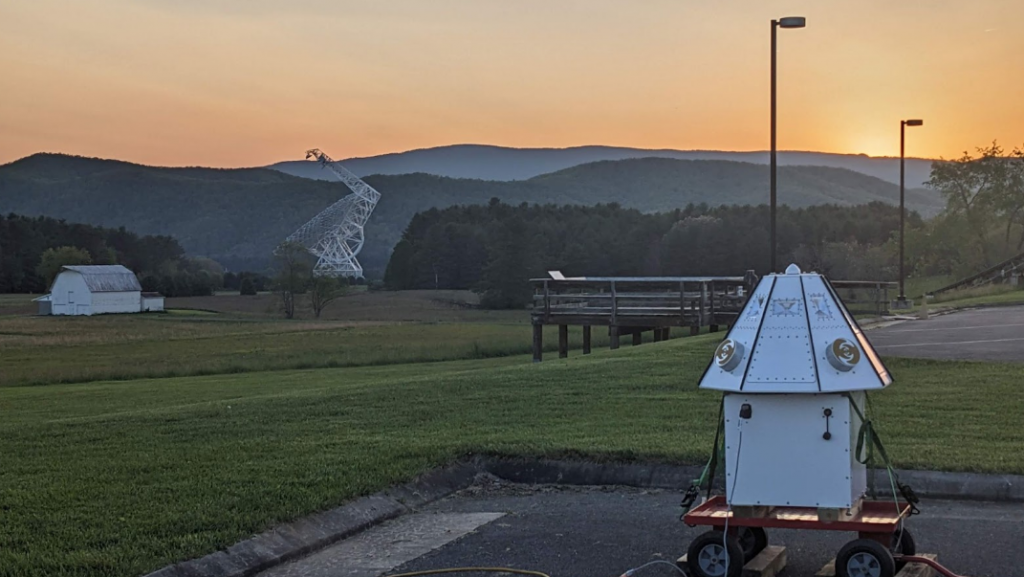
ASM-1 in testing at the Green Bank Observatory in Green Bank, WV in May 2023. Insights from this first prototype were folded into the design of the ASM-2 device. Credit: NSF/AUI/NSF NRAO
The U.S. National Science Foundation National Radio Astronomy Observatory (NSF NRAO) has received funding to expand its study of an invisible—and crucial—scientific and technological resource: the radio spectrum. This work focuses on key radio frequency bands being considered for repurposing as part of the National Spectrum Strategy announced by the U.S. government.
The radio spectrum is a finite resource. The wavelengths observed by radio astronomers overlap with those used by satellite constellations, WIFI, Bluetooth, and other everyday devices. The NSF NRAO has been working for years to find solutions for sharing and protecting the bands they observe in the radio spectrum from radio frequency interference (RFI). In 2024, NSF NRAO engineers debuted an Advanced Spectrum Monitor (ASM) to test the levels of RFI present at the NSF Green Bank Observatory in Green Bank, West Virginia. The ASM was developed by NSF NRAO engineers at the Central Development Laboratory, located in Charlottesville, Virginia, near the headquarters of the NSF NRAO.
Expanding on this research, the NSF NRAO will use the NSF Very Large Array and the NSF Green Bank Telescope to further analyze the current state of RFI in the 7.125-8.4 GHz bands. NSF NRAO engineers will also commission a series of new Advanced Spectrum Monitors (ASM-2) to test and deploy at the NSF NRAO’s facilities (including the NSF Central Development Lab in Charlottesville, VA) along with other partners who use the radio spectrum in industry, technology, and national defense. The ASM-2 will help protect sensitive radio astronomy, and other activities that use the radio spectrum, by providing real-time directional data on the radio frequency environment from 1-50 GHz.
This work by the NSF NRAO is a critical step in balancing the needs of commercial spectrum users in science, business, industry, and government. As the U.S. moves forward with its National Spectrum Strategy, this project will play a vital role in safeguarding the future of radio astronomy and ensuring continued U.S. leadership in scientific research. “Protecting the radio spectrum is a shared responsibility—one that demands innovation, partnership, and vision. With this new award from the U.S. National Science Foundation, we are advancing the technology that safeguards radio astronomy and building bridges with industry, government, and the broader scientific community,” adds Tony Beasley, Director of the NSF NRAO.
About NRAO
The National Radio Astronomy Observatory (NRAO) is a facility of the U.S. National Science Foundation, operated under cooperative agreement by Associated Universities, Inc.
This news article was originally published on the NRAO website on June 24, 2025.


Recent News
Professor John E. Carlstrom Delivers 2026 NSF NRAO Jansky Lectures
Carlstrom will present his talk: “What Do We Know About The Big Bang?” to the public on three dates, along with a recording that will be shared on the NSF NRAO’s YouTube channel.
10 Questions: Desmond Wysenyuy
Meet Desmond Wysenyuy, program coordinator for the North American Regional Office of Astronomy for Development.
Cosmic Cocktail: Exotic Methanol Discovered in Planet-Building Zones
New results from the ALMA COMPASS Large Program (Complex Organic Molecules in Protostars with ALMA Spectral Surveys) show that young, still-forming stars are surrounded by a surprisingly sophisticated “chemical starter kit”, including organic molecules such as methanol that may one day enrich planets.