
Meet Desmond Wysenyuy, program coordinator for the North American Regional Office of Astronomy for Development.
Recent News
Cosmic Cocktail: Exotic Methanol Discovered in Planet-Building Zones
New results from the ALMA COMPASS Large Program (Complex Organic Molecules in Protostars with ALMA Spectral Surveys) show that young, still-forming stars are surrounded by a surprisingly sophisticated “chemical starter kit”, including organic molecules such as methanol that may one day enrich planets.
Proctor Foundation for Art and Science Offers Stellar Guitar to Space Camp Auction
To celebrate the Inspiration4 Mission’s 5th Anniversary, mission pilot Dr. Sian Proctor is choosing to celebrate in a fitting way — raising funds to send community college students and faculty to Space Camp.
Galactic Mystery: How “Ice Cubes” Survive in the Milky Way’s Blazing Bubbles
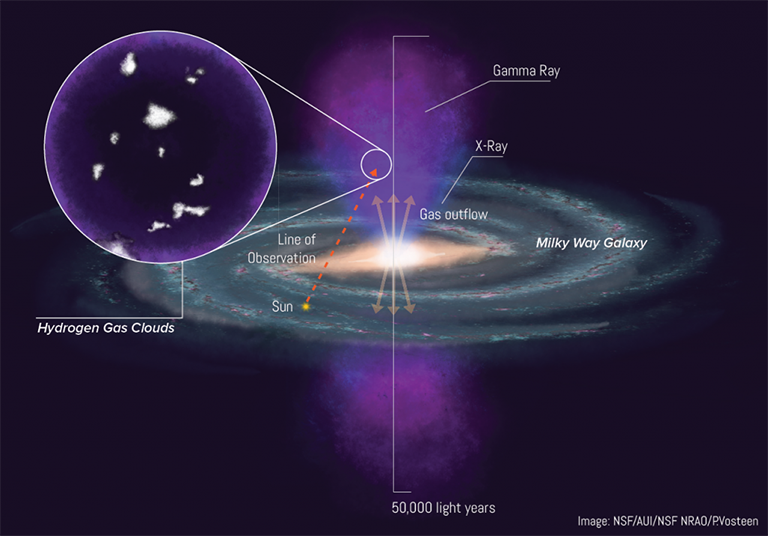
Astronomers discover fragile hydrogen clouds surviving inside the superheated Fermi Bubbles, revealing the Milky Way’s most extreme outflows are younger and more complex than ever imagined
A team of astronomers has made a surprising discovery using the U.S. National Science Foundation Green Bank Telescope (NSF GBT): eleven fast-moving clouds of cold, neutral hydrogen gas—akin to “ice cubes”—surviving deep inside the Fermi Bubbles, two enormous lobes of superheated plasma erupting from the center of our Milky Way Galaxy. These cold clouds reside more than 13,000 light-years above the Galactic center, in a region where frigid materials like this were never expected to be discovered.
The Fermi Bubbles are among the most violent environments in our Galaxy, filled with plasma at temperatures over a million degrees Kelvin. In such a harsh setting, cold gas should quickly evaporate or be torn apart—much like ice cubes tossed into an active volcano. Yet, these clouds remain structured, dynamic, and surprisingly long-lived, with lifetimes estimated at several million years. This resilience matches independent estimates of the Fermi Bubbles’ age and challenges existing models, which often predict much longer formation times for the Bubbles themselves.
“These findings change our previous assumptions, showing that cold gas can persist in the hot, turbulent Fermi Bubbles,” explained Rongmon Bordoloi, the lead scientist of this research and an associate professor North Carolina State University, “We didn’t know that cold gas can survive in these extreme outflows. This challenges our understanding of how galaxies recycle and expel matter.”
To find these cold clouds, the research team conducted the deepest-ever 21 cm radio survey of the Fermi Bubbles, using the NSF GBT’s unmatched sensitivity and resolution. They identified eleven cold hydrogen clouds at unprecedented heights, making these the highest-latitude neutral hydrogen clouds ever detected within the Bubbles. The NSF GBT’s unique capabilities were essential for this breakthrough—no other instruments can match its sensitivity and sky coverage for this type of observation.
“We believe that these cold clouds were swept up from the Milky Way’s center and carried aloft by the very hot wind that formed the Fermi bubbles”, said Jay Lockman an astronomer at the Green Bank Observatory and coauthor of the paper. “Just as you can’t see the motion of the wind on Earth unless there are clouds to track it, we can’t see the hot wind from the Milky Way but can detect radio emission from the cold clouds it has entrained.”
These findings also challenge the previously understood age of the Fermi Bubbles, which are now likely believed to have been formed more recently. The survival of these fragile, cold clouds suggests that the Fermi Bubbles may be only a few million years old—pointing to a dramatic outburst from the Milky Way’s central black hole, rather than star formation, as their likely origin. “If the Bubbles were older, these clouds would have long since vanished,” adds Bordoloi.
Scientists wonder how these clouds formed or survived. Did they condense out of the hot plasma, were they swept up from the galaxy’s disk, or are they remnants of pre-existing structures? What physical processes—such as magnetic fields or pressure confinement—are allowing them to resist destruction in such an extreme environment.
“Finding these cold clouds so high up in the Fermi Bubbles was unexpected”, adds co-author Andrew Fox, ESA-AURA Astronomer at the Space Telescope Science Institute in Baltimore, MD. “It challenges our understanding of where they came from and what their ultimate fate will be.”
This discovery pushes the boundaries of what scientists thought possible in our Galaxy’s most extreme environments. It opens new avenues for research into how galaxies evolve, how matter cycles through the cosmos, and what physical mechanisms allow fragile structures to persist amid cosmic violence. Future studies will focus on unraveling the origins and survival mechanisms of these clouds, providing critical tests for models of galactic feedback and outflows.
About GBO
The Green Bank Observatory, part of the National Radio Astronomy Observatory, is a facility of the U.S. National Science Foundation, operated under cooperative agreement by Associated Universities, Inc.
This news article was originally published on the NRAO website on July 7, 2025.


Recent News
10 Questions: Desmond Wysenyuy
Meet Desmond Wysenyuy, program coordinator for the North American Regional Office of Astronomy for Development.
Cosmic Cocktail: Exotic Methanol Discovered in Planet-Building Zones
New results from the ALMA COMPASS Large Program (Complex Organic Molecules in Protostars with ALMA Spectral Surveys) show that young, still-forming stars are surrounded by a surprisingly sophisticated “chemical starter kit”, including organic molecules such as methanol that may one day enrich planets.
Proctor Foundation for Art and Science Offers Stellar Guitar to Space Camp Auction
To celebrate the Inspiration4 Mission’s 5th Anniversary, mission pilot Dr. Sian Proctor is choosing to celebrate in a fitting way — raising funds to send community college students and faculty to Space Camp.