
A new study connects the black hole’s famous ring of light to a compact region that marks the likely base of the jet, bringing scientists closer to understanding how black holes power some of the brightest beacons in the universe.
Recent News
Magnetic Superhighways Discovered in a Starburst Galaxy’s Winds
Using the Atacama Large Millimeter/submillimeter Array (ALMA), an international team of astronomers has mapped a magnetic highway driving a powerful galactic wind into the nearby galaxy merger of Arp 220, revealing for the first time that its fast, molecular outflows are strongly magnetized and likely helping to drive metals, dust, and cosmic rays into the space around the galaxy.
Making Scientific Breakthroughs Possible in 2025
2025 was an incredibly productive year for AUI, marked by significant advances across astronomy, energy, advanced therapeutics, and STEM education and workforce development.
Cosmic Lens Reveals Hyperactive Cradle of Future Galaxy Cluster
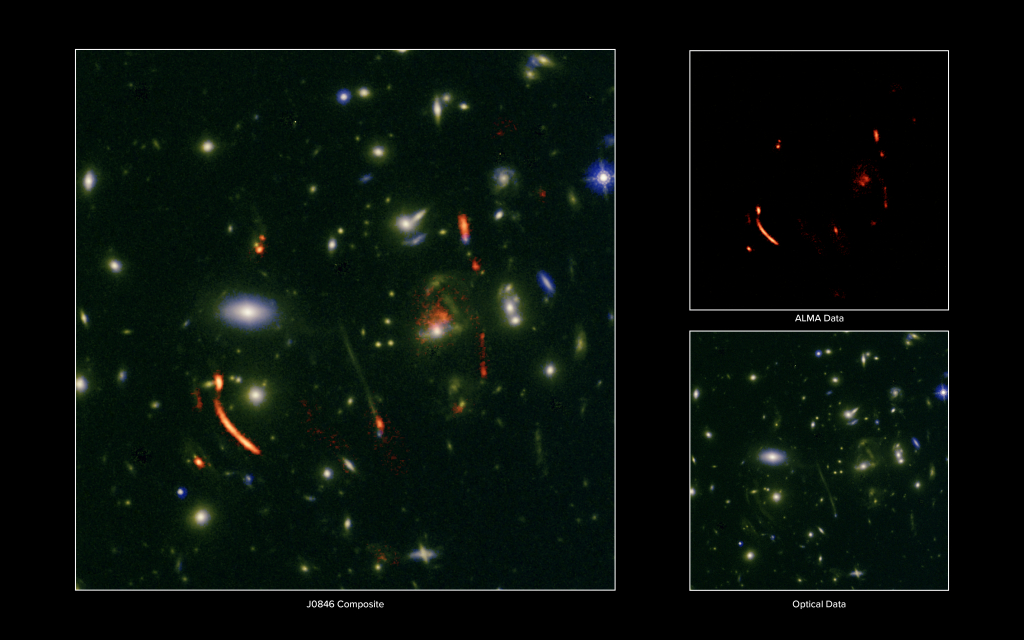
The galaxy cluster lens J0846 in optical light (bottom right), the ALMA view of dust-enshrouded, star-forming galaxies strongly lensed into bright arcs (top right), and a composite view (left) revealing at least 11 dusty galaxies in a compact protocluster core more than 11 billion light-years away, magnified by the foreground cluster’s gravity. Image credit: NSF/AUI/NSF NRAO/B. Saxton; NSF/NOIRLab
The NSF VLA and ALMA uncover first strongly lensed protocluster core, a compact swarm of dusty, star‐bursting galaxies in the early Universe
Galaxy clusters are formed by a dense packing of many galaxies, making them the most massive structures in the Universe. Their progenitors, protoclusters, show these galaxies in their infancy, offering a window to study how they all formed. This early “settlement” of galaxies will eventually evolve into a sprawling metropolis by the present day. Astronomers using the U.S. National Science Foundation Very Large Array (NSF VLA) and the Atacama Large Millimeter/submillimeter Array (ALMA) have discovered a rare protocluster that was exceptionally bright, all when the Universe was 11 billion years younger. The system, called PJ0846+15 (J0846), is the first strongly lensed protocluster core discovered, revealing how some of the most massive galaxy clusters in the present-day Universe began their lives.
High-resolution ALMA observations show that what once looked like a single bright submillimeter source in data sourced from the Planck telescope is actually a tight concentration of at least 11 dusty, star-forming galaxies, all packed into a region smaller than the distance between the Milky Way and Andromeda. These galaxies were undergoing a powerful starburst episode when the Universe was only a few billion years old, making J0846 one of the fastest-growing protocluster cores yet identified. Dust in these galaxies absorbs most of their visible light, hiding them from optical telescopes while they build stars at extraordinary rates. ALMA’s sensitivity to submillimeter emission from cold dust and molecular gas pierces this “dust blanket,” revealing the gas reservoirs and star‐forming activity that will eventually assemble into a massive galaxy cluster.
J0846 lies behind a massive foreground galaxy cluster that sits roughly halfway along our line of sight, creating a rare double‐cluster alignment. The foreground cluster acts as a gravitational lens, magnifying, distorting, and in some cases duplicating the images of the distant galaxies like a cosmic funhouse mirror, boosting their apparent brightness and angular size. This natural magnification turns the system into a powerful zoom lens, allowing astronomers to study the background protocluster in far greater detail than would otherwise be possible. The younger, more distant protocluster is more than twice as far away as the foreground cluster, effectively letting astronomers glimpse different stages of cluster evolution along nearly the same line of sight—like looking through a forest from mature trees in the foreground to tiny saplings farther away.
ALMA maps the CO(3–2) emission and dust continuum from the background galaxies, confirming that at least 11 systems share a common redshift and occupy a compact volume, and enabling precise measurements of their star formation rates, gas masses, and dynamics. These data show that the protocluster core hosts enormous reservoirs of cold gas feeding intense, dust‐enshrouded star formation that will rapidly build up the stellar mass of future cluster galaxies. Complementary NSF VLA observations at 6 GHz trace the radio continuum from star formation and possible active galactic nuclei in both the foreground and background structures. The NSF VLA imaging helps characterize the morphology of the foreground cluster galaxies and identify radio counterparts to the lensed background members, tying together the lensing mass distribution and the activity within the protocluster.
“Galaxy clusters are akin to a sprawling modern metropolis that was built upon an ancient civilization from the past. For example, if an archaeologist digs deeper into the ground then they uncover that earlier civilization. Similarly, when astronomers observe objects that are further away we are able to look further back in time. In this way, the study of this distant protocluster gives us a glimpse into how one of the more early ‘settlements’ of galaxies grew and evolved into the matured structures such as that foreground galaxy cluster that we observe today,” said lead author Nicholas Foo, a graduate student at Arizona State University.
Protoclusters like J0846 are the precursors of today’s massive galaxy clusters, representing early “construction sites” where gravity is rapidly assembling gas, galaxies, and dark matter into the largest structures in the cosmos. By combining ALMA’s view of dust and molecular gas with the NSF VLA’s maps of radio emission, astronomers obtain a multi‐wavelength picture of how galaxies in this dense environment grow, interact, and transform over time. The rare double‐cluster alignment and strong lensing make J0846 an exceptional laboratory for testing models of cluster formation and the co‐evolution of galaxies and their environments. As the NSF VLA and ALMA continue to target this field, the system will serve as a benchmark for connecting today’s mature clusters to their compact, dust‐rich, star‐bursting ancestors in the early Universe.
About NRAO
The National Radio Astronomy Observatory is a facility of the U.S. National Science Foundation, operated under cooperative agreement by Associated Universities, Inc.
Media Contact:
Corrina C. Jaramillo Feldman
Sr. Public Information Officer
VLA, VLBA, ngVLA
[email protected]
(505) 366-7267
This news article was originally published on the NRAO website on January 7, 2026.


Recent News
New Event Horizon Telescope Results Trace M87 Jet Back to Its Black Hole
A new study connects the black hole’s famous ring of light to a compact region that marks the likely base of the jet, bringing scientists closer to understanding how black holes power some of the brightest beacons in the universe.
Magnetic Superhighways Discovered in a Starburst Galaxy’s Winds
Using the Atacama Large Millimeter/submillimeter Array (ALMA), an international team of astronomers has mapped a magnetic highway driving a powerful galactic wind into the nearby galaxy merger of Arp 220, revealing for the first time that its fast, molecular outflows are strongly magnetized and likely helping to drive metals, dust, and cosmic rays into the space around the galaxy.
Making Scientific Breakthroughs Possible in 2025
2025 was an incredibly productive year for AUI, marked by significant advances across astronomy, energy, advanced therapeutics, and STEM education and workforce development.