Scheduled for April 18, the workshop offers participants the rare opportunity to capture stunning images of the cosmos from one of the world’s most remarkable and bespoke astronomical settings.
Recent News
NSF NRAO to Host Spring 2026 VLA Open House
The U.S. National Science Foundation National Radio Astronomy Observatory (NSF NRAO) invites the public to the U.S. National Science Foundation Very Large Array (NSF VLA) for its annual Spring Open House on Saturday, April 18, 2026, from 9:00 a.m. to 4:00 p.m.
ALMA Detects Extremely Abundant Alcohol in Interstellar Comet 3I/ATLAS
New research reveals that 3I/ATLAS is packed with an unusually large amount of the organic molecule methanol – more than almost all known comets in our own solar system.
Breakthrough Listen, NSF Green Bank Telescope Probe Galactic Heart for Hidden Pulsars
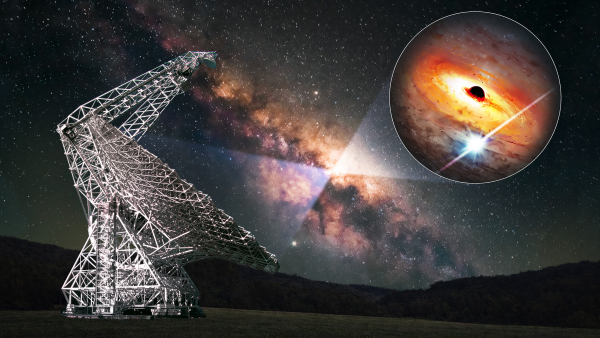
Artist’s impression of the NSF Green Bank Telescope gathering data on the center of the Milky Way. The inset image shows the black hole at our Galaxy’s center, and a nearby candidate (unconfirmed) pulsar. Image credit: Danielle Futselaar / Breakthrough Listen
Astronomers discover possible millisecond pulsar, challenging ideas about how many neutron stars lurk around the Milky Way’s central black hole
Astronomers from Breakthrough Listen have used the U.S. National Science Foundation National Radio Astronomy Observatory’s Green Bank Telescope (NSF GBT) to carry out one of the most sensitive pulsar searches ever aimed at the Milky Way’s Galactic Center.
The Galactic Center, home to the supermassive black hole Sagittarius A* and dense stellar populations, presents unique scientific opportunities and challenges for understanding stellar dynamics, extreme astrophysical environments, and tests of Einstein’s theory of General Relativity. In this research, recent Columbia University PhD graduate Karen Perez and collaborators conducted more than 20 hours of observations with the NSF GBT using the Breakthrough Listen Digital Backend, which enabled high-time and high-frequency resolution data products across a wide radio bandwidth. Of these observations, 11 hours were dedicated to the innermost 1.4 arcminutes of the Galactic Center, resulting in one of the deepest and most sensitive pulsar surveys ever performed toward this region.
These observations uncovered a promising candidate for a millisecond pulsar, with a rotation period of 8.19 milliseconds. If confirmed it would be the first such object found in the Galactic Center.
Find links to the paper, press materials, artwork, and the datasets and software at the University of Oxford Physics Department and the Breakthrough Listen Research Group.
About NRAO
The National Radio Astronomy Observatory (NRAO) is a facility of the U.S. National Science Foundation, operated under cooperative agreement by Associated Universities, Inc.
This news article was originally published on the NRAO website on February 9, 2026.


Recent News
Astrophotography Workshop Announced at Iconic Very Large Array
Scheduled for April 18, the workshop offers participants the rare opportunity to capture stunning images of the cosmos from one of the world’s most remarkable and bespoke astronomical settings.
NSF NRAO to Host Spring 2026 VLA Open House
The U.S. National Science Foundation National Radio Astronomy Observatory (NSF NRAO) invites the public to the U.S. National Science Foundation Very Large Array (NSF VLA) for its annual Spring Open House on Saturday, April 18, 2026, from 9:00 a.m. to 4:00 p.m.
ALMA Detects Extremely Abundant Alcohol in Interstellar Comet 3I/ATLAS
New research reveals that 3I/ATLAS is packed with an unusually large amount of the organic molecule methanol – more than almost all known comets in our own solar system.