
To celebrate the Inspiration4 Mission’s 5th Anniversary, mission pilot Dr. Sian Proctor is choosing to celebrate in a fitting way — raising funds to send community college students and faculty to Space Camp.
Recent News
10 Questions: Judelyn Padgett
Meet Judelyn Padgett, a project manager at AUI headquarters.
NA-ROAD Announces the 2026 Women and Girls in Astronomy Program Cohort
The Women and Girls in Astronomy Program (WGAP), led by Associated Universities, Inc. (AUI), under the North American Regional Office of Astronomy for Development (NA-ROAD), is proud to announce the selection of ten regional projects to receive funding through the 2026 cycle.
Astronomers Discover a Superheated Star Factory in the Early Universe
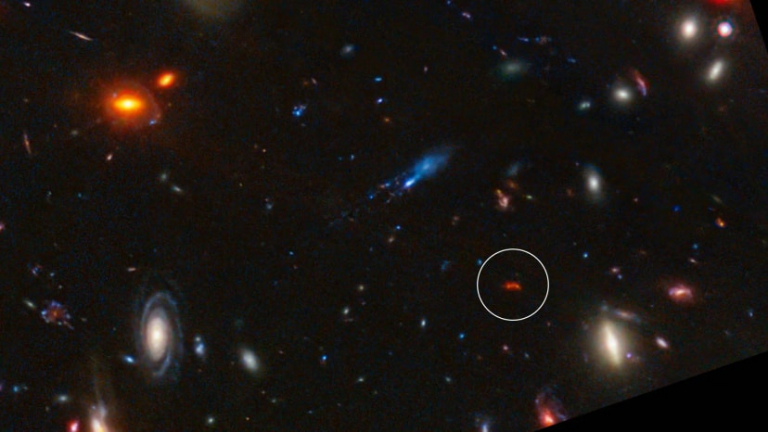
Glowing deep red from the distant past: galaxy Y1 shines thanks to dust grains heated by newly-formed stars (circled in this image from the James Webb telescope). Credit: NASA, ESA, CSA, STScI, J. Diego (Instituto de Física de Cantabria, Spain), J. D’Silva (U. Western Australia), A. Koekemoer (STScI), J. Summers & R. Windhorst (ASU), and H. Yan (U. Missouri)
Astronomers have uncovered a previously unknown, extreme kind of star factory by taking the temperature of a distant galaxy using the ALMA telescope. The galaxy is glowing intensely in superheated cosmic dust while forming stars 180 times faster than our own Milky Way. The discovery indicates how galaxies could have grown quickly when the universe was very young, solving a long-standing puzzle for astronomers.
The first generations of stars formed under conditions very different from anywhere we can see in the nearby universe today. Astronomers are studying these differences using powerful telescopes that can detect galaxies so far away their light has travelled towards us for billions of year.
Now, an international team of astronomers led by Tom Bakx at Chalmers University of Technology in Sweden has measured the temperature of one of the most distant known star factories. The galaxy, known as Y1, is so far away that its light has taken over 13 billion years to reach us.
This research is presented in the paper A warm ultraluminous infrared galaxy just 600 million years after the Big Bang in Monthly Notices of the Royal Astronomical Society, lead author Tom Bakx (Chalmers University of Technology, Sweden).
Read more in this press release from Chalmers University.
About ALMA
The Atacama Large Millimeter/submillimeter Array (ALMA), an international astronomy facility, is a partnership of the European Southern Observatory (ESO), the U.S. National Science Foundation (NSF) and the National Institutes of Natural Sciences (NINS) of Japan in cooperation with the Republic of Chile. ALMA is funded by ESO on behalf of its Member States, by NSF in cooperation with the National Research Council of Canada (NRC) and the National Science and Technology Council (NSTC) in Taiwan and by NINS in cooperation with the Academia Sinica (AS) in Taiwan and the Korea Astronomy and Space Science Institute (KASI).
ALMA construction and operations are led by ESO on behalf of its Member States; by the National Radio Astronomy Observatory (NRAO), managed by Associated Universities, Inc. (AUI), on behalf of North America; and by the National Astronomical Observatory of Japan (NAOJ) on behalf of East Asia. The Joint ALMA Observatory (JAO) provides the unified leadership and management of the construction, commissioning and operation of ALMA.
This news article was originally published on the NRAO website on November 12, 2025.


Recent News
Proctor Foundation for Art and Science Offers Stellar Guitar to Space Camp Auction
To celebrate the Inspiration4 Mission’s 5th Anniversary, mission pilot Dr. Sian Proctor is choosing to celebrate in a fitting way — raising funds to send community college students and faculty to Space Camp.
10 Questions: Judelyn Padgett
Meet Judelyn Padgett, a project manager at AUI headquarters.
NA-ROAD Announces the 2026 Women and Girls in Astronomy Program Cohort
The Women and Girls in Astronomy Program (WGAP), led by Associated Universities, Inc. (AUI), under the North American Regional Office of Astronomy for Development (NA-ROAD), is proud to announce the selection of ten regional projects to receive funding through the 2026 cycle.