
To celebrate the Inspiration4 Mission’s 5th Anniversary, mission pilot Dr. Sian Proctor is choosing to celebrate in a fitting way — raising funds to send community college students and faculty to Space Camp.
Recent News
10 Questions: Judelyn Padgett
Meet Judelyn Padgett, a project manager at AUI headquarters.
NA-ROAD Announces the 2026 Women and Girls in Astronomy Program Cohort
The Women and Girls in Astronomy Program (WGAP), led by Associated Universities, Inc. (AUI), under the North American Regional Office of Astronomy for Development (NA-ROAD), is proud to announce the selection of ten regional projects to receive funding through the 2026 cycle.
ALMA Creates Largest-Ever Image of the Milky Way’s Core
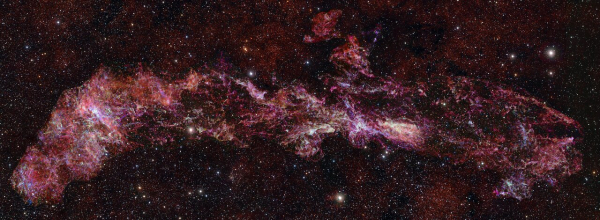
This image shows the complex distribution of molecular gas in the Central Molecular Zone (CMZ) of the Milky Way. It was obtained with the Atacama Large Millimeter/submillimeter Array (ALMA), in which ESO is a partner. This map is as long as three full Moons side-by-side in the sky, and it is in fact the largest ALMA image ever obtained. This map is part of ACES — the ALMA CMZ Exploration Survey — a project designed to understand how gas condenses into stars in the extreme and chaotic environment at the heart of our galaxy. The survey has charted the distribution of dozens of different molecules, five of which are shown here in different colours: sulphur monoxide (cyan), silicon monoxide (green), isocyanic acid (red), cyanoacetylene (blue), and carbon monosulphide (magenta). The stars in the foreground of this image were observed at infrared wavelengths (Y, Z and J filters) with ESO’s VISTA telescope as part of a different project. The actual density of stars in the CMZ is much higher than what is shown here, where we have opted to highlight the details in the molecular cloud. Note that the edges of the ALMA map appear somewhat sharp because the ALMA observations do not cover the entire rectangular area here. Image Credit: ALMA(ESO/NAOJ/NRAO)/S. Longmore et al. Background: ESO/D. Minniti et al.
Astronomers using the Atacama Large Millimeter/submillimeter Array (ALMA), of which the U.S. National Science Foundation National Radio Astronomy Observatory is a partner, have produced the largest and most detailed image ever made of the Milky Way’s center, revealing the region’s hidden chemistry and complex web of gas filaments.
The new survey—known as the ALMA CMZ Exploration Survey (ACES)—maps more than 650 light-years across the Central Molecular Zone, the extreme environment that surrounds our galaxy’s supermassive black hole. By detecting dozens of molecules, from simple silicon compounds to complex organic species, ACES provides the most comprehensive view yet of the cold gas that fuels star formation in this turbulent region.
Combining hundreds of individual ALMA observations, the mosaic spans an area three times the width of the full Moon. This unprecedented dataset will help astronomers investigate how massive stars form and evolve in galactic centers, offering new insights into how similar processes shaped galaxies in the early Universe.
Read the full press release issued by the European Southern Observatory.
About NRAO
The National Radio Astronomy Observatory (NRAO) is a facility of the U.S. National Science Foundation, operated under cooperative agreement by Associated Universities, Inc.
About ALMA
The Atacama Large Millimeter/submillimeter Array (ALMA), an international astronomy facility, is a partnership of the European Southern Observatory (ESO), the U.S. National Science Foundation (NSF) and the National Institutes of Natural Sciences (NINS) of Japan in cooperation with the Republic of Chile. ALMA is funded by ESO on behalf of its Member States, by NSF in cooperation with the National Research Council of Canada (NRC) and the National Science and Technology Council (NSTC) in Taiwan and by NINS in cooperation with the Academia Sinica (AS) in Taiwan and the Korea Astronomy and Space Science Institute (KASI).
ALMA construction and operations are led by ESO on behalf of its Member States; by the National Radio Astronomy Observatory (NRAO), managed by Associated Universities, Inc. (AUI), on behalf of North America; and by the National Astronomical Observatory of Japan (NAOJ) on behalf of East Asia. The Joint ALMA Observatory (JAO) provides the unified leadership and management of the construction, commissioning and operation of ALMA.
This news article was originally published on the NRAO website on Febrary 25, 2026.


Recent News
Proctor Foundation for Art and Science Offers Stellar Guitar to Space Camp Auction
To celebrate the Inspiration4 Mission’s 5th Anniversary, mission pilot Dr. Sian Proctor is choosing to celebrate in a fitting way — raising funds to send community college students and faculty to Space Camp.
10 Questions: Judelyn Padgett
Meet Judelyn Padgett, a project manager at AUI headquarters.
NA-ROAD Announces the 2026 Women and Girls in Astronomy Program Cohort
The Women and Girls in Astronomy Program (WGAP), led by Associated Universities, Inc. (AUI), under the North American Regional Office of Astronomy for Development (NA-ROAD), is proud to announce the selection of ten regional projects to receive funding through the 2026 cycle.