
Meet Melissa Carrillo, a beamline and research scientist at the Industrial Macromolecular Crystallography Association Collaborative Access Team (IMCA-CAT), located at Sector 17-ID of the Advanced Photon Source (APS) at Argonne National Laboratory.
A Star’s Last Gasps: ALMA Reveals a Giant Gas Ring & Budding Hourglass Around a Star in Transition
Recent News
Astronomers Track a Flaring Dwarf-Star Duo with Exceptional Precision
Astronomers have measured the orbit, masses, and distance of a pair of small, active stars with extraordinary precision, using the U.S. National Science Foundation’s Very Long Baseline Array (NSF VLBA), operated by the U.S. National Science Foundation National Radio Astronomy Observatory (NSF NRAO).
What Lurks Within the Shadows of Betelgeuse?
A new study using the U.S. National Science Foundation’s Very Large Array and the Atacama Large Millimeter/submillimeter Array shows compelling new evidence that Betelgeuse’s atmosphere is being actively perturbed by the aforementioned close-in stellar companion.
A Star’s Last Gasps: ALMA Reveals a Giant Gas Ring & Budding Hourglass Around a Star in Transition
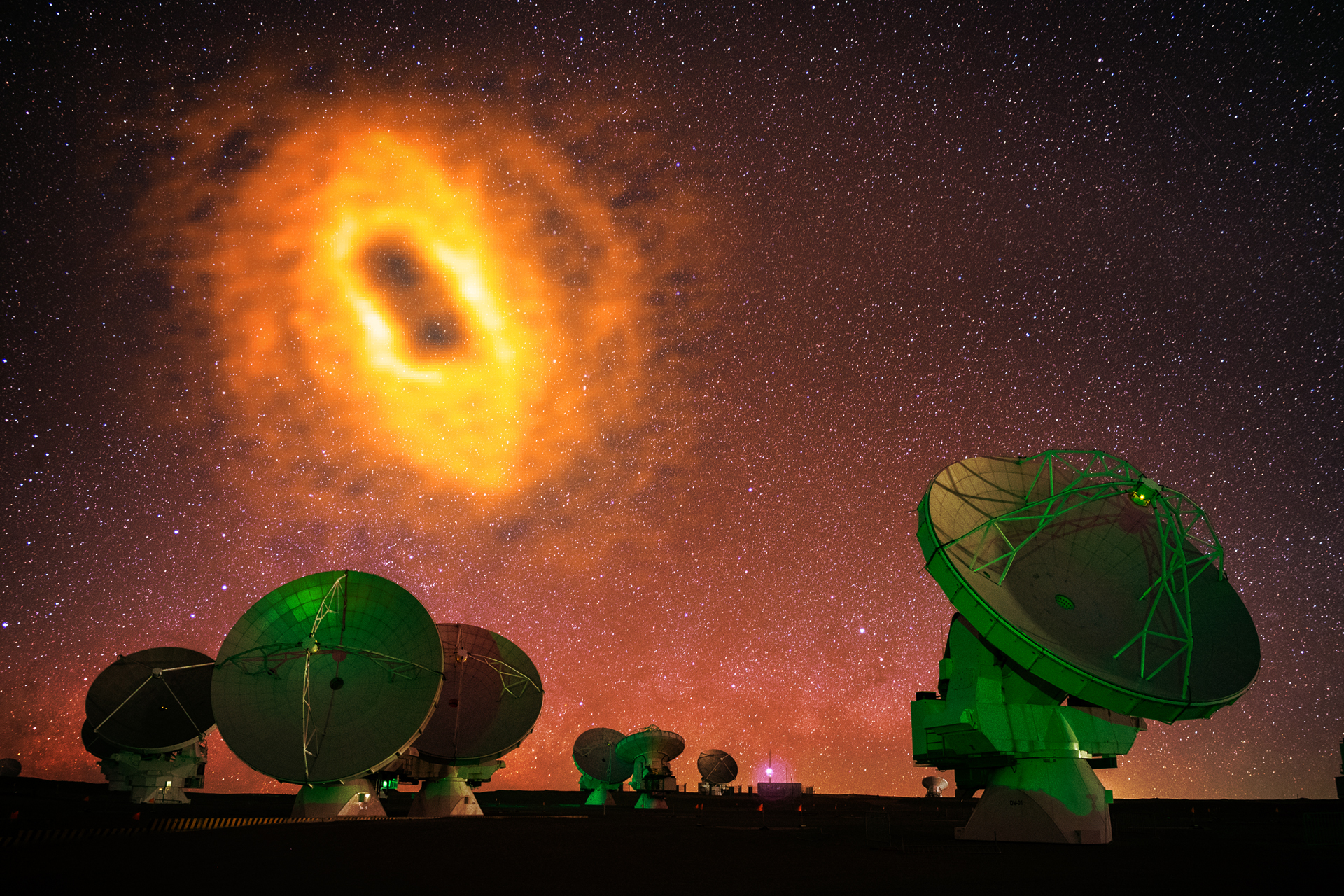
This image shows the central region of IRAS 06530-0213 that consists of a bipolar nebula surrounded by filamentary arcs, as seen by ALMA (Sahai et al. 2026). This composite image features astrophotography by Bettymaya Foott, along with the detailed radio data. Image credit: IRAS 06530-0213: ALMA (ESO/NAOJ/NRAO); Sahai et al. (2026). Astrophotography: NSF/AUI/NSF NRAO/B.Foott. Composite: NSF/AUI/NSF NRAO/M.Weiss
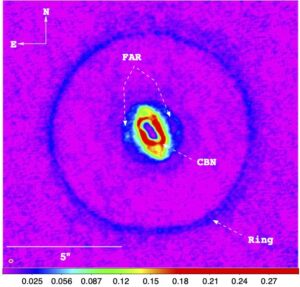
ALMA image of IRAS 06530-0213, revealing a giant ring of molecular gas surrounding a young, hourglass-shaped nebula. The outer ring is thought to be the remnant of the star’s last thermal pulse, while the inner structures trace its more recent mass-loss history. Credit: ALMA (ESO/NAOJ/NRAO); Sahai et al. (2026)
A giant ring of gas and a missing disk are changing how astronomers think about the last chapter of a Sun-like star’s life
ALMA image of IRAS 06530-0213, revealing a giant ring of molecular gas surrounding a young, hourglass-shaped nebula. The outer ring is thought to be the remnant of the star’s last thermal pulse, while the inner structures trace its more recent mass-loss history. Credit: ALMA (ESO/NAOJ/NRAO); Sahai et al. (2026)
Stars like our Sun don’t die quietly. In their final act, they swell into red giants, shed their outer layers into space, and leave behind a glowing, often strikingly sculpted cloud of gas called a planetary nebula. That transformation is thought to take only a few thousand years, a blink in the life of a star, so catching one in the act is rare.
Using the Atacama Large Millimeter/submillimeter Array (ALMA), a team led by astronomers at NASA’s Jet Propulsion Laboratory has done just that. Their new images of a star called IRAS 06530-0213, about 12,000 light-years away in the constellation Monoceros, reveal a giant ring of gas that appears to be a frozen fossil of the star’s last thermonuclear flare-up, encircling an hourglass-shaped nebula that is only now taking shape.
“Most of us think of stars as unchanging points of light, but this is a real-time snapshot of a star’s death throes,” said Raghvendra Sahai, senior research scientist at JPL and lead author of the study, which has been published in The Astrophysical Journal. “It’s the brief, violent transition between a bloated red giant and a glowing planetary nebula, frozen mid-action.”
A Heartbeat Frozen in Gas
Late in life, a star like this one burns hydrogen and helium in shells around its core. Every so often, that helium shell flares up in what astronomers call a thermal pulse, a brief burst of nuclear burning that jolts the star and flings material into space. Theorists have long predicted that such pulses leave behind shells of gas, and similar shells have been spotted around other aging stars. But no one had seen one around a star that had already begun its final transformation.
In IRAS 06530, ALMA found a thin, spherical shell of gas that looks like a ring about half a light-year across in the sky. Measuring how fast the gas is moving outward, the team estimates the shell was blown off about 6,500 years ago. This is the first direct evidence of the last thermal pulse before a star of this type enters its final phase, the team says.
“It’s essentially a physical snapshot of an event that, until now, we’ve mostly inferred from theoretical models,” said Sahai. “We’ve caught, for the first time, a star’s final nuclear heartbeat, frozen in gas.”
A Star in the Middle of a Dramatic Transition
The new images tell the story of what came next. After the pulse, the star’s mass loss dropped off for roughly 2,000 years. Then over the next ~1,000 years, mass loss rose sharply again, with the star shedding a thick, lumpy shell of gas, now seen as a tangle of curved filaments surrounding the star. Inside that, the star has begun to carve out a bipolar (hourglass-shaped) nebula and a dense doughnut of gas around its middle. By the team’s estimate, these youngest structures formed within just the last 700 years or so, which means the star crossed over from its red-giant phase very recently, in astronomical terms.
The star’s final tens of thousands of years of mass loss have also left a fingerprint: the curved filaments appear to form part of a spiral pattern. Spirals like this are usually attributed to an unseen companion star orbiting the dying one, a stellar dance partner stirring the outflowing gas as it goes.
Strange Chemistry, and a Missing Disk
Two results complicate the picture.
First, the gas has an unusual isotopic fingerprint. Isotopes are versions of an element with slightly different weights. In the dense gas near the star, the team found more than expected of the rare, heavy forms of carbon, oxygen, and nitrogen. This pattern doesn’t match standard models of how stars like this make and mix their elements. Similar fingerprints have been seen in a few other odd objects, and some researchers have proposed that bursts of explosive nuclear burning might be responsible.
Second, the astronomers did not find what they expected near the star. Other dying stars known to have companions typically sit inside a compact disk of dust, like a miniature version of the disks that form planets. Such disks are indirect evidence of ongoing mass transfer/accretion from a close companion, which is the mechanism usually invoked to explain jet-sculpted hourglass shapes. ALMA sees no such disk around IRAS 06530. Any disk there would be more than 50 times fainter than those seen around well-known cases such as the Red Rectangle. One possibility is that a disk existed briefly, powered a short burst of high-speed jets that helped sculpt the hourglass, and then faded away.
“Dying stars so often have hidden companions that reshape their ejected material into intricate, bipolar or multipolar forms instead of simple spheres,” said Sahai. “IRAS 06530 shows that the story is more complicated than the tidy explanation we’ve been using.”
Part of a Larger Survey
The observations are part of PANORAMA, an ALMA survey of dying stars that are transitioning to planetary nebulae, designed to map the outflows and the structures near each star in unprecedented detail. IRAS 06530 is the first object from the survey to be presented in detail.
About NRAO
The National Radio Astronomy Observatory (NRAO) is a facility of the U.S. National Science Foundation, operated under cooperative agreement by Associated Universities, Inc.
About ALMA
The Atacama Large Millimeter/submillimeter Array (ALMA), an international astronomy facility, is a partnership of the European Southern Observatory (ESO), the U.S. National Science Foundation (NSF) and the National Institutes of Natural Sciences (NINS) of Japan in cooperation with the Republic of Chile. ALMA is funded by ESO on behalf of its Member States, by NSF in cooperation with the National Research Council of Canada (NRC) and the National Science and Technology Council (NSTC) in Taiwan and by NINS in cooperation with the Academia Sinica (AS) in Taiwan and the Korea Astronomy and Space Science Institute (KASI).
ALMA construction and operations are led by ESO on behalf of its Member States; by the National Radio Astronomy Observatory (NRAO), managed by Associated Universities, Inc. (AUI), on behalf of North America; and by the National Astronomical Observatory of Japan (NAOJ) on behalf of East Asia. The Joint ALMA Observatory (JAO) provides the unified leadership and management of the construction, commissioning and operation of ALMA.
This news article was originally published on the NRAO website on November 20, 2026.


Recent News
10 Questions: Melissa Carrillo
Meet Melissa Carrillo, a beamline and research scientist at the Industrial Macromolecular Crystallography Association Collaborative Access Team (IMCA-CAT), located at Sector 17-ID of the Advanced Photon Source (APS) at Argonne National Laboratory.
Astronomers Track a Flaring Dwarf-Star Duo with Exceptional Precision
Astronomers have measured the orbit, masses, and distance of a pair of small, active stars with extraordinary precision, using the U.S. National Science Foundation’s Very Long Baseline Array (NSF VLBA), operated by the U.S. National Science Foundation National Radio Astronomy Observatory (NSF NRAO).
What Lurks Within the Shadows of Betelgeuse?
A new study using the U.S. National Science Foundation’s Very Large Array and the Atacama Large Millimeter/submillimeter Array shows compelling new evidence that Betelgeuse’s atmosphere is being actively perturbed by the aforementioned close-in stellar companion.