Carlstrom will present his talk: “What Do We Know About The Big Bang?” to the public on three dates, along with a recording that will be shared on the NSF NRAO’s YouTube channel.
Recent News
10 Questions: Desmond Wysenyuy
Meet Desmond Wysenyuy, program coordinator for the North American Regional Office of Astronomy for Development.
Cosmic Cocktail: Exotic Methanol Discovered in Planet-Building Zones
New results from the ALMA COMPASS Large Program (Complex Organic Molecules in Protostars with ALMA Spectral Surveys) show that young, still-forming stars are surrounded by a surprisingly sophisticated “chemical starter kit”, including organic molecules such as methanol that may one day enrich planets.
AUI to Attend AAS 247 Conference
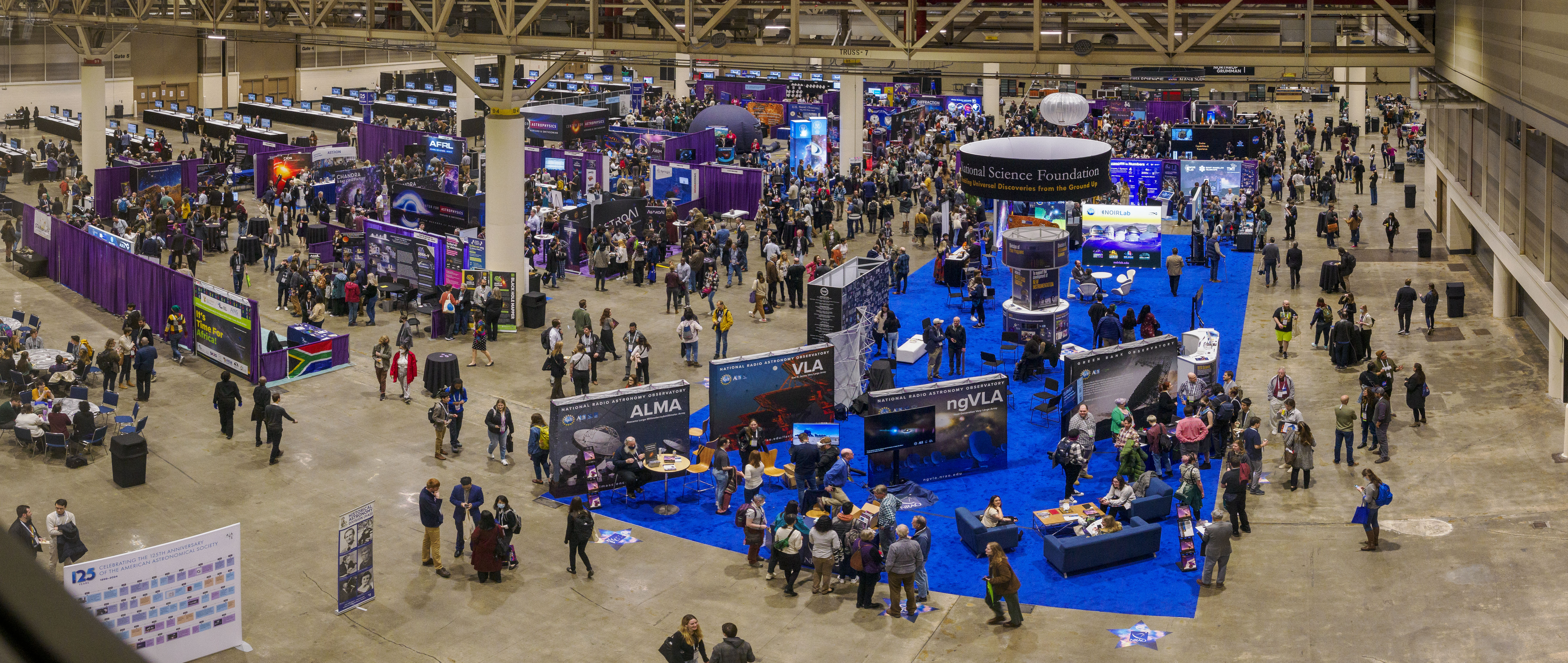
Image credit: NSF/ AUI/ NRAO
AUI will attend the 247th meeting of the American Astronomical Society (AAS) in Pheonix from Jan. 4-8, 2026. Staff will deliver five presentations. The full schedule is as follows:
Monday, January 5, 2026 | 9-10 AM MT
Title: Joining ASTRO ACCEL: A Global Network Accelerating Research and Practice in Astronomy Education, Engagement, Communications, and Culture
Type: iPoster
Location:
Phoenix Convention Center, Exhibit Hall B/C/D
Phoenix Convention Center, Exhibit Hall B/C/D
Monday, January 5, 2026 | 10-10:20 AM MT
Title: The North American Regional Office of Astronomy for Development: Reflections on Its First Five Years
Type: Historical Astronomy Division (HAD)
Location: Phoenix Convention Center, 221 B
Monday, January 5, 2026 | 2:30-2:40 PM MT
Title: Cosmovisions International Network (CIN)
Type: Oral
Location: Phoenix Convention Center, 227 B
Thursday, January 8, 2026 | 9-10 AM MT
Poster Title: Change Agents Connecting Through ACEAP
Type: iPoster
Location: Phoenix Convention Center, Exhibit Hall B/C/D
Thursday, January 8, 2026 | 9-10 AM MT
Poster Title: Traceable Impacts of the 2024/2025 Astronomy in Chile Educator Ambassador Program (ACEAP)
Type: iPoster
Location: Phoenix Convention Center, Exhibit Hall B/C/D
Please note: locations and times are subject to change. Refer to the official AAS block schedule for the latest information.
Conference attendees are encouraged to visit the AUI booth (415) in the exhibit hall to learn about the latest discoveries and initiatives at AUI and its managed facilities.
AUI is a proud sponsor of the 247th AAS meeting.


Recent News
Professor John E. Carlstrom Delivers 2026 NSF NRAO Jansky Lectures
Carlstrom will present his talk: “What Do We Know About The Big Bang?” to the public on three dates, along with a recording that will be shared on the NSF NRAO’s YouTube channel.
10 Questions: Desmond Wysenyuy
Meet Desmond Wysenyuy, program coordinator for the North American Regional Office of Astronomy for Development.
Cosmic Cocktail: Exotic Methanol Discovered in Planet-Building Zones
New results from the ALMA COMPASS Large Program (Complex Organic Molecules in Protostars with ALMA Spectral Surveys) show that young, still-forming stars are surrounded by a surprisingly sophisticated “chemical starter kit”, including organic molecules such as methanol that may one day enrich planets.