
Scheduled for April 18, the workshop offers participants the rare opportunity to capture stunning images of the cosmos from one of the world’s most remarkable and bespoke astronomical settings.
Recent News
NSF NRAO to Host Spring 2026 VLA Open House
The U.S. National Science Foundation National Radio Astronomy Observatory (NSF NRAO) invites the public to the U.S. National Science Foundation Very Large Array (NSF VLA) for its annual Spring Open House on Saturday, April 18, 2026, from 9:00 a.m. to 4:00 p.m.
ALMA Detects Extremely Abundant Alcohol in Interstellar Comet 3I/ATLAS
New research reveals that 3I/ATLAS is packed with an unusually large amount of the organic molecule methanol – more than almost all known comets in our own solar system.
ALMA Helps Unmask Monster Black Hole Behind Record-Breaking Cosmic Burst
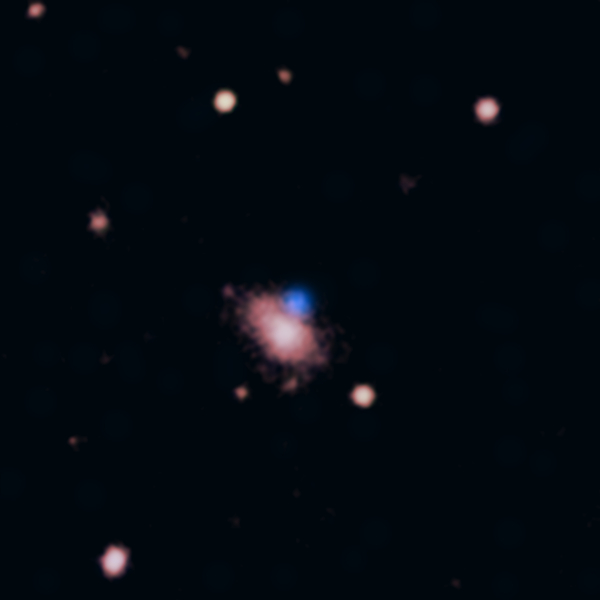
This composite image features X-ray and optical data of a so-called luminous fast blue optical transient (LFBOT) named AT 2024wpp. LFBOTs are a class of object involving bright flashes of blue and ultraviolet light that gradually fade away, leaving behind faint X-ray and radio signals. The X-ray data from NASA’s Chandra X-ray Observatory shows AT 2024wpp as a blue point source within its host galaxy, seen in optical data from the Legacy Survey (red and white). As the brightest LFBOT ever seen, AT 2024wpp is easily detected despite being about 1.1 billion light-years from Earth. Image credit: X-ray: NASA/CXC/UC Berkeley/Nayana A.J et al.; Optical: Legacy Survey/DECaLS/BASS/MzLS; Image Processing: NASA/CXC/SAO/P. Edmonds and N. Wolk
Astronomers have used the Atacama Large Millimeter/submillimeter Array (ALMA), of which the U.S. National Science Foundation National Radio Astronomy Observatory (NSF NRAO) in a partner, together with a suite of space- and ground-based telescopes, to study AT 2024wpp, the most luminous fast blue optical transient (LFBOT) ever observed. These rare, brief, and intensely bright blue outbursts have puzzled researchers for a decade, but the extreme brightness and detailed multiwavelength data from AT 2024wpp show that they cannot be explained by any kind of normal stellar explosion such as a supernova.
Instead, the new observations indicate that AT 2024wpp was powered by an extreme tidal disruption event in which a black hole up to about 100 times the mass of the Sun tore apart a massive companion star in a matter of days, converting an extraordinary fraction of the star’s mass into energy. As the disrupted stellar debris crashed into material the black hole had previously stripped and stored in its surroundings, it produced intense blue, ultraviolet, X-ray, and radio emission, with jets launched at roughly 40 percent of the speed of light. This result offers a new way to probe how intermediate-mass black holes grow and interact with nearby massive stars in actively star-forming galaxies.
ALMA’s sensitive millimeter observations, together with data from facilities such as NASA’s Chandra X-ray Observatory and CSIRO’s Australia Telescope Compact Array, were crucial for tracing the fast jets and surrounding gas, helping to distinguish this tidal disruption scenario from competing models. By bringing together data from telescopes and partner observatories around the world, the AT 2024wpp campaign demonstrates how coordinated, rapid-response observations can unravel the physics behind the brightest and most fleeting explosions in the universe.
This information was adapted from news shared by UC Berkley and the Chandra X-ray Center.
This news article was originally published on the NRAO website on December 16, 2025.


Recent News
Astrophotography Workshop Announced at Iconic Very Large Array
Scheduled for April 18, the workshop offers participants the rare opportunity to capture stunning images of the cosmos from one of the world’s most remarkable and bespoke astronomical settings.
NSF NRAO to Host Spring 2026 VLA Open House
The U.S. National Science Foundation National Radio Astronomy Observatory (NSF NRAO) invites the public to the U.S. National Science Foundation Very Large Array (NSF VLA) for its annual Spring Open House on Saturday, April 18, 2026, from 9:00 a.m. to 4:00 p.m.
ALMA Detects Extremely Abundant Alcohol in Interstellar Comet 3I/ATLAS
New research reveals that 3I/ATLAS is packed with an unusually large amount of the organic molecule methanol – more than almost all known comets in our own solar system.