
To celebrate the Inspiration4 Mission’s 5th Anniversary, mission pilot Dr. Sian Proctor is choosing to celebrate in a fitting way — raising funds to send community college students and faculty to Space Camp.
NSF National Radio Astronomy Observatory and Mexican Institutions Sign Historic Agreements to Advance ngVLA Collaboration
Recent News
10 Questions: Judelyn Padgett
Meet Judelyn Padgett, a project manager at AUI headquarters.
NA-ROAD Announces the 2026 Women and Girls in Astronomy Program Cohort
The Women and Girls in Astronomy Program (WGAP), led by Associated Universities, Inc. (AUI), under the North American Regional Office of Astronomy for Development (NA-ROAD), is proud to announce the selection of ten regional projects to receive funding through the 2026 cycle.
NSF National Radio Astronomy Observatory and Mexican Institutions Sign Historic Agreements to Advance ngVLA Collaboration
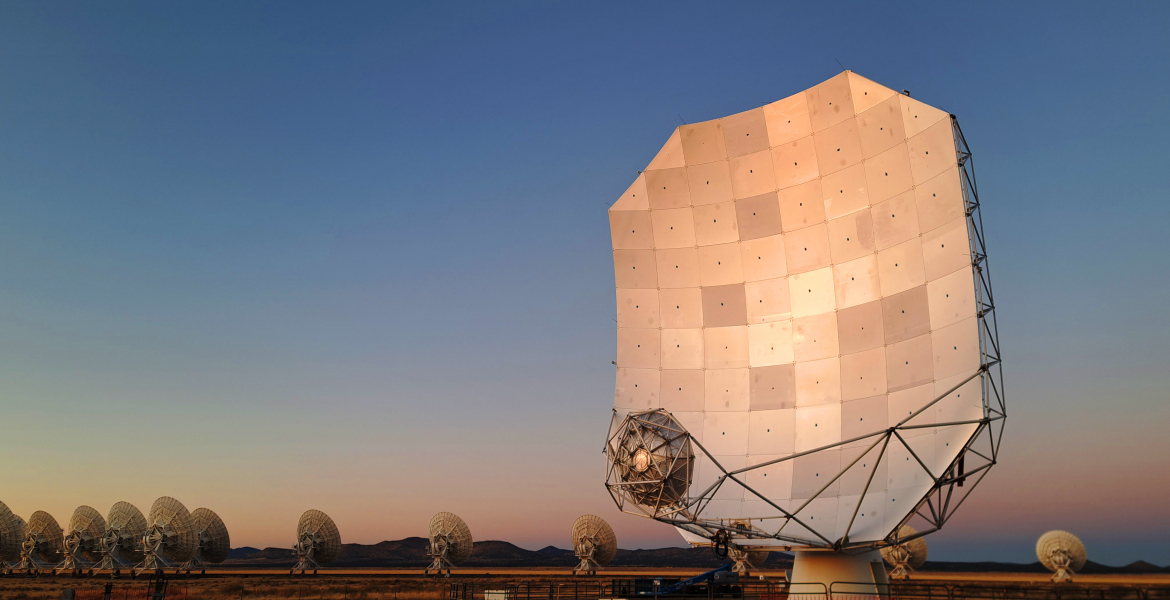
The ngVLA Prototype at the VLA site in New Mexico. Photo credit: NSF/AUI/NSF NRAO
The U.S. National Science Foundation National Radio Astronomy Observatory (NSF NRAO), in partnership with several leading Mexican universities and research institutes, has announced a series of landmark agreements and meetings aimed at advancing Mexico’s role in the Next Generation Very Large Array (ngVLA) project. This represents a significant step in strengthening international collaboration for one of the world’s most ambitious astronomical observatories.
Over the past months, directors and senior scientists from the Institute of Radio Astronomy and Astrophysics (IRyA), the Institute of Astronomy (IA) at the National Autonomous University of Mexico (UNAM), the National Institute of Astrophysics, Optics and Electronics (INAOE), the Autonomous University of Chihuahua (UACH), the University of Sonora (UNISON), and the NSF NRAO have met with Mexican and U.S. authorities to chart a course for deepening scientific collaboration on the ngVLA.
Key meetings included a discussion with UNAM’s Rector, Dr. Leonardo Lomelí Vanegas, underscoring UNAM’s commitment to expanding its leadership in radio astronomy, along with strategic engagement with officials from the U.S. Embassy in Mexico, reinforcing cross-border scientific ties. There have also been consultations with the Mexican Secretariat of Science, Humanities, Technology and Innovation (SECIHTI), highlighting governmental support for this binational initiative.
Concurrently, representatives from the participating Mexican institutions convened to formalize the creation of the Consortium of Mexican Universities and Institutions. This consortium, led by the IRyA Director, Dr. Luis A. Zapata, is dedicated to supporting, promoting, and strengthening Mexico’s national participation in the ngVLA project, working in close partnership with the NSF NRAO.
During a binational event hosted at UNAM’s Institute of Astronomy on September 18, 2025, a Letter of Intent was signed by directors and representatives from IRyA, IA-UNAM, INAOE, UACH, UNISON, and the NSF NRAO. The signatories declared their, “interest and commitment to establish a Consortium of Mexican Universities and Institutions. The purpose of this Consortium is to support, promote, and strengthen national participation in the Next Generation Very Large Array (ngVLA) project, in close collaboration with the U.S. National Science Foundation National Radio Astronomy Observatory (NSF NRAO) of the United States of America”.
Tony Beasley, Director of NSF NRAO, stated, “These agreements and the formation of a national consortium mark a new era of partnership between our institutions and communities. The ngVLA will be a transformative instrument for radio astronomy worldwide, and these collaborations will ensure that Mexican scientists, engineers, and students are at the heart of new discoveries for decades to come.”
Luis A. Zapata, Director of the IRyA–UNAM, mentioned, “We have a long tradition of collaboration with our colleagues at the NSF NRAO, and this new initiative will open a new window to further expand our joint efforts in developing state-of-the-art astronomical technology in Mexico.”
The ngVLA will consist of more than 240 antennas across the United States (primarily in the Southwest) and Mexico, delivering unprecedented sensitivity and resolution across the radio spectrum. With its foundation built on partnerships such as this, the project is poised to deliver new insight into the universe, foster training opportunities for the next generation of scientists, and strengthen technological innovation across North America.
About NRAO
The National Radio Astronomy Observatory is a major facility of the U.S. National Science Foundation, operated under cooperative agreement by Associated Universities, Inc.
This news article was originally published on the NRAO website on November 14, 2025.


Recent News
Proctor Foundation for Art and Science Offers Stellar Guitar to Space Camp Auction
To celebrate the Inspiration4 Mission’s 5th Anniversary, mission pilot Dr. Sian Proctor is choosing to celebrate in a fitting way — raising funds to send community college students and faculty to Space Camp.
10 Questions: Judelyn Padgett
Meet Judelyn Padgett, a project manager at AUI headquarters.
NA-ROAD Announces the 2026 Women and Girls in Astronomy Program Cohort
The Women and Girls in Astronomy Program (WGAP), led by Associated Universities, Inc. (AUI), under the North American Regional Office of Astronomy for Development (NA-ROAD), is proud to announce the selection of ten regional projects to receive funding through the 2026 cycle.