
A new study connects the black hole’s famous ring of light to a compact region that marks the likely base of the jet, bringing scientists closer to understanding how black holes power some of the brightest beacons in the universe.
Recent News
Magnetic Superhighways Discovered in a Starburst Galaxy’s Winds
Using the Atacama Large Millimeter/submillimeter Array (ALMA), an international team of astronomers has mapped a magnetic highway driving a powerful galactic wind into the nearby galaxy merger of Arp 220, revealing for the first time that its fast, molecular outflows are strongly magnetized and likely helping to drive metals, dust, and cosmic rays into the space around the galaxy.
Making Scientific Breakthroughs Possible in 2025
2025 was an incredibly productive year for AUI, marked by significant advances across astronomy, energy, advanced therapeutics, and STEM education and workforce development.
Groundbreaking Magnetic Field Discovery Near Massive Protostar
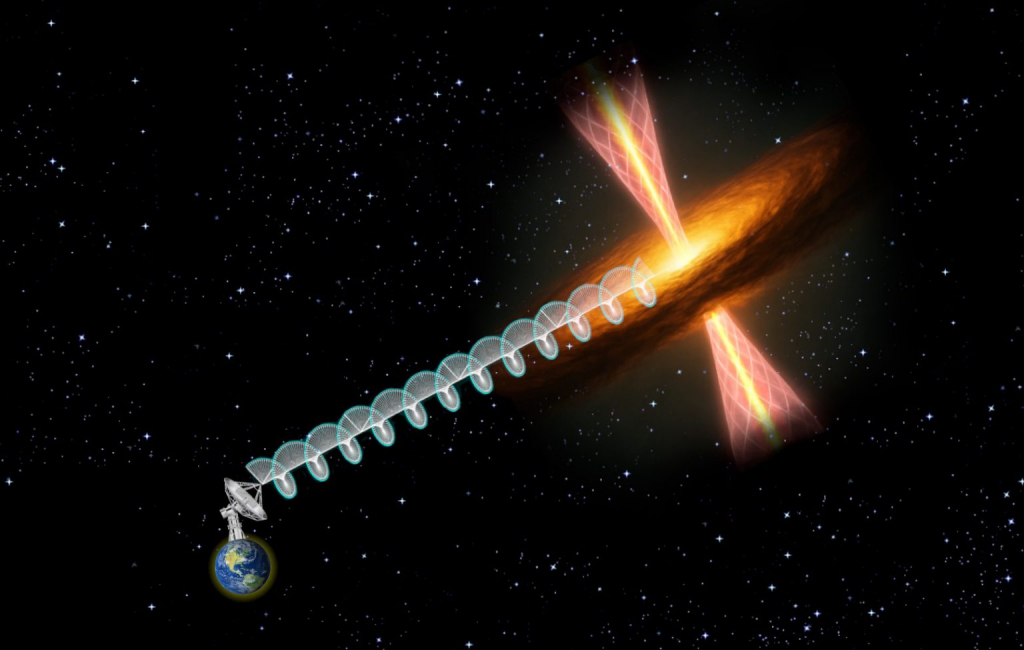
Schematic of circular polarization being detected in radio waves from a massive protostar surrounded by a disk and driving a bipolar jet. This is an artistic image, not drawn to scale. Credit: AG Cheriyan/IIST
The U.S. National Science Foundation National Radio Astronomy Observatory (NSF NRAO) proudly announces a major breakthrough in our understanding of star formation, thanks to the unparalleled capabilities of the U.S. National Science Foundation Karl G. Jansky Very Large Array (NSF VLA). An international team, led by astronomers from the Indian Institute of Space Science and Technology (IIST) and the Indian Institute of Science (IISc), has for the first time detected circular polarization in radio emission originating from a massive protostar, IRAS 18162-2048—unveiling fresh clues about the cosmic forces shaping our universe.
Circularly polarized radio waves have been directly observed from a young, massive protostar, a phenomenon previously recorded only near black holes and low-mass protostars, demonstrating a new link between diverse cosmic environments. This rare signal, detected using the NSF VLA, has enabled astronomers to infer magnetic field strengths of about 20–35 Gauss close to the forming star. These values are roughly 100 times stronger than Earth’s magnetic field—providing the first direct clues to magnetic field strengths in such extreme environments. The findings reinforce a long-standing theory that the mechanisms launching powerful astrophysical jets are fundamentally similar, from low-mass stars through to supermassive black holes.
NSF NRAO is honored to contribute this critical technology and support to discoveries that deepen humanity’s knowledge of the cosmos. Read the full releases from IIST and IISc.
About NRAO
The National Radio Astronomy Observatory (NRAO) is a facility of the U.S. National Science Foundation, operated under cooperative agreement by Associated Universities, Inc.
This news article was originally published on the NRAO website on July 18, 2025.


Recent News
New Event Horizon Telescope Results Trace M87 Jet Back to Its Black Hole
A new study connects the black hole’s famous ring of light to a compact region that marks the likely base of the jet, bringing scientists closer to understanding how black holes power some of the brightest beacons in the universe.
Magnetic Superhighways Discovered in a Starburst Galaxy’s Winds
Using the Atacama Large Millimeter/submillimeter Array (ALMA), an international team of astronomers has mapped a magnetic highway driving a powerful galactic wind into the nearby galaxy merger of Arp 220, revealing for the first time that its fast, molecular outflows are strongly magnetized and likely helping to drive metals, dust, and cosmic rays into the space around the galaxy.
Making Scientific Breakthroughs Possible in 2025
2025 was an incredibly productive year for AUI, marked by significant advances across astronomy, energy, advanced therapeutics, and STEM education and workforce development.