
News Releases

NA-ROAD Announces the 2026 Women and Girls in Astronomy Program Cohort
The Women and Girls in Astronomy Program (WGAP), led by Associated Universities, Inc. (AUI), under the North American Regional Office of Astronomy for Development (NA-ROAD), is proud to announce the selection of ten regional projects to receive funding through the 2026 cycle.
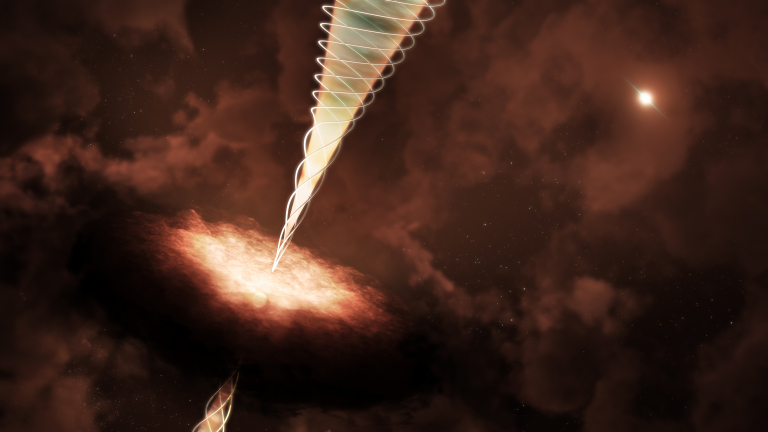
Twisted Physics: Astronomers Solve 30-Year-Old Stellar Mystery
Astronomers using the Atacama Large Millimeter/submillimeter Array (ALMA) have captured the first direct, high-resolution images of a magnetic field wrapped tightly around the outflow of gas streaming away from a forming star — evidence that solves a decades-old puzzle about how young stars sculpt the powerful jets that form them.
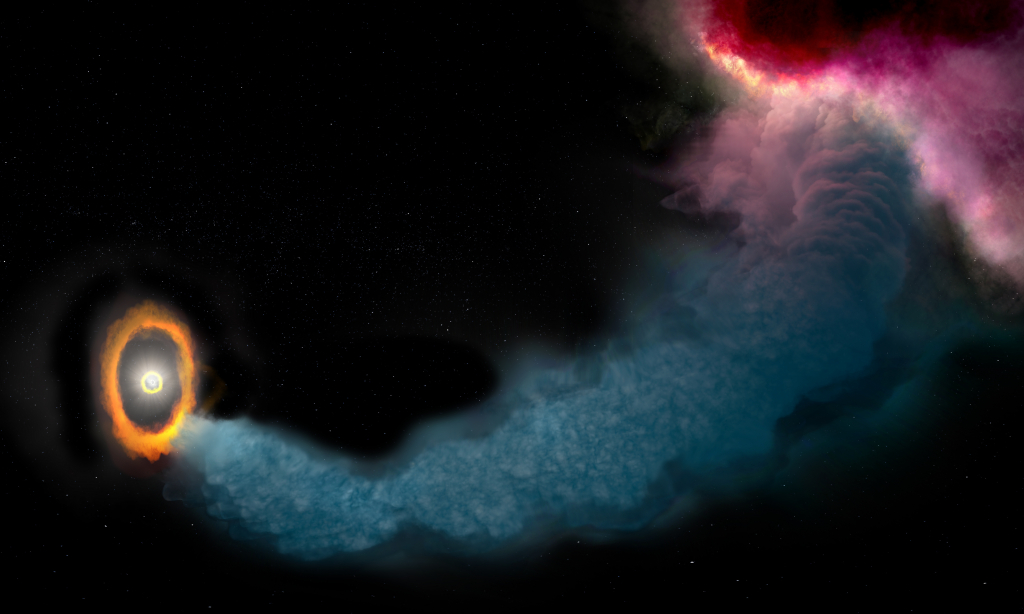
A Trillion Mile Cosmic Stream of Gas Feeds GW Orionis
A team of astronomers using the Atacama Large Millimeter/submillimeter Array (ALMA), of which the U.S. National Science Foundation National Radio Astronomy Observatory is a partner, has captured a massive stream of gas—one trillion miles, or .2 light years long—feeding the young triple-star system GW Orionis.
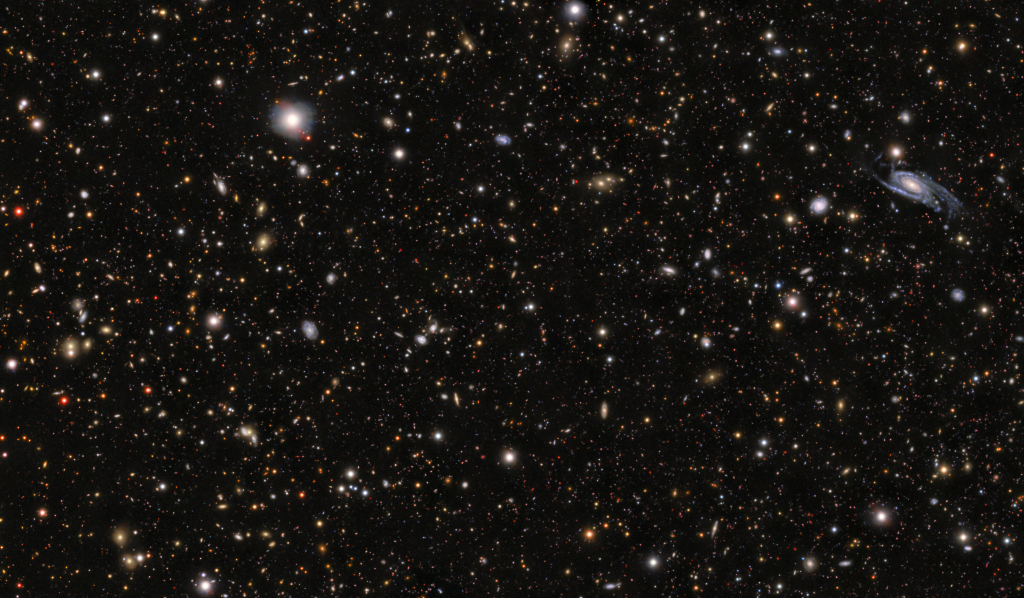
NSF NRAO radio observations help rule out a relativistic jet in rare stellar explosion
Astronomers studying a rare stellar explosion first spotted as a brief burst of X-rays used radio observations to help show that the dying star did not produce the powerful jet often associated with gamma-ray bursts.
AUI by the Numbers
75+
Years of Experience in Managing
Federally Funded Research and
Development Centers (FFRDCs)
30
Active Research Patents
1,130+
Doctoral Dissertations Supported by
National Radio Astronomy
Observatory Facilities
Highlights
- AUI is laying the groundwork to upgrade the U.S. National Science Foundation National Radio Astronomy Observatory’s Karl G. Jansky Very Large Array (VLA) to become the Next Generation Very Large Array (ngVLA).
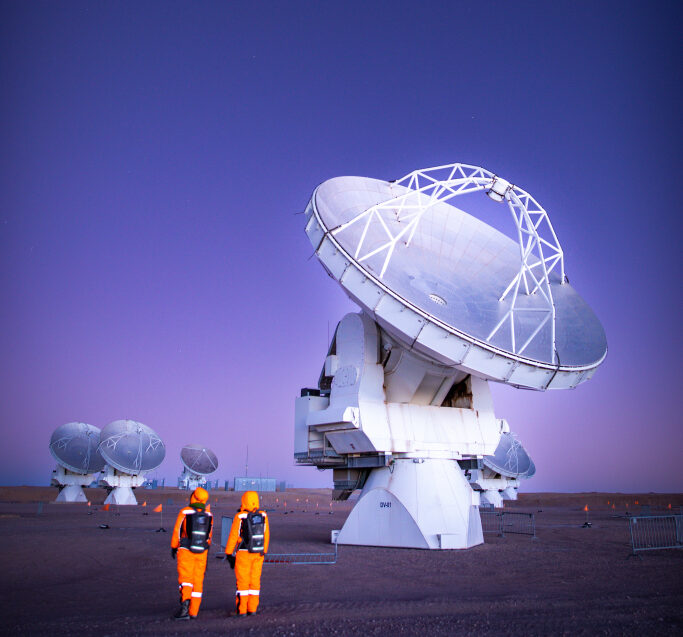
- AUI led efforts to create the $1.4-billion Atacama Large Millimeter/submillimeter Array (ALMA), the world’s largest radio telescope, as part of an international consortium.
- AUI has joined with LEAP Manufacturing in support of the UT-Dallas Batteries and Energy to Advance Commercialization and National Security (BEACONS) Center. Funded by a $30-million agreement by the U.S. Department of Defense, BEACONS will develop and commercialize new battery technologies and manufacturing processes, enhance the domestic availability of critical raw materials, and train high-quality workers for jobs in an expanding battery energy storage workforce.
- AUI maintains over a dozen STEM education and public engagement efforts and programs that seek to inspire people of all ages, and to prepare the next generation STEM workforce.
Leadership
Who We Are
AUI is an independent, not-for-profit corporation founded in 1946 that builds, manages and operates large research and development (R&D) facilities for the federal government, including the U.S. National Science Foundation’s National Radio Astronomy Observatory (NRAO) facilities, the Center for American Supply Chain Resilience (CASCR), and the AUI Center for Advancing Therapeutics. AUI also develops and implements innovative approaches to education, outreach and workforce development.
Media Contacts
Matt Schaub
Director of External Affairs and Strategic Communications
[email protected]
Please contact Matt Schaub for all media inquiries.
Kelsey Underwood
Digital Communications Specialist
[email protected]
Please contact Kelsey Underwood for logos and branding guidelines.