
Meet Desmond Wysenyuy, program coordinator for the North American Regional Office of Astronomy for Development.
Recent News
Cosmic Cocktail: Exotic Methanol Discovered in Planet-Building Zones
New results from the ALMA COMPASS Large Program (Complex Organic Molecules in Protostars with ALMA Spectral Surveys) show that young, still-forming stars are surrounded by a surprisingly sophisticated “chemical starter kit”, including organic molecules such as methanol that may one day enrich planets.
Proctor Foundation for Art and Science Offers Stellar Guitar to Space Camp Auction
To celebrate the Inspiration4 Mission’s 5th Anniversary, mission pilot Dr. Sian Proctor is choosing to celebrate in a fitting way — raising funds to send community college students and faculty to Space Camp.
Groundbreaking Magnetic Field Discovery Near Massive Protostar
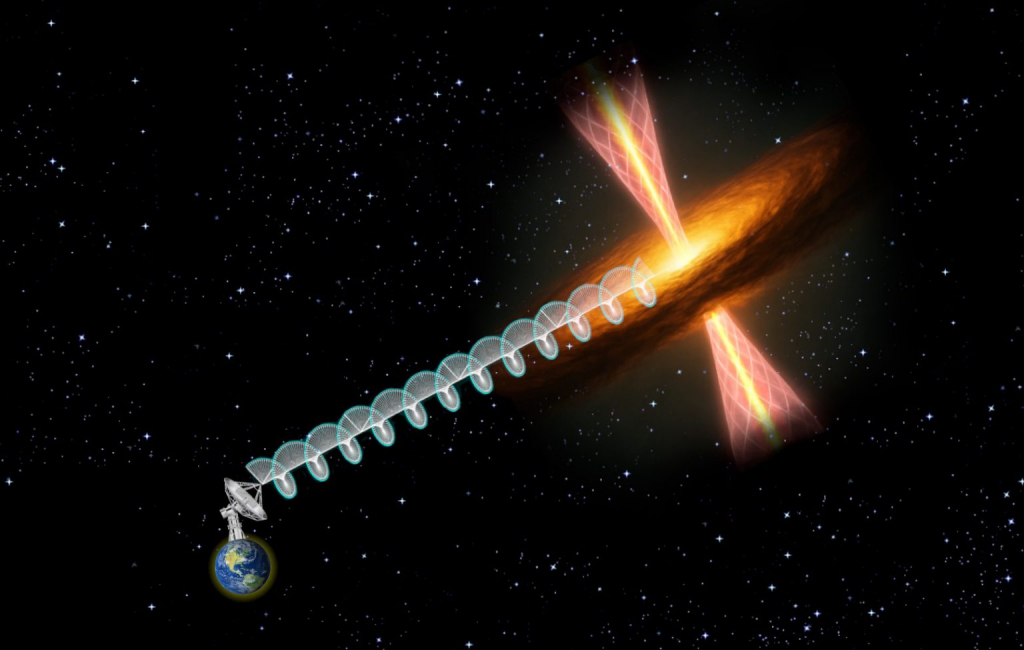
Schematic of circular polarization being detected in radio waves from a massive protostar surrounded by a disk and driving a bipolar jet. This is an artistic image, not drawn to scale. Credit: AG Cheriyan/IIST
The U.S. National Science Foundation National Radio Astronomy Observatory (NSF NRAO) proudly announces a major breakthrough in our understanding of star formation, thanks to the unparalleled capabilities of the U.S. National Science Foundation Karl G. Jansky Very Large Array (NSF VLA). An international team, led by astronomers from the Indian Institute of Space Science and Technology (IIST) and the Indian Institute of Science (IISc), has for the first time detected circular polarization in radio emission originating from a massive protostar, IRAS 18162-2048—unveiling fresh clues about the cosmic forces shaping our universe.
Circularly polarized radio waves have been directly observed from a young, massive protostar, a phenomenon previously recorded only near black holes and low-mass protostars, demonstrating a new link between diverse cosmic environments. This rare signal, detected using the NSF VLA, has enabled astronomers to infer magnetic field strengths of about 20–35 Gauss close to the forming star. These values are roughly 100 times stronger than Earth’s magnetic field—providing the first direct clues to magnetic field strengths in such extreme environments. The findings reinforce a long-standing theory that the mechanisms launching powerful astrophysical jets are fundamentally similar, from low-mass stars through to supermassive black holes.
NSF NRAO is honored to contribute this critical technology and support to discoveries that deepen humanity’s knowledge of the cosmos. Read the full releases from IIST and IISc.
About NRAO
The National Radio Astronomy Observatory (NRAO) is a facility of the U.S. National Science Foundation, operated under cooperative agreement by Associated Universities, Inc.
This news article was originally published on the NRAO website on July 18, 2025.


Recent News
10 Questions: Desmond Wysenyuy
Meet Desmond Wysenyuy, program coordinator for the North American Regional Office of Astronomy for Development.
Cosmic Cocktail: Exotic Methanol Discovered in Planet-Building Zones
New results from the ALMA COMPASS Large Program (Complex Organic Molecules in Protostars with ALMA Spectral Surveys) show that young, still-forming stars are surrounded by a surprisingly sophisticated “chemical starter kit”, including organic molecules such as methanol that may one day enrich planets.
Proctor Foundation for Art and Science Offers Stellar Guitar to Space Camp Auction
To celebrate the Inspiration4 Mission’s 5th Anniversary, mission pilot Dr. Sian Proctor is choosing to celebrate in a fitting way — raising funds to send community college students and faculty to Space Camp.