
Carlstrom will present his talk: “What Do We Know About The Big Bang?” to the public on three dates, along with a recording that will be shared on the NSF NRAO’s YouTube channel.
Recent News
10 Questions: Desmond Wysenyuy
Meet Desmond Wysenyuy, program coordinator for the North American Regional Office of Astronomy for Development.
Cosmic Cocktail: Exotic Methanol Discovered in Planet-Building Zones
New results from the ALMA COMPASS Large Program (Complex Organic Molecules in Protostars with ALMA Spectral Surveys) show that young, still-forming stars are surrounded by a surprisingly sophisticated “chemical starter kit”, including organic molecules such as methanol that may one day enrich planets.
NSF Funds New Opportunity for Undergraduate Students
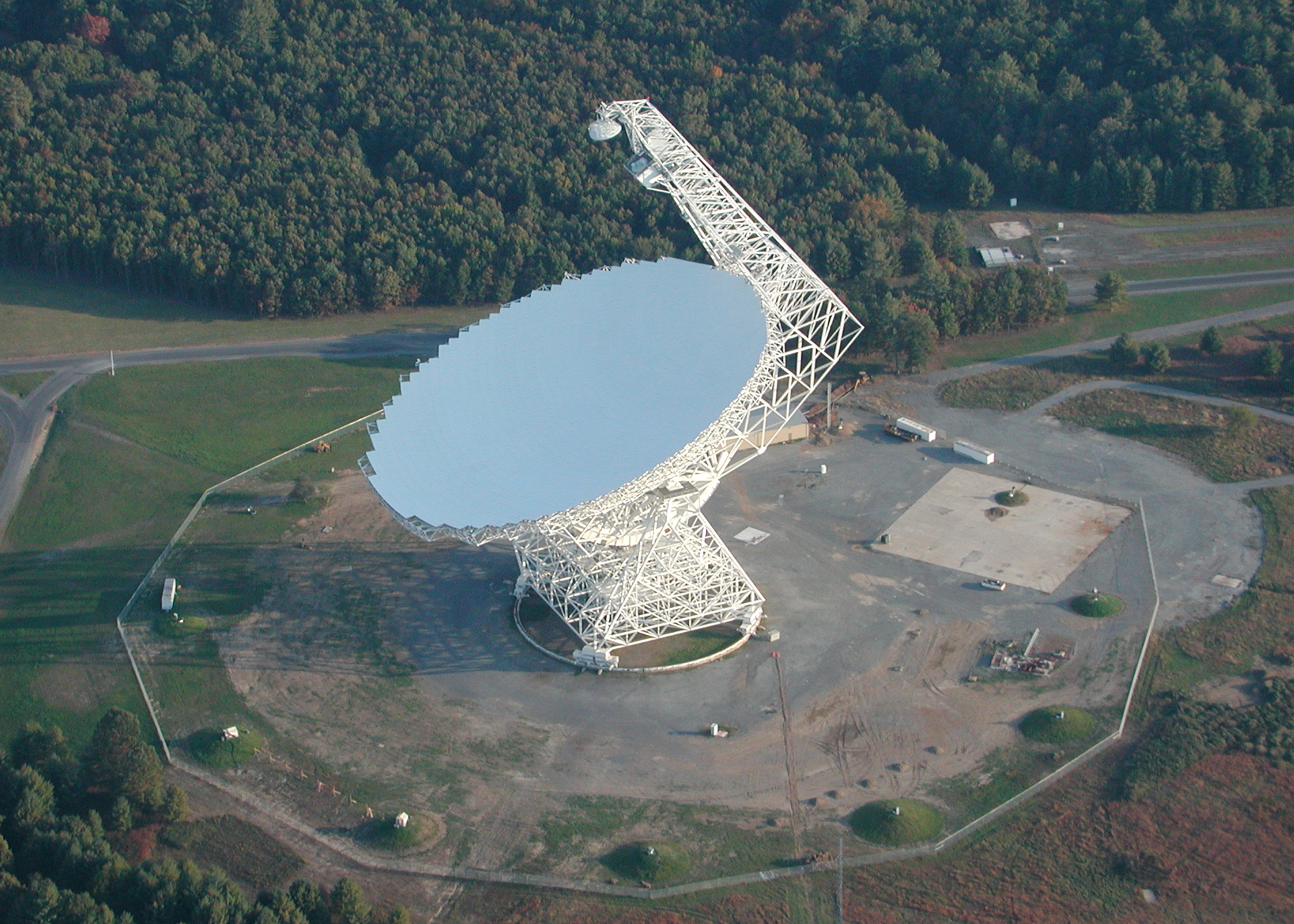
Green Bank Telescope. Credit: NRAO/AUI/NSF
Students to Research Impacts of New Astronomy Curriculum
AUI and the University of North Carolina Chapel Hill (UNC-Chapel Hill) are currently seeking undergraduate students to contribute to cutting-edge research in astronomy education. This paid opportunity, open to education and STEM majors, explores the impacts of new curriculum centered on the use of robotic telescopes, and is made possible through U.S. National Science Foundation funding. The program, consisting of approximately 360 primarily flexible workhours, runs from June 2024 through January 2025. This research experience is hybrid and features travel allowance for activities including an in-person field training at the Green Bank Observatory on June 9-15. Applications are due Sunday, May 5, 2024.
“Specifically, the research will focus on understanding how pedagogical methods and collaborative approaches impact student outcomes in astronomy education” said Dan Reichart, professor of physics and astronomy at the UNC-Chapel Hill and director of the Skynet Robotic Telescope Network. “What we are really looking for are students active in STEM or educational fields, with a strong academic record and interest in research. In turn, participants will have an opportunity to be mentored, work with an international team, travel to data collection sites and help present research findings at a professional conference.”
Travel will be funded through an allowance and the students will be supported with a $4,000 stipend.
“This is a wonderful introduction into education research,” said Tiffany Stone Wolbrecht, AUI’s interim director for education and public engagement. “The selected students will gain valuable experience in observational data analysis, research methods, collaborating on an international research team, and may even have the opportunity to publish outcomes beyond the program.”
The experience is part of a Research Experience for Undergraduate (REU) program and focuses on exploring STEM attitudes, self-efficacy and career intentions in introductory astronomy courses. The selected REU students will play a crucial role in investigating emerging trends in STEM education through a case study approach. They will collect observational and interview data, analyze existing survey data and collaborate with our research team to uncover insights into student learning experiences.
To apply, U.S. citizens and permanent residents that are currently enrolled in an undergraduate degree program should submit a current resume or CV, a statement of interest outlining their motivation for participating in the REU program and relevant experience (max 500 words), and preferably two letters of recommendation to Tiffany Stone Wolbrecht at [email protected].
We believe that diversity strengthens our research community and enriches the educational experience for everyone involved. We are committed to fostering an inclusive environment where all individuals, including women, people of color, LGBTQ+ individuals, individuals with disabilities, and first-generation college students feel welcome and valued. We actively encourage applications from students from these underrepresented groups.


Recent News
Professor John E. Carlstrom Delivers 2026 NSF NRAO Jansky Lectures
Carlstrom will present his talk: “What Do We Know About The Big Bang?” to the public on three dates, along with a recording that will be shared on the NSF NRAO’s YouTube channel.
10 Questions: Desmond Wysenyuy
Meet Desmond Wysenyuy, program coordinator for the North American Regional Office of Astronomy for Development.
Cosmic Cocktail: Exotic Methanol Discovered in Planet-Building Zones
New results from the ALMA COMPASS Large Program (Complex Organic Molecules in Protostars with ALMA Spectral Surveys) show that young, still-forming stars are surrounded by a surprisingly sophisticated “chemical starter kit”, including organic molecules such as methanol that may one day enrich planets.