Carlstrom will present his talk: “What Do We Know About The Big Bang?” to the public on three dates, along with a recording that will be shared on the NSF NRAO’s YouTube channel.
Recent News
10 Questions: Desmond Wysenyuy
Meet Desmond Wysenyuy, program coordinator for the North American Regional Office of Astronomy for Development.
Cosmic Cocktail: Exotic Methanol Discovered in Planet-Building Zones
New results from the ALMA COMPASS Large Program (Complex Organic Molecules in Protostars with ALMA Spectral Surveys) show that young, still-forming stars are surrounded by a surprisingly sophisticated “chemical starter kit”, including organic molecules such as methanol that may one day enrich planets.
Paul A. Vanden Bout awarded the 2023 Karl G. Jansky Lectureship
Credit: NRAO/AUI/NSF
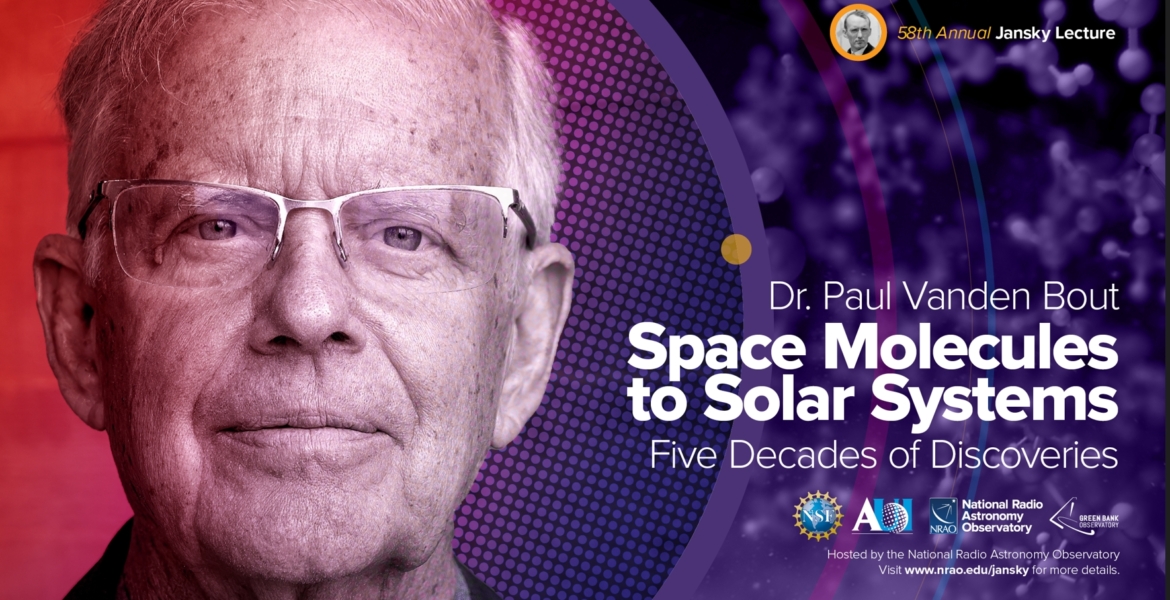
Associated Universities, Inc. (AUI) and the National Radio Astronomy Observatory (NRAO) have awarded the 2023 Karl G. Jansky Lectureship to Dr. Paul A. Vanden Bout, Senior Scientist, Emeritus at NRAO. The Jansky Lectureship is an honor established by the trustees of AUI to recognize outstanding contributions to the advancement of radio astronomy.
After earning his Ph.D. from the University of California, Berkeley, Dr. Vanden Bout pioneered work in millimeter-wavelength astronomy at McDonald Observatory. He was the Director of NRAO from 1985 to 2002, and oversaw the completion of the Very Long Baseline Array, Green Bank Telescope, Expanded Very Large Array, now the Jansky Very Large Array, and the start of the Atacama Large Millimeter/submillimeter Array (ALMA). He was Interim Director of ALMA from 2002 – 2003, and Interim Head of the North American ALMA Science Center from 2004 – 2005. ALMA is one of the largest astronomical projects in the world, a complex array of 66 radio telescopes located high in the Chilean desert. One of the biggest challenges was simply ensuring ALMA was successful. “Every big project has funding difficulties and touch-and-go situations. ALMA was no exception,” Dr. Vanden Bout said. Beyond his service as NRAO Director, Dr. Vanden Bout has published nearly 100 research articles. He is also the first author of “The ALMA Telescope: The Story of a Science Mega-Project,” published by Cambridge University Press in Fall 2023.
Dr. Vanden Bout will deliver his Jansky Lecture, entitled “Millimeter Astronomy at NRAO – Some Personal Remembrances, “ in Charlottesville, VA on Wednesday November 8; at the Green Bank Observatory in Green Bank, WV on Thursday November 9; and in Socorro, NM on Friday November 17. Learn more about these event times and locations.
First awarded in 1966, the Jansky Lectureship is named in honor of the man who, in 1932, first detected radio waves from a cosmic source. Karl Jansky’s discovery of radio waves from the central region of the Milky Way started the science of radio astronomy.
Other recipients of the Jansky award include eight Nobel laureates (Drs. Subrahmanyan Chandrasekhar, Edward Purcell, Charles Townes, Arno Penzias, Robert Wilson, William Fowler, Joseph Taylor, and Reinhard Genzel) as well as Jocelyn Bell-Burnell, discoverer of the first pulsar, and Vera Rubin, discoverer of dark matter in galaxies.
See a list of past recipients.
The National Radio Astronomy Observatory and the Green Bank Observatory are facilities of the National Science Foundation, operated under cooperative agreement by Associated Universities, Inc.
This news article was originally published on NRAO website on October 12, 2023.


Recent News
Professor John E. Carlstrom Delivers 2026 NSF NRAO Jansky Lectures
Carlstrom will present his talk: “What Do We Know About The Big Bang?” to the public on three dates, along with a recording that will be shared on the NSF NRAO’s YouTube channel.
10 Questions: Desmond Wysenyuy
Meet Desmond Wysenyuy, program coordinator for the North American Regional Office of Astronomy for Development.
Cosmic Cocktail: Exotic Methanol Discovered in Planet-Building Zones
New results from the ALMA COMPASS Large Program (Complex Organic Molecules in Protostars with ALMA Spectral Surveys) show that young, still-forming stars are surrounded by a surprisingly sophisticated “chemical starter kit”, including organic molecules such as methanol that may one day enrich planets.