
An inside look at unique careers in STEMIn each installment of our “10 Questions” blog series, readers will meet a staff member from AUI or one of its managed facilities, gaining insight into their career journey, what their role involves and what makes their work...
Recent News
Cosmic Cocktail: Exotic Methanol Discovered in Planet-Building Zones
New results from the ALMA COMPASS Large Program (Complex Organic Molecules in Protostars with ALMA Spectral Surveys) show that young, still-forming stars are surrounded by a surprisingly sophisticated “chemical starter kit”, including organic molecules such as methanol that may one day enrich planets.
Proctor Foundation for Art and Science Offers Stellar Guitar to Space Camp Auction
To celebrate the Inspiration4 Mission’s 5th Anniversary, mission pilot Dr. Sian Proctor is choosing to celebrate in a fitting way — raising funds to send community college students and faculty to Space Camp.
Unusual stellar nurseries near our galaxy’s center puzzle scientists
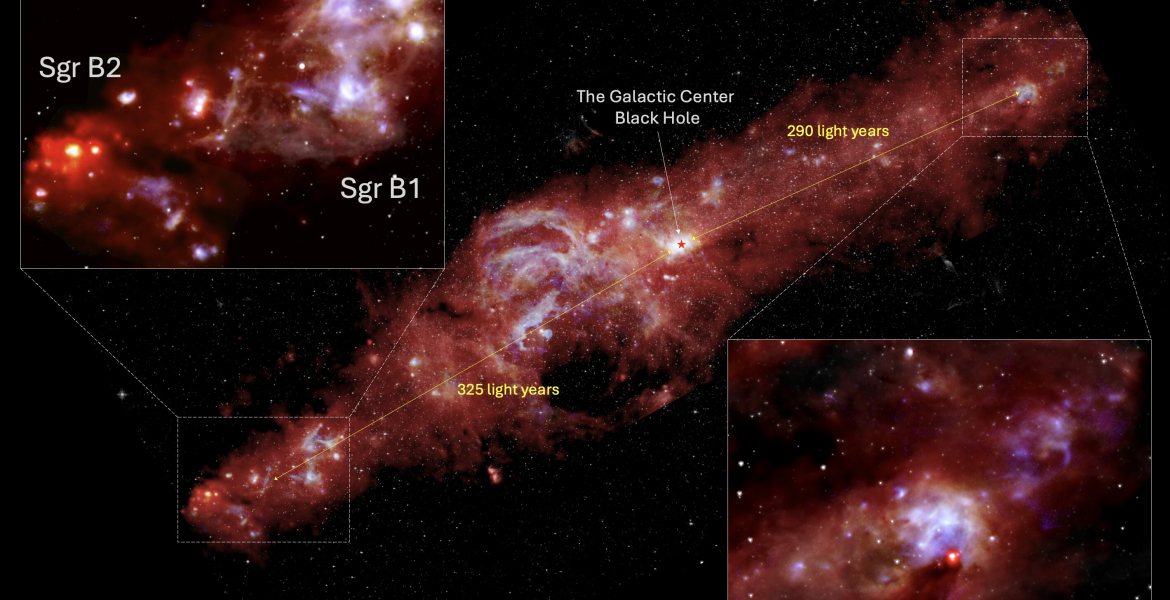
These images are made from data from the Stratospheric Observatory for Infrared Astronomy (SOFIA), the Spitzer Space Telescope, and the Herschel Space Observatory. Image credit: J. De Buizer (SETI) / SOFIA / Spitzer / Herschel
New research led by Dr. James De Buizer at the SETI Institute and Dr. Wanggi Lim at IPAC at Caltech revealed surprising results about the rate at which high-mass stars form in the galactic center of the Milky Way. The researchers based their study primarily on observations from NASA’s now-retired SOFIA airborne observatory, and using data from the U.S. National Science Foundation Very Large Array archive, and focuses on three star-forming regions—Sgr B1, Sgr B2, and Sgr C—located at the heart of the galaxy.
This science was presented at the 246th American Astronomical Society Conference in Anchorage, Alaska on Monday, June 9, 2025, 2:15 PM AK. You can read the full release from SETI.
About NRAO
The National Radio Astronomy Observatory (NRAO) is a facility of the U.S. National Science Foundation, operated under cooperative agreement by Associated Universities, Inc.
This news article was originally published on the NRAO website on June 13, 2025.


Recent News
10 Questions: Desmond Wysenyuy
An inside look at unique careers in STEMIn each installment of our “10 Questions” blog series, readers will meet a staff member from AUI or one of its managed facilities, gaining insight into their career journey, what their role involves and what makes their work...
Cosmic Cocktail: Exotic Methanol Discovered in Planet-Building Zones
New results from the ALMA COMPASS Large Program (Complex Organic Molecules in Protostars with ALMA Spectral Surveys) show that young, still-forming stars are surrounded by a surprisingly sophisticated “chemical starter kit”, including organic molecules such as methanol that may one day enrich planets.
Proctor Foundation for Art and Science Offers Stellar Guitar to Space Camp Auction
To celebrate the Inspiration4 Mission’s 5th Anniversary, mission pilot Dr. Sian Proctor is choosing to celebrate in a fitting way — raising funds to send community college students and faculty to Space Camp.