
Carlstrom will present his talk: “What Do We Know About The Big Bang?” to the public on three dates, along with a recording that will be shared on the NSF NRAO’s YouTube channel.
Recent News
10 Questions: Desmond Wysenyuy
Meet Desmond Wysenyuy, program coordinator for the North American Regional Office of Astronomy for Development.
Cosmic Cocktail: Exotic Methanol Discovered in Planet-Building Zones
New results from the ALMA COMPASS Large Program (Complex Organic Molecules in Protostars with ALMA Spectral Surveys) show that young, still-forming stars are surrounded by a surprisingly sophisticated “chemical starter kit”, including organic molecules such as methanol that may one day enrich planets.
10 Questions: Judelyn Padgett

An inside look at unique careers in STEM
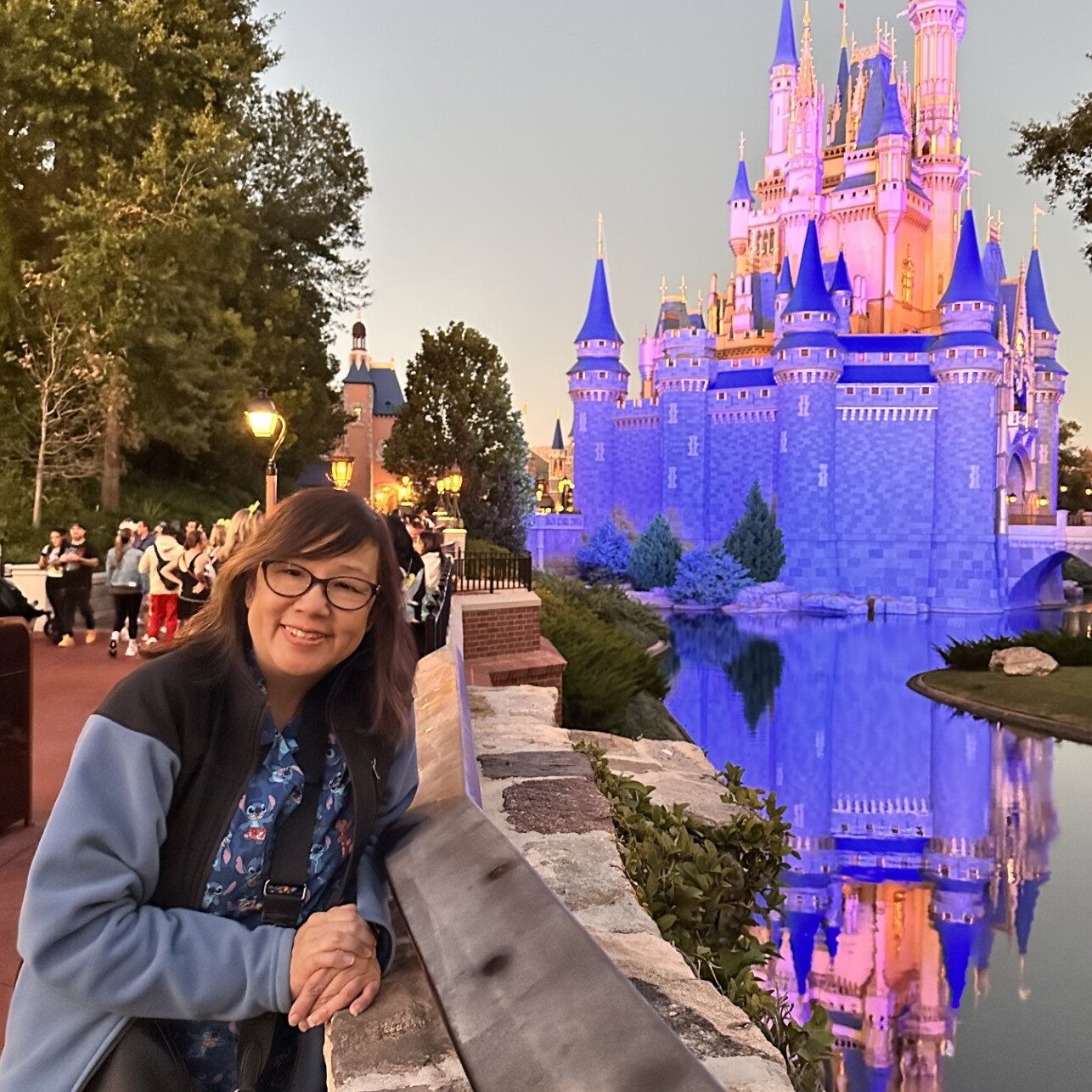
In each installment of our “10 Questions” blog series, readers will meet a staff member from AUI or one of its managed facilities, gaining insight into their career journey, what their role involves and what makes their work meaningful.
1. What is your role and what facility do you work for?
I am a project manager III with AUI. My primary role is to implement new cloud-based applications such as Enterprise Resource Planning (Costpoint) and Human Resource Information Systems (Dayforce). I have also implemented additional cloud-based applications for the U.S. National Science Foundation’s National Radio Astronomy Observatory, supported AUI proposals and performed information technology related tasks.
2. What drew you to this field and how did you get started?
I have always been fascinated with science and earned a degree in computer science. I am methodical, intrigued with processes and enjoy solving problems, hence software development has always been a way to perform tasks consistently and efficiently. I have held various roles in my career; software development, process and business analysis, production billing, and of course, project management.
3. What do you enjoy most about your job and why?
I enjoy working with great people; they are experts in their field of work and have good suggestions for configuration of the application. There is great satisfaction in working with a newly formed team, watching them progress into a cohesive unit, getting the work done in a timely manner, working through the hard issues, testing thoroughly, and finally coming to the day for cutoff into the new system. It’s an exhilarating rush!
4. How does the work you do help others at AUI?
Being able to implement tools that facilitate enhanced productivity and reduce manual tasks is very satisfying. Most people are grateful for the automation and can spend more time on problem solving, rather than manual entry on spreadsheets. It also helps eliminates the various ways that resources may enter data and streamlines the process. Data is consistent, conventional, reportable and users know where to find it.
5. What’s a project you’ve recently completed, and what impact do you hope it will have?
Costpoint went live on October 1, 2024, and Dayforce went live on January 1, 2025. Both are cloud-based applications, and a big impact is that new functionality and bug fixes are implemented by the vendors and pushed out to us on a regular basis. There are also numerous reasons why Accounting wanted to move to Costpoint and Dayforce facilitated employee access to benefits, training, payroll information and performance management in a one-stop shop.
6. What is something about your job that most people do not know?
Every project is different and the project manager needs to determine what works best for the team; from organizing the project, managing the tasks, determining gaps and risk, and keeping motivation and interest high. There are often multiple departmental stakeholders that will need to agree on various outcomes for a project. There is a certain amount of creativity that a project manager needs to bring into a project to keep the team engaged, especially when there is a lot of work to do in a short period of time.
7. Can you describe a typical workday?
Start the day by reviewing the project plan, RAID (Risks, Actions, Issues, Dependencies), check email and determine if I need to reach out to the vendor and/or team members. There were likely three or four meetings with various teams that required producing meeting notes, recordings and updating the RAID log. Generate presentations for internal meetings, stakeholder readouts and management status reviews. These decks often require “translation” into relevant information to be consumed by our internal team. Might need to talk with individual stakeholders about issues or with vendors for coordination of meeting, delivery of materials and status. There are many items to be worked every day if we want to keep the project on schedule and deliver on time. And then we do it all again the following day!
8. What challenges did you face during this project, and how did you work through them?
The biggest challenge was the amount of time required of the team to work through the implementation, while they continued to support their day job. We generated RACI (Responsible, Accountable, Consult, Inform) matrices to identify organizational roles and coordinated meetings around those roles. We would prioritize tasks to work through the highest ones first. I give much credit and gratitude to the team who worked countless hours and weekends to support these important projects.
9. What is the most memorable moment of your career thus far?
There are really too many “memorable moments” but suffice it to say, it’s usually around the “Go Live” of a project.
10. What’s the best career advice you’ve ever received?
Always keep moving forward in your career and continue to learn. Roles shift and you need to be prepared to take on new challenges.


Recent News
Professor John E. Carlstrom Delivers 2026 NSF NRAO Jansky Lectures
Carlstrom will present his talk: “What Do We Know About The Big Bang?” to the public on three dates, along with a recording that will be shared on the NSF NRAO’s YouTube channel.
10 Questions: Desmond Wysenyuy
Meet Desmond Wysenyuy, program coordinator for the North American Regional Office of Astronomy for Development.
Cosmic Cocktail: Exotic Methanol Discovered in Planet-Building Zones
New results from the ALMA COMPASS Large Program (Complex Organic Molecules in Protostars with ALMA Spectral Surveys) show that young, still-forming stars are surrounded by a surprisingly sophisticated “chemical starter kit”, including organic molecules such as methanol that may one day enrich planets.