
An inside look at unique careers in STEMIn each installment of our “10 Questions” blog series, readers will meet a staff member from AUI or one of its managed facilities, gaining insight into their career journey, what their role involves and what makes their work...
Recent News
Cosmic Cocktail: Exotic Methanol Discovered in Planet-Building Zones
New results from the ALMA COMPASS Large Program (Complex Organic Molecules in Protostars with ALMA Spectral Surveys) show that young, still-forming stars are surrounded by a surprisingly sophisticated “chemical starter kit”, including organic molecules such as methanol that may one day enrich planets.
Proctor Foundation for Art and Science Offers Stellar Guitar to Space Camp Auction
To celebrate the Inspiration4 Mission’s 5th Anniversary, mission pilot Dr. Sian Proctor is choosing to celebrate in a fitting way — raising funds to send community college students and faculty to Space Camp.
Young Stars Shape the Fate of Galaxies
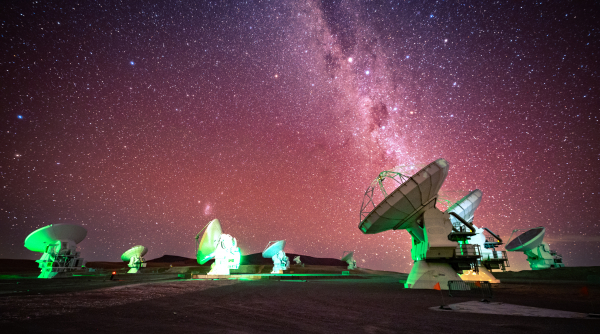
The Milky Way Galaxy pours into an ALMA antenna. The astro-modified camera used to take this photo lets in the hydrogen alpha light that is normally filtered out. This modification makes the camera more sensitive to the red end of the electromagnetic spectrum, thus giving a pink tint to the sky. The green lights are used to show antenna activity. Image credit: NSF/ AUI/ NSF NRAO/ B.Foott
Observations from ALMA, Webb, and Hubble reveal how young stars reshape their galactic environments
Astronomers have new insight into how young stars shape the evolution of galaxies, highlighting the powerful role of stellar “feedback” in influencing cosmic environments. In a new study, shared in a press conference at the 248th meeting of the American Astronomical Society, the researchers analyzed roughly 18,000 star-forming regions in nearby spiral galaxies using observations from the the Atacama Large Millimeter/submillimeter Array (of which the U.S. National Science Foundation National Radio Astronomy Observatory is a partner) alongside the James Webb Space Telescope and the Hubble Space Telescope. This data came from the international research collaboration, Physics at High Angular resolution in Nearby GalaxieS (PHANGS), which aims to better understand how galaxies grow and change over time.
The team found that in typical galaxies, pressure from ionized gas generated by newly formed stars drives the expansion of star-forming regions. However, whether these regions continue to grow or stall depends strongly on their surrounding environment. “When young massive stars form, they release large amounts of energy that disrupt their surroundings and push interstellar material outward,” said lead author Debosmita Pathak, a graduate student in astronomy at The Ohio State University.
This process, known as stellar feedback, plays a key role in regulating star formation and shaping the structure and chemistry of galaxies. It can either trigger the birth of new stars or halt it by dispersing the gas needed for star formation. To explore how these effects vary in extreme conditions, researchers compared normal galaxies with NGC 3256, a highly active system formed by a collision between two galaxies. They found that feedback pressures in NGC 3256 are about 100 times stronger than in galaxies like the Milky Way, creating a more turbulent and unpredictable environment.
“These measurements reveal physical conditions we haven’t been able to study before,” Pathak said. “They help us better understand the processes driving galactic evolution across different environments.” This research offers new clues about how young stars influence galaxies long before dramatic events like supernova explosions occur, and it provides a benchmark for improving models of how galaxies evolve across the universe.
This text was adapted from a press release created by Ohio State University. Find their original press release here.
This press conference was held on Wednesday, June 17th at 10:15am PDT. Find a recording from this presentation on the AAS Press Office YouTube channel.
About ALMA
The Atacama Large Millimeter/submillimeter Array (ALMA), an international astronomy facility, is a partnership of the European Southern Observatory (ESO), the U.S. National Science Foundation (NSF) and the National Institutes of Natural Sciences (NINS) of Japan in cooperation with the Republic of Chile. ALMA is funded by ESO on behalf of its Member States, by NSF in cooperation with the National Research Council of Canada (NRC) and the National Science and Technology Council (NSTC) in Taiwan and by NINS in cooperation with the Academia Sinica (AS) in Taiwan and the Korea Astronomy and Space Science Institute (KASI).
ALMA construction and operations are led by ESO on behalf of its Member States; by the National Radio Astronomy Observatory (NRAO), managed by Associated Universities, Inc. (AUI), on behalf of North America; and by the National Astronomical Observatory of Japan (NAOJ) on behalf of East Asia. The Joint ALMA Observatory (JAO) provides the unified leadership and management of the construction, commissioning and operation of ALMA.
About the NSF NRAO
The NSF National Radio Astronomy Observatory (NSF NRAO) is a major facility of the U.S. National Science Foundation, operated under cooperative agreement by Associated Universities, Inc.
This news article was originally published on the NRAO website on June 17, 2026.


Recent News
10 Questions: Desmond Wysenyuy
An inside look at unique careers in STEMIn each installment of our “10 Questions” blog series, readers will meet a staff member from AUI or one of its managed facilities, gaining insight into their career journey, what their role involves and what makes their work...
Cosmic Cocktail: Exotic Methanol Discovered in Planet-Building Zones
New results from the ALMA COMPASS Large Program (Complex Organic Molecules in Protostars with ALMA Spectral Surveys) show that young, still-forming stars are surrounded by a surprisingly sophisticated “chemical starter kit”, including organic molecules such as methanol that may one day enrich planets.
Proctor Foundation for Art and Science Offers Stellar Guitar to Space Camp Auction
To celebrate the Inspiration4 Mission’s 5th Anniversary, mission pilot Dr. Sian Proctor is choosing to celebrate in a fitting way — raising funds to send community college students and faculty to Space Camp.