
Astronomers using the Atacama Large Millimeter/submillimeter Array (ALMA) have captured the first direct, high-resolution images of a magnetic field wrapped tightly around the outflow of gas streaming away from a forming star — evidence that solves a decades-old puzzle about how young stars sculpt the powerful jets that form them.
Recent News
A Trillion Mile Cosmic Stream of Gas Feeds GW Orionis
A team of astronomers using the Atacama Large Millimeter/submillimeter Array (ALMA), of which the U.S. National Science Foundation National Radio Astronomy Observatory is a partner, has captured a massive stream of gas—one trillion miles, or .2 light years long—feeding the young triple-star system GW Orionis.
NSF NRAO radio observations help rule out a relativistic jet in rare stellar explosion
Astronomers studying a rare stellar explosion first spotted as a brief burst of X-rays used radio observations to help show that the dying star did not produce the powerful jet often associated with gamma-ray bursts.
NSF Green Bank Telescope Tunes in to Artemis II
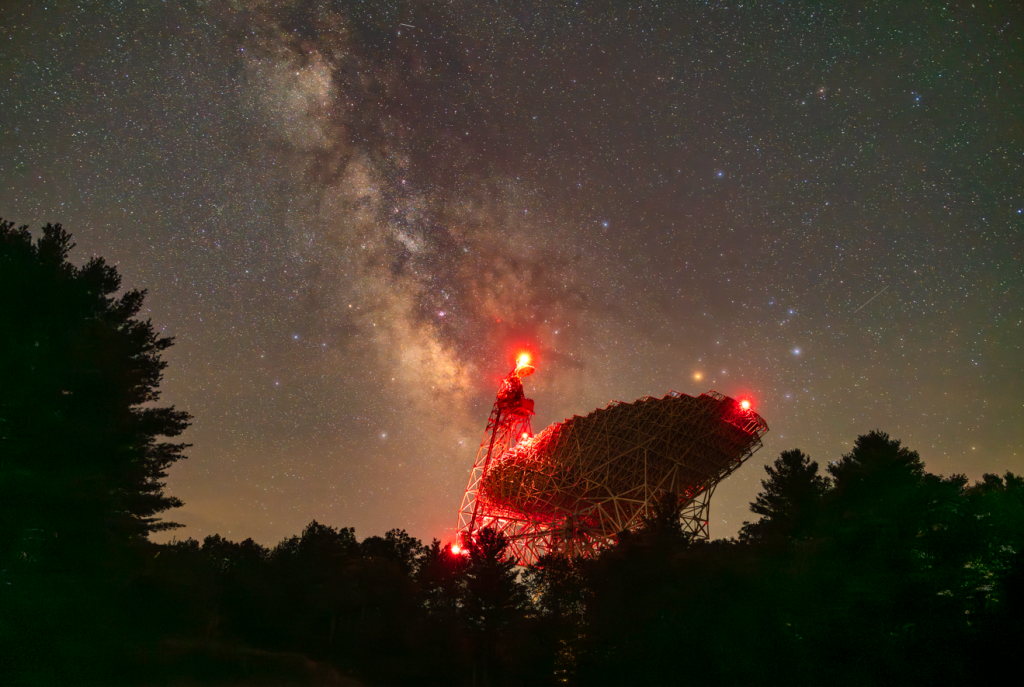
The NSF Green Bank Telescope. Image credit: NSF/AUI/NSF NRAO/J.Hellerman
World’s largest fully steerable radio telescope partners with NASA’s communications network to support tracking for historic lunar test flight
The National Science Foundation’s Green Bank Telescope (NSF GBT) will support NASA’s Artemis II mission by helping to track the crewed Orion spacecraft throughout its historic journey around the Moon.
As part of NASA’s Space Communications and Navigation (SCaN) program, the NSF GBT will support Artemis II tracking and communications, adding extra sensitivity and coverage to the networks that keep astronauts connected with Earth. Using its 100-meter collecting area and highly sensitive receivers, the NSF GBT will conduct radar observations of Orion as it travels beyond low Earth orbit, contributing precise tracking data that supports the mission’s safety and navigation. The GBT will provide support for the Artemis II mission for five days of the roughly 10-day test flight, observing Orion for six hours each day while the crew is closest to the Moon.
Artemis II is the first crewed flight test of NASA’s SLS (Space Launch System) rocket and Orion spacecraft, sending four astronauts on a lunar flyby to test life-support, communications, and other critical systems in deep space. This is the first crewed mission beyond low Earth orbit since 1972’s Apollo 17, and the first crewed lunar flyby in more than 50 years.
“These joint observations with the GBT give NASA a unique view of the Artemis II mission,” shares Will Armentrout, a scientist with the NSF GBO, who helps coordinate GBT operations for this project. All other observations of the mission around the world will be passive—with telescopes picking up the signals that Orion is emitting from its on-board antennas. The GBT will be performing active observations, using radar, with NASA’s Jet Propulsion Laboratory. A NASA Deep Space Network (DSN) antenna in California will beam radio energy toward the Orion spacecraft, and the GBT will pick up the extremely faint reflection of the energy off of the Orion spacecraft.
“Radar lets us pinpoint the trajectory of the spacecraft without relying on its on-board communication antennas,” explains Armentrout. “Performing radar observations at the distance of the Moon requires powerful transmitters and really, really big radio telescopes, like the GBT, so this partnership lets us spotlight some of the very best space support capabilities that the U.S. has to offer. We’re honored to work with NASA on the first crewed Moon mission in decades and look forward to even more collaboration as launch cadence increases!”
By partnering with SCaN, the NSF GBT continues its legacy of enabling groundbreaking space exploration—from studying distant galaxies to helping guide humanity’s return to the Moon. Most recently, the NSF GBT provided radar observations for NASA’s Double Asteroid Redirection Test, the world’s first “planetary protection” mission. Conversations are currently underway to provide ongoing support to NASA’s DSN. This collaboration underscores the importance of combining national research facilities with NASA’s spaceflight infrastructure and demonstrating how ground-based radio astronomy assets can directly support human exploration beyond Earth orbit.
About GBO and NRAO
The Green Bank Observatory is a part of the National Radio Astronomy Observatory (NRAO), a major facility of the U.S. National Science Foundation, operated under cooperative agreement by Associated Universities, Inc.
This news article was originally published on the NRAO website on April 1, 2026.


Recent News
Twisted Physics: Astronomers Solve 30-Year-Old Stellar Mystery
Astronomers using the Atacama Large Millimeter/submillimeter Array (ALMA) have captured the first direct, high-resolution images of a magnetic field wrapped tightly around the outflow of gas streaming away from a forming star — evidence that solves a decades-old puzzle about how young stars sculpt the powerful jets that form them.
A Trillion Mile Cosmic Stream of Gas Feeds GW Orionis
A team of astronomers using the Atacama Large Millimeter/submillimeter Array (ALMA), of which the U.S. National Science Foundation National Radio Astronomy Observatory is a partner, has captured a massive stream of gas—one trillion miles, or .2 light years long—feeding the young triple-star system GW Orionis.
NSF NRAO radio observations help rule out a relativistic jet in rare stellar explosion
Astronomers studying a rare stellar explosion first spotted as a brief burst of X-rays used radio observations to help show that the dying star did not produce the powerful jet often associated with gamma-ray bursts.