
Carlstrom will present his talk: “What Do We Know About The Big Bang?” to the public on three dates, along with a recording that will be shared on the NSF NRAO’s YouTube channel.
Recent News
10 Questions: Desmond Wysenyuy
Meet Desmond Wysenyuy, program coordinator for the North American Regional Office of Astronomy for Development.
Cosmic Cocktail: Exotic Methanol Discovered in Planet-Building Zones
New results from the ALMA COMPASS Large Program (Complex Organic Molecules in Protostars with ALMA Spectral Surveys) show that young, still-forming stars are surrounded by a surprisingly sophisticated “chemical starter kit”, including organic molecules such as methanol that may one day enrich planets.
NRAO to Outfit the VLBA with New Ultra Wideband Receivers
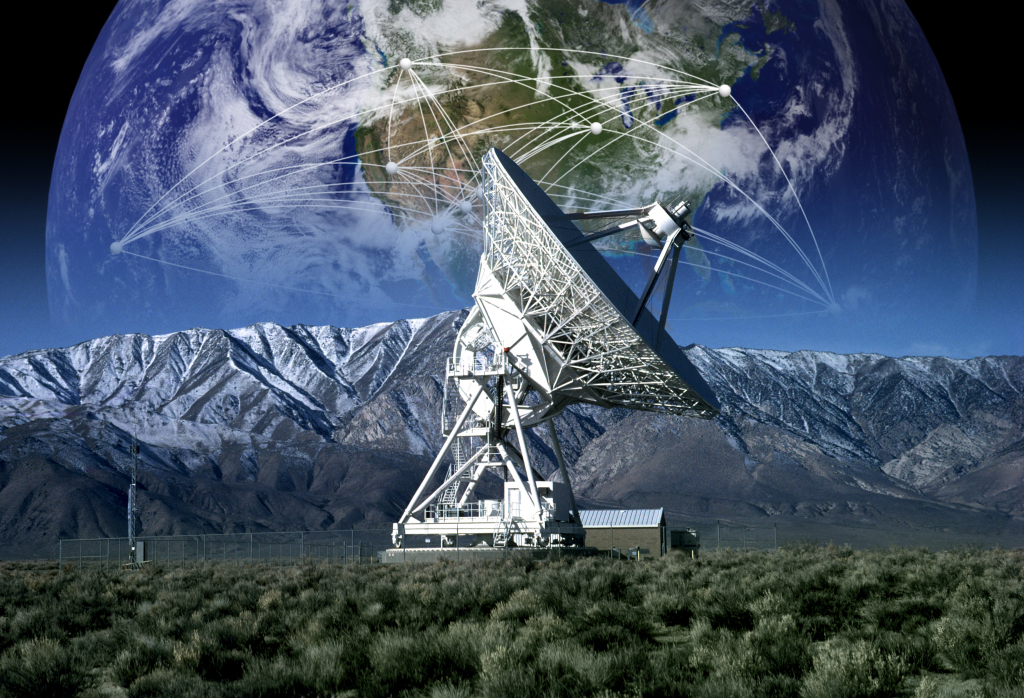
Owens Valley VLBA Antenna with VLBA schematic in the background. Credit: NSF/AUI/NSF NRAO
The U.S. National Science Foundation National Radio Astronomy Observatory (NSF NRAO) has begun a major upgrade to the NSF Very Long Baseline Array (NSF VLBA) with the development and installation of state-of-the-art ultra wideband receivers capable of operating across the frequency range of 8 to 40 gigahertz (GHz). This new technology, first prototyped by NRAO in collaboration with NASA’s Jet Propulsion Laboratory (JPL), and tested on the NSF VLBA’s Owens Valley station, promises to significantly expand the scientific capabilities of the NSF VLBA.
The prototype receiver demonstrated excellent performance, with sensitivity comparable to the NSF VLBA’s existing X-band (8 GHz) and K-band (22 GHz) receivers—and better than the current Ku-band system. Most notably, the new technology will finally open the door to Ka-band observations (27–40 GHz) across the VLBA, enabling science at frequencies previously unavailable to the array.
“This new receiver represents a breakthrough in capability for the VLBA,” said Project Manager Antonia Hubbard. “With dual-band coverage at 8.4 and 32 GHz, and continuous sensitivity over an extraordinarily wide range of frequencies, we will be able to tackle new scientific questions while supporting critical national needs in astrometry and celestial reference frames.”
The project is strongly supported by the U.S. Naval Observatory (USNO), which funds 50 percent of VLBA operations and is especially interested in the precision astrometry that Ka-band access will make possible.
Unlike previous NSF NRAO receiver designs, the new wideband system integrates advanced front-end and digital backend technologies drawn from several recent research initiatives, with contributions from engineers and scientists across NSF NRAO’s facilities in New Mexico and West Virginia.
The project’s first phase is fully funded, with three receivers currently under construction. One receiver will be permanently installed on a VLBA antenna by October 2027. Completing the vision—a full set of ten receivers, one for each VLBA station—will provide uniform ultra wideband capability across the array.
“This wideband system leverages the initial engineering work of JPL,” added Walter Brisken. “By scaling that work up across the entire VLBA, we’ll give the astronomical community access to an unprecedented frequency range on the longest radio interferometer in the world.”
The VLBA provides unmatched angular resolution for radio astronomy, geodesy, and astrometry. The addition of ultra wideband receivers will ensure it remains at the cutting edge of discovery for decades to come.
About NRAO
The National Radio Astronomy Observatory is a facility of the U.S. National Science Foundation, operated under cooperative agreement by Associated Universities, Inc.
This news article was originally published on the NRAO website on September 16, 2025.


Recent News
Professor John E. Carlstrom Delivers 2026 NSF NRAO Jansky Lectures
Carlstrom will present his talk: “What Do We Know About The Big Bang?” to the public on three dates, along with a recording that will be shared on the NSF NRAO’s YouTube channel.
10 Questions: Desmond Wysenyuy
Meet Desmond Wysenyuy, program coordinator for the North American Regional Office of Astronomy for Development.
Cosmic Cocktail: Exotic Methanol Discovered in Planet-Building Zones
New results from the ALMA COMPASS Large Program (Complex Organic Molecules in Protostars with ALMA Spectral Surveys) show that young, still-forming stars are surrounded by a surprisingly sophisticated “chemical starter kit”, including organic molecules such as methanol that may one day enrich planets.