Carlstrom will present his talk: “What Do We Know About The Big Bang?” to the public on three dates, along with a recording that will be shared on the NSF NRAO’s YouTube channel.
Recent News
10 Questions: Desmond Wysenyuy
Meet Desmond Wysenyuy, program coordinator for the North American Regional Office of Astronomy for Development.
Cosmic Cocktail: Exotic Methanol Discovered in Planet-Building Zones
New results from the ALMA COMPASS Large Program (Complex Organic Molecules in Protostars with ALMA Spectral Surveys) show that young, still-forming stars are surrounded by a surprisingly sophisticated “chemical starter kit”, including organic molecules such as methanol that may one day enrich planets.
NRAO and GBO Saddened at Loss of Arecibo Telescope
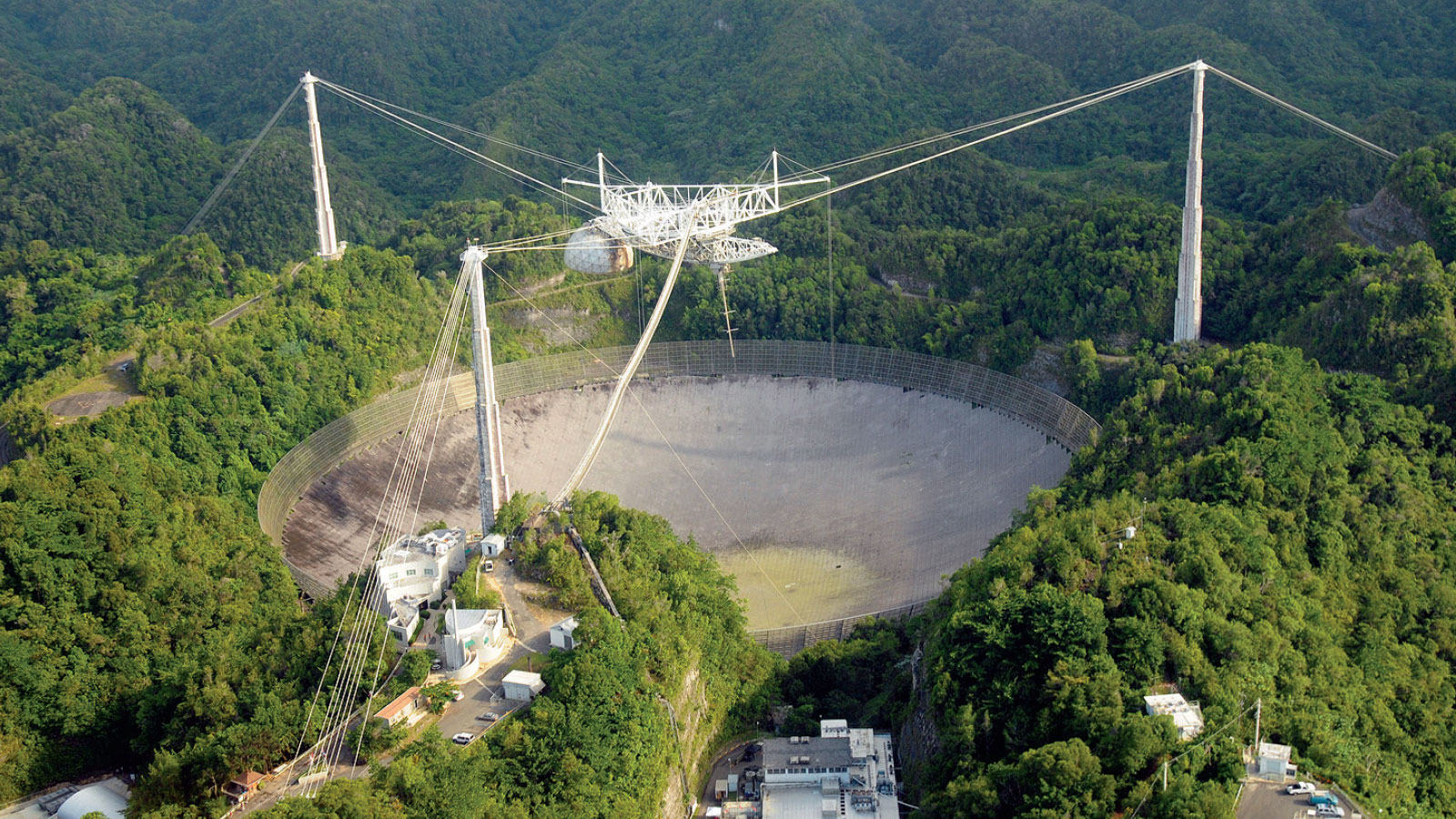
The National Radio Astronomy Observatory (NRAO) and the Green Bank Observatory (GBO) are saddened by the announcement of the decommissioning of the Arecibo Telescope in Puerto Rico due to recent and devastating structural damage. See the National Science Foundation’s full release here.
The 305-meter Arecibo radio telescope has a long and distinguished history of landmark contributions to astronomy and planetary science and often has been a valued partner with NRAO telescopes and the Green Bank Telescope in research projects. Its loss will be a blow to science.
The staff and facilities of NRAO and GBO stand ready to assist in filling the gap that this loss will create, and offer our best wishes to our colleagues who are affected by this development.
Frequently Asked Questions:
Can any NRAO facilities or the Green Bank Telescope replace the Arecibo Telescope?
While some instruments of the NRAO and GBO can perform some of the Arecibo Telescope’s functions, none will be a total replacement for its capabilities. The Arecibo Telescope is irreplaceable.
Does the NRAO or GBO support the NSF’s move to decommission the telescope?
We defer to the engineers’ reports evaluating the devastating damage done to the telescope’s infrastructure and threats to staff safety, as shared in the NSF’s release.
Will the NRAO or GBO be providing support to the staff displaced by this event?
We encourage AO staff displaced by this loss to consider any of our current open opportunities with the NRAO or GBO.
###
Media Contact:
Dave Finley, Public Information Officer
[email protected]
(505) 241-9210
###
This news article was originally published on the NRAO website on November 19, 2020.


Recent News
Professor John E. Carlstrom Delivers 2026 NSF NRAO Jansky Lectures
Carlstrom will present his talk: “What Do We Know About The Big Bang?” to the public on three dates, along with a recording that will be shared on the NSF NRAO’s YouTube channel.
10 Questions: Desmond Wysenyuy
Meet Desmond Wysenyuy, program coordinator for the North American Regional Office of Astronomy for Development.
Cosmic Cocktail: Exotic Methanol Discovered in Planet-Building Zones
New results from the ALMA COMPASS Large Program (Complex Organic Molecules in Protostars with ALMA Spectral Surveys) show that young, still-forming stars are surrounded by a surprisingly sophisticated “chemical starter kit”, including organic molecules such as methanol that may one day enrich planets.