
To celebrate the Inspiration4 Mission’s 5th Anniversary, mission pilot Dr. Sian Proctor is choosing to celebrate in a fitting way — raising funds to send community college students and faculty to Space Camp.
Recent News
10 Questions: Judelyn Padgett
Meet Judelyn Padgett, a project manager at AUI headquarters.
NA-ROAD Announces the 2026 Women and Girls in Astronomy Program Cohort
The Women and Girls in Astronomy Program (WGAP), led by Associated Universities, Inc. (AUI), under the North American Regional Office of Astronomy for Development (NA-ROAD), is proud to announce the selection of ten regional projects to receive funding through the 2026 cycle.
Neighboring Star’s Warped Ring Shaped by Evolving Planets
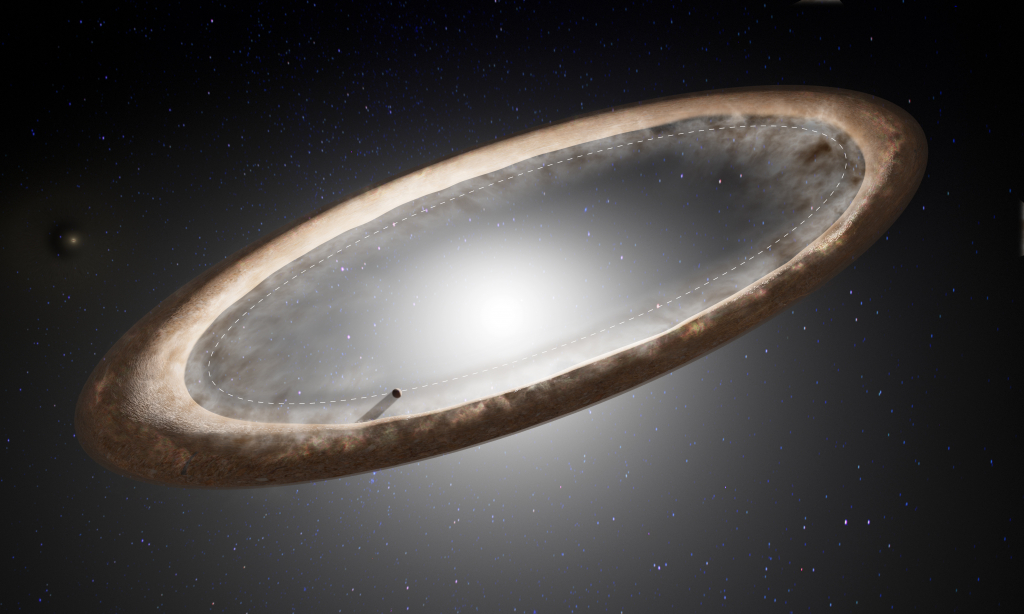
The bright star in the center, Fomalhaut, is surrounded by an ancient debris disk of uneven brightness. The disk is closer to the star in the south, where the disk is wider and fainter, and further from the star in the north, where the disk is narrower and brighter. The dotted ring shows the possible orbit of a planet implied by Lovell et al. Credit: NSF/AUI/NSF NRAO/B. Saxton
Unusual shape of Fomalhaut’s debris ring shows evidence of sculpting by ancient planets, rewriting story of planetary system evolution
Astronomers using the Atacama Large Millimeter/submillimeter Array (ALMA) have made the highest resolution image to date, revealing new insights into the unusual and mysterious architecture of the debris disk encircling Fomalhaut, one of the brightest and most well-studied stars in our cosmic neighborhood. Debris disks are vast belts of dust and rocky bodies, similar to our Solar System’s asteroid belt—but much larger. The lopsidedness (or eccentricity) of Fomalhaut’s disk has fascinated astronomers for nearly two decades.
An international research team, led by astronomers at the Center for Astrophysics | Harvard & Smithsonian and Johns Hopkins University, published two papers analyzing these new observations in the Astrophysical Journal/Astrophysical Journal Letters. They have now found that Fomalhaut’s disk is not just eccentric—its eccentricity changes with distance from the star. Unlike previous models assuming a uniform or “fixed” eccentricity, their new data-driven model shows that the disk’s shape grows less stretched (or less eccentric) the farther a segment is from Fomalhaut. This morphology is known as a negative eccentricity gradient. You can imagine the offsets between the star and the ring’s center, much like Saturn’s rings, if Saturn wasn’t sitting neatly in the middle.
“Our observations show, for the first time, that the disk’s eccentricity isn’t constant,” said lead author of one of the papers, Joshua Bennett Lovell, a Submillimeter Array Fellow with the Harvard-Smithsonian Center for Astrophysics. “It steadily drops off with distance, a finding that has never before been conclusively demonstrated in any debris disk.” Lovell is also an ALMA Ambassador with the U.S. National Science Foundation National Radio Astronomy Observatory’s North American ALMA Science Center.
Using high-resolution ALMA images at 1.3mm wavelengths, the team fitted a new model setup to the data, one that accounts for the disk’s radius, width, and asymmetries, with an eccentric ring model that can alter its eccentricity with distance from the star. The best-fitting model pointed to a steep decline in eccentricity with distance, as predicted by dynamical theories of how planets can shape debris disks, but as-yet seen anywhere in the universe.
This negative gradient offers clues about hidden planets, currently unseen by astronomers, orbiting Fomalhaut. The new model suggests a massive planet orbiting inside of Fomalhaut’s disk may have sculpted its eccentricity profile early in the extrasolar system’s history. The unusual shape of the debris disk may have formed in the system’s youth, during the protoplanetary disk phase, and has remained this way for more than 400 million years, thanks to the continued push, and pull of this planet.
In the second paper, led by Graduate Student Jay Chittidi at Johns Hopkins University, the team exhausted the possibility that the ring’s eccentricity is fixed with the distance from the star. “Although the shift in brightness from the pericenter side of the disk, nearest to the star, to the apocenter side, furthest from the star, between the JWST and ALMA data was expected, the precise shifts that we measured in the disk brightness and the ring’s width could not be explained by the old models,” said Jay. “Simply put: we couldn’t find a model with a fixed eccentricity that could explain these peculiar features in Fomalhaut’s disk. Comparing the old and new models, we are now able to better interpret this disk, and reconstruct the history and present state of this dynamic system.”
Researchers hope this new model will be further tested with more ALMA observations, which were recently approved, “And hopefully we’ll find new clues that will help us uncover that planet!” adds Lovell. The team has shared the eccentricity model code developed for this newly published research to enable other astronomers to apply it to similar systems.
About NRAO
The National Radio Astronomy Observatory (NRAO) is a facility of the U.S. National Science Foundation, operated under cooperative agreement by Associated Universities, Inc.
About ALMA
The Atacama Large Millimeter/submillimeter Array (ALMA), an international astronomy facility, is a partnership of the European Southern Observatory (ESO), the U.S. National Science Foundation (NSF) and the National Institutes of Natural Sciences (NINS) of Japan in cooperation with the Republic of Chile. ALMA is funded by ESO on behalf of its Member States, by NSF in cooperation with the National Research Council of Canada (NRC) and the National Science and Technology Council (NSTC) in Taiwan and by NINS in cooperation with the Academia Sinica (AS) in Taiwan and the Korea Astronomy and Space Science Institute (KASI).
ALMA construction and operations are led by ESO on behalf of its Member States; by the National Radio Astronomy Observatory (NRAO), managed by Associated Universities, Inc. (AUI), on behalf of North America; and by the National Astronomical Observatory of Japan (NAOJ) on behalf of East Asia. The Joint ALMA Observatory (JAO) provides the unified leadership and management of the construction, commissioning and operation of ALMA.
This news article was originally published on the NRAO website on September 4, 2025.


Recent News
Proctor Foundation for Art and Science Offers Stellar Guitar to Space Camp Auction
To celebrate the Inspiration4 Mission’s 5th Anniversary, mission pilot Dr. Sian Proctor is choosing to celebrate in a fitting way — raising funds to send community college students and faculty to Space Camp.
10 Questions: Judelyn Padgett
Meet Judelyn Padgett, a project manager at AUI headquarters.
NA-ROAD Announces the 2026 Women and Girls in Astronomy Program Cohort
The Women and Girls in Astronomy Program (WGAP), led by Associated Universities, Inc. (AUI), under the North American Regional Office of Astronomy for Development (NA-ROAD), is proud to announce the selection of ten regional projects to receive funding through the 2026 cycle.