
Astronomers using the Atacama Large Millimeter/submillimeter Array (ALMA) and NASA’s James Webb Space Telescope (JWST) have discovered that some of the most massive stars in our galaxy are emitting unbelievably tiny grains of carbon dust—dust that one day could form future stars and planets.
Hidden Giants of the Early Universe: NSF NRAO Telescopes Help Reveal Divergent Fates of the Most Massive Galaxies
Recent News
ALMA Creates Largest-Ever Image of the Milky Way’s Core
The new survey—known as the ALMA CMZ Exploration Survey (ACES)—maps more than 650 light-years across the Central Molecular Zone, the extreme environment that surrounds our galaxy’s supermassive black hole.
Mission Patagonia Welcomes Its 2026 Nature Guardians
A small cohort of educators, scientists and environmental leaders will embark March 3-14 to the southern edge of the world for Mission Patagonia, an immersive outdoor environmental education experience designed to foster deep connection to place, people and planet.
Hidden Giants of the Early Universe: NSF NRAO Telescopes Help Reveal Divergent Fates of the Most Massive Galaxies
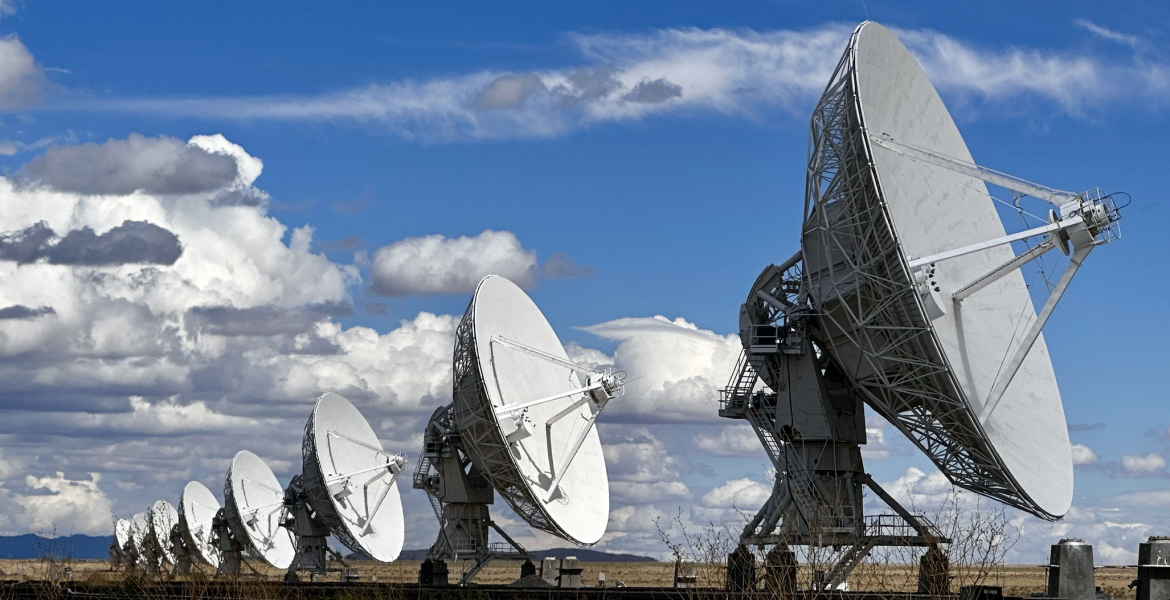
The U.S. National Science Foundation Very Large Array on the plains of San Agustin, New Mexico. Image credit: NSF/AUI/NSF NRAO/C. Jaramillo Feldman
Astronomers using the U.S. National Science Foundation National Radio Astronomy Observatory (NSF NRAO) instruments Atacama Large Millimeter/submillimeter Array (ALMA) and, the U.S. National Science Foundation Very Large Array (NSF VLA), and the W. M. Keck Observatory have uncovered the hidden lives of some of the most massive galaxies in the early Universe, revealing that while some shut down star formation quickly, others continue forming stars behind thick veils of cosmic dust. By extending the Massive Ancient Galaxies At z > 3 Near-infrared (MAGAZ3NE) survey into the radio regime, the team has shown that ultramassive galaxies just 1–2 billion years after the Big Bang follow multiple evolutionary paths rather than a single, simple track. This research was led by Wenjun Chang, a graduate student at UC Riverside, under the mentorship of Gillian Wilson, Vice Chancellor for Research, Innovation and Economic Development and Professor of Physics at UC Merced, and will be presented by Chang at a press conference at the 247th meeting of the American Astronomical Society on January 5th, 2026, in Phoenix, Arizona.
This new study targets ultramassive galaxies containing more than 100 billion stars at redshifts between 3 and 4, systems that sit at the extreme high-mass end of the galaxy population and are difficult for current cosmological simulations to explain. Earlier observations from Subaru, UltraVISTA, VIDEO, Spitzer, and Herschel suggested that many of these galaxies had already stopped forming stars, but those shorter-wavelength data could not distinguish truly “dead” galaxies from those whose ongoing star formation is simply buried in dust. Radio and millimeter observations from ALMA and the NSF VLA are uniquely sensitive to cold gas and dust, the raw material and tracer of star formation, allowing astronomers to directly test whether these galaxies are genuinely quenched or still quietly building stars.
By carefully combining ultraviolet-to-radio light into detailed spectral energy distributions, the researchers were able to measure obscured star formation, pinpoint active galactic nuclei, and probe the dust and molecular gas reservoirs that fuel or shut down stellar birth. The analysis reveals that most of the surveyed ultramassive galaxies are truly quiescent and exceptionally dust-poor, indicating that they exhausted or expelled their star-forming gas with surprising speed, while a minority still host residual or heavily hidden star formation. These findings provide rare, direct evidence that powerful feedback from supermassive black holes and depleted cold-gas supplies likely play a central role in halting star formation in the Universe’s most massive galaxies.
This work highlights how ALMA and the NSF VLA together open a unique window on galaxy evolution, tracing both the cool gas that fuels new stars and the radio signatures of black hole activity across cosmic time. By pushing radio and millimeter observations to earlier and earlier epochs, NSF NRAO facilities are helping astronomers test models of galaxy formation under the most extreme conditions, where small differences in gas content and feedback can have outsized effects on how galaxies live and die. You can read the full release from the University of California Merced and the Keck Observatory.
About NRAO
The National Radio Astronomy Observatory is a facility of the U.S. National Science Foundation, operated under cooperative agreement by Associated Universities, Inc.
This news article was originally published on the NRAO website on January 5, 2026.


Recent News
A Quintillion-to-One: Giant Stars, Tiny Dust
Astronomers using the Atacama Large Millimeter/submillimeter Array (ALMA) and NASA’s James Webb Space Telescope (JWST) have discovered that some of the most massive stars in our galaxy are emitting unbelievably tiny grains of carbon dust—dust that one day could form future stars and planets.
ALMA Creates Largest-Ever Image of the Milky Way’s Core
The new survey—known as the ALMA CMZ Exploration Survey (ACES)—maps more than 650 light-years across the Central Molecular Zone, the extreme environment that surrounds our galaxy’s supermassive black hole.
Mission Patagonia Welcomes Its 2026 Nature Guardians
A small cohort of educators, scientists and environmental leaders will embark March 3-14 to the southern edge of the world for Mission Patagonia, an immersive outdoor environmental education experience designed to foster deep connection to place, people and planet.