
Meet Judelyn Padgett, a project manager at AUI headquarters.
Recent News
NA-ROAD Announces the 2026 Women and Girls in Astronomy Program Cohort
The Women and Girls in Astronomy Program (WGAP), led by Associated Universities, Inc. (AUI), under the North American Regional Office of Astronomy for Development (NA-ROAD), is proud to announce the selection of ten regional projects to receive funding through the 2026 cycle.
Twisted Physics: Astronomers Solve 30-Year-Old Stellar Mystery
Astronomers using the Atacama Large Millimeter/submillimeter Array (ALMA) have captured the first direct, high-resolution images of a magnetic field wrapped tightly around the outflow of gas streaming away from a forming star — evidence that solves a decades-old puzzle about how young stars sculpt the powerful jets that form them.
Astronomers Watch Unfolding Saga of Massive Star Formation
A pair of images of a young star, made 18 years apart, has revealed a dramatic difference that is providing astronomers with a unique, “real-time” look at how massive stars develop in the earliest stages of their formation.
The astronomers used the National Science Foundation’s Karl G. Jansky Very Large Array (VLA) to study a massive young star called W75N(B)-VLA 2, some 4200 light-years from Earth. They compared an image made in 2014 with an earlier VLA image from 1996.
“The comparison is remarkable,” said Carlos Carrasco-Gonzalez of the Center of Radioastronomy and Astrophysics of the National Autonomous University of Mexico, leader of the research team. The 1996 image shows a compact region of a hot, ionized wind ejected from the young star. The 2014 image shows that ejected wind deformed into an distinctly elongated outflow.
“We’re seeing this dramatic change in real time, so this object is providing us an exciting opportunity to watch over the next few years as a very young star goes through the early stages of its formation,” Carrasco-Gonzalez said.
The scientists believe the young star is forming in a dense, gaseous environment, and is surrounded by a doughnut-shaped, dusty torus. The star has episodes in which it ejects a hot, ionized wind for several years. At first, that wind can expand in all directions, and so forms a spherical shell around the star. Later, the wind hits the dusty torus, which slows it. Wind expanding outward along the poles of the torus, where there is less resistance, moves more quickly, resulting in an elongated shape for the outflow.
“In the span of only 18 years, we’ve seen exactly what we predicted,” Carrasco-Gonzalez said.
There are theoretical models developed to explain why nearly-spherical expansion of such outflows had been seen with young stars much more massive than the Sun, when narrower, beam-like outflows were expected based on observations of less-massive, Sun-like stars at similar stages of development. W75N(B)-VLA 2 is estimated to be about 8 times more massive than the Sun. The more-uniform outflows are seen in massive young stars in the first few thousand years of their lives, the stage at which W75N(B)-VLA 2 is thought to be.
“Our understanding of how massive young stars develop is much less complete than our understanding of how Sun-like stars develop,” Carrasco-Gonzalez said. “It’s going to be really great to be able to watch one as it changes. We expect to learn a lot from this object,” he added.
Carrasco-Gonzalez worked with an international team of astronomers from Mexico, the Netherlands, Sweden, Spain, Korea, and Japan. The scientists reported their discovery in the journal Science.
The National Radio Astronomy Observatory is a facility of the National Science Foundation, operated under cooperative agreement by Associated Universities, Inc.
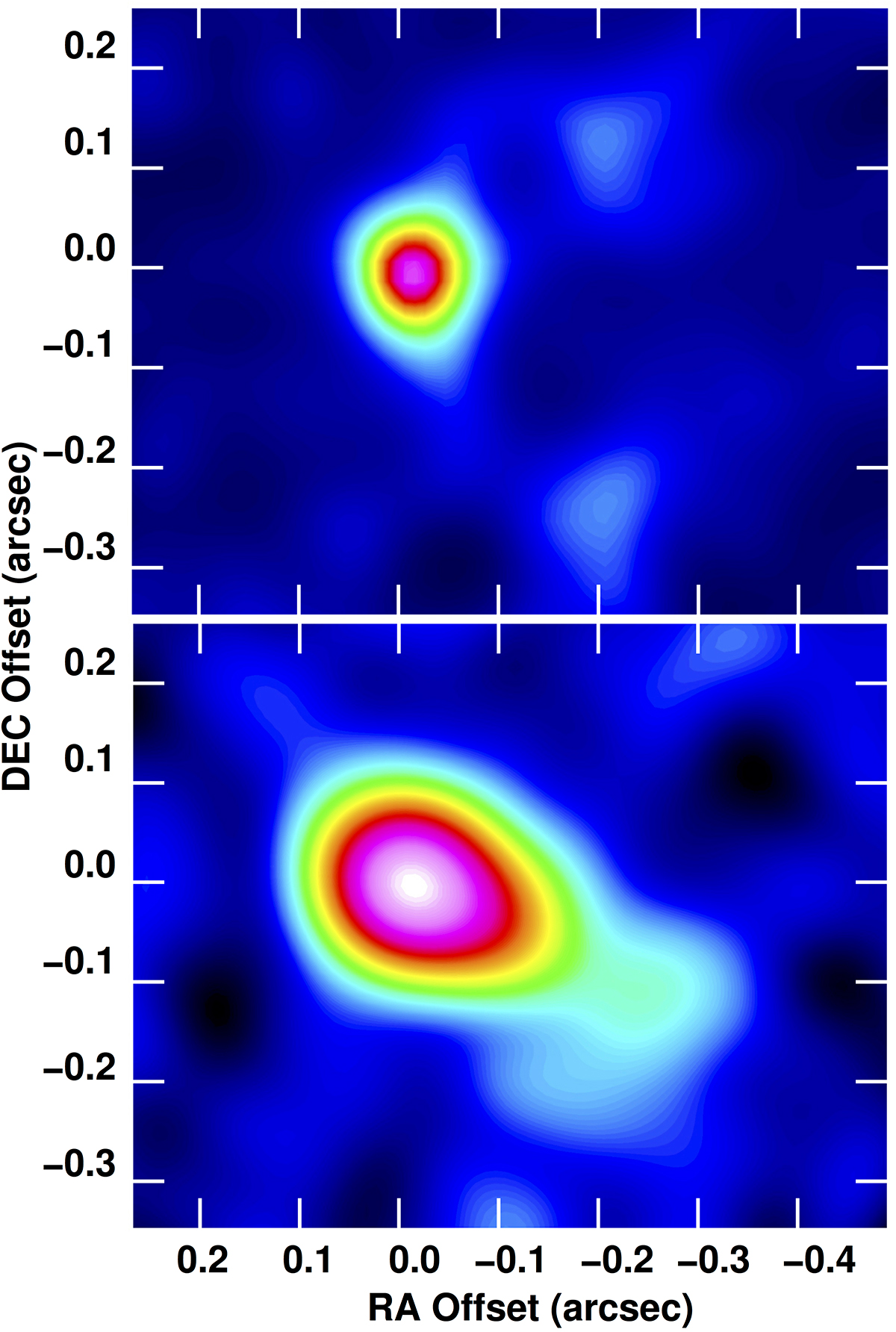
VLA images of W75N(B)-VLA-2: Top, 1996; Bottom, 2014.
CREDIT: Carrasco-Gonzalez, et al., NRAO/AUI/NSF
Contact:
Dave Finley, Public Information Officer
(575) 835-7302
[email protected]


Recent News
10 Questions: Judelyn Padgett
Meet Judelyn Padgett, a project manager at AUI headquarters.
NA-ROAD Announces the 2026 Women and Girls in Astronomy Program Cohort
The Women and Girls in Astronomy Program (WGAP), led by Associated Universities, Inc. (AUI), under the North American Regional Office of Astronomy for Development (NA-ROAD), is proud to announce the selection of ten regional projects to receive funding through the 2026 cycle.
Twisted Physics: Astronomers Solve 30-Year-Old Stellar Mystery
Astronomers using the Atacama Large Millimeter/submillimeter Array (ALMA) have captured the first direct, high-resolution images of a magnetic field wrapped tightly around the outflow of gas streaming away from a forming star — evidence that solves a decades-old puzzle about how young stars sculpt the powerful jets that form them.