
To celebrate the Inspiration4 Mission’s 5th Anniversary, mission pilot Dr. Sian Proctor is choosing to celebrate in a fitting way — raising funds to send community college students and faculty to Space Camp.
Astronomers Make First Radio Detection of Rare Supernova Type, Revealing Secrets of Stellar Death
Recent News
10 Questions: Judelyn Padgett
Meet Judelyn Padgett, a project manager at AUI headquarters.
NA-ROAD Announces the 2026 Women and Girls in Astronomy Program Cohort
The Women and Girls in Astronomy Program (WGAP), led by Associated Universities, Inc. (AUI), under the North American Regional Office of Astronomy for Development (NA-ROAD), is proud to announce the selection of ten regional projects to receive funding through the 2026 cycle.
Astronomers Make First Radio Detection of Rare Supernova Type, Revealing Secrets of Stellar Death
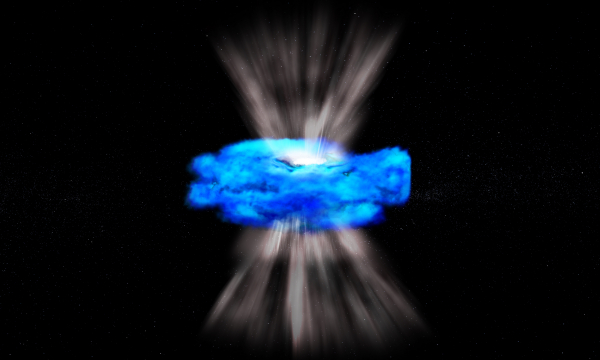
A star explodes into a dense disk of helium-rich material, generating strong radio waves for the first time. How did this happen? One idea is that years before any explosion, a small star stripped of its hydrogen and made of mostly helium orbits an even smaller ultra-dense star made of neutrons. As the stars approach each other, the helium star begins to lose more and more mass to the neutron star, forming a chaotic disk of material around the system. Eventually, there is an explosion, with the exact cause unclear. The ejected material in the explosion slams into the disk of mass lost, creating shocks which produce strong radio emission. This emission was then observed by astronomers using the Very Large Array. Credit: NSF/AUI/NSF NRAO/B. Saxton
Astronomers using the U.S. National Science Foundation Very Large Array (NSF VLA) have made an unprecedented discovery, capturing the first-ever radio signals from a rare class of stellar explosion known as a Type Ibn supernova. This achievement brings fresh insight into the death throes of massive stars and provides a rare glimpse into the final years of a star’s life, previously hidden from view.
The supernova, designated SN 2023fyq, represents a unique opportunity to observe a massive star’s final act. Type Ibn supernovae result when a star explodes into helium-rich gas previously ejected from its surface. Using the NSF VLA’s powerful radio vision, astronomers tracked radio emissions from this explosion over a span of 18 months, uncovering compelling evidence about the environment around the dying star.
“We captured a rare, first-ever radio signal from a star exploding into helium-rich gas it shed shortly before the blast,” said Raphael Baer-Way, a graduate student at UVA working with Maryam Modjaz (UVA) and Poonam Chandra (NRAO) and primary investigator on the study. “Radio observations allowed us to ‘view’ the final decade of the star’s life before the demise. These observations revealed the star shedding its helium layers, including a significant five-year surge in mass loss immediately preceding the supernova, providing fresh evidence for binary-driven, exotic explosions.” This discovery reveals that the star underwent a dramatic period of mass loss, likely caused by the influence of a gravitationally bound stellar companion.
Radio and X-ray data revealed the density and extent of the helium-rich material ejected before the explosion. Astronomers determined that the star shed material at an astonishing rate — up to 0.4% of the mass of the sun per year — during a short-lived but intense phase leading up to the supernova explosion. This dynamic process aligns with predictions for stars in close binary systems and gives astrophysicists new, direct evidence of the mechanisms driving such rare supernovae.
Until now, the existence of dense material around most Type Ibn supernovae had only been inferred from optical studies. Dr. A.J. Nayana at UC Berkeley, a co-lead investigator, says “Our study probes the material ejected years before the explosion – revealing that the star underwent an intense phase of mass-loss in the final 0.7–3 years of its life.” By pinpointing the timeframe and magnitude of the mass loss, astronomers have filled a crucial gap in the story of how massive stars end their lives and enrich the Universe.
This landmark detection sets the stage for future studies of supernovae with radio telescopes, promising to deepen our understanding of the life cycles of stars and the forces that shape our galaxy. Dr. Wynn Jacobson-Galan at Caltech, another lead investigator and VLA program PI, says, “this study has opened up a whole new avenue for constraining the end points of certain massive stars and really highlights the need for systematic radio follow-up of similar events with incredible instruments like the VLA and GMRT.”
About NRAO
The National Radio Astronomy Observatory is a facility of the U.S. National Science Foundation, operated under cooperative agreement by Associated Universities, Inc.
This news article was originally published on the NRAO website on December 12, 2025.


Recent News
Proctor Foundation for Art and Science Offers Stellar Guitar to Space Camp Auction
To celebrate the Inspiration4 Mission’s 5th Anniversary, mission pilot Dr. Sian Proctor is choosing to celebrate in a fitting way — raising funds to send community college students and faculty to Space Camp.
10 Questions: Judelyn Padgett
Meet Judelyn Padgett, a project manager at AUI headquarters.
NA-ROAD Announces the 2026 Women and Girls in Astronomy Program Cohort
The Women and Girls in Astronomy Program (WGAP), led by Associated Universities, Inc. (AUI), under the North American Regional Office of Astronomy for Development (NA-ROAD), is proud to announce the selection of ten regional projects to receive funding through the 2026 cycle.