
These joint efforts support the pathfinder for ngVLA technologies, focusing on very long baseline interferometry (VLBI) capabilities that enable ultra-sharp imaging of the Universe.
Recent News
Astronomers Detect Magnetic Fingerprint of a Cosmic Explosion for the First Time
Using the U.S. National Science Foundation Very Large Array (NSF VLA) radio telescope, which is operated by the U. S. National Science Foundation National Radio Astronomy Observatory (NSF NRAO), the team detected polarized light from a gamma-ray burst (GRB) afterglow for the first time at radio wavelengths.
NSF VLA Sky Survey Sets New Standard for High-Resolution, Wide-Area Radio Astronomy
The U.S. National Science Foundation National Radio Astronomy Observatory (NSF NRAO) has completed observations for the Very Large Array Sky Survey (VLASS), the most detailed radio survey of the sky ever conducted.
VLITE Marks 11 Years of Capturing the Dynamic Radio Sky
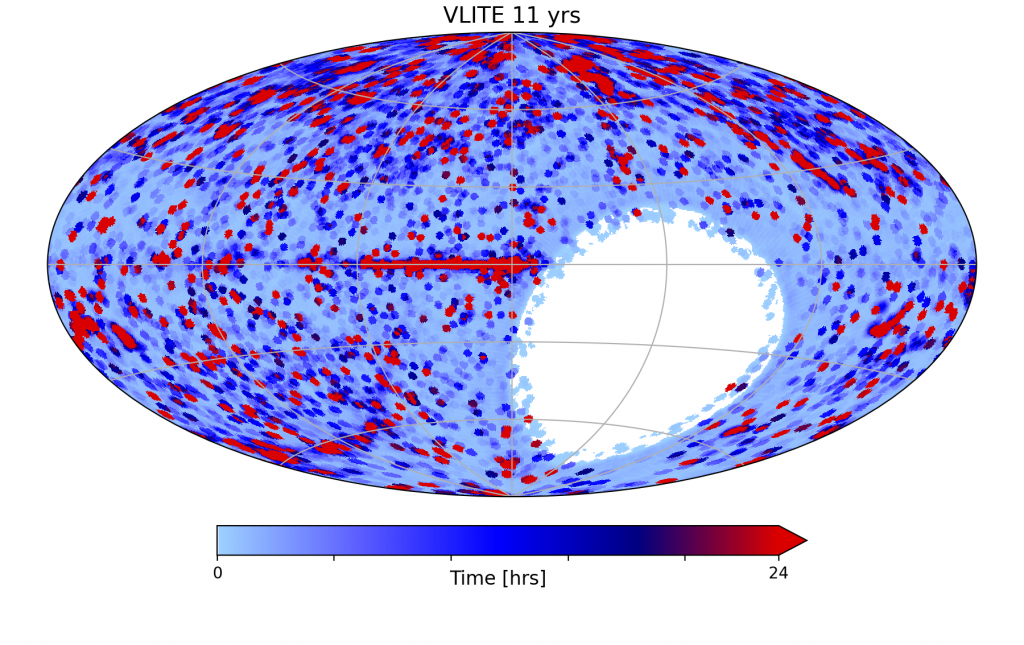
VLITE 11 year sky coverage map. Image credit: NRAO/AUI/NSF
A collaboration between the U.S. Naval Research Laboratory and the National Radio Astronomy Observatory celebrates over a decade of commensal observing with the VLA
he U.S. National Science Foundation National Radio Astronomy Observatory (NSF NRAO) and the U.S. Naval Research Laboratory (NRL) are celebrating the 11th anniversary of the VLA Low-band Ionosphere and Transient Experiment (VLITE), a pioneering program that has opened new windows into the low-frequency radio universe.
Launched in late 2014, VLITE operates commensally with the U.S. National Science Foundation Very Large Array (NSF VLA), continuously recording low-frequency data while the NSF VLA conducts its regular science observations. This innovative model has enabled VLITE to build an unprecedented dataset of the dynamic radio sky, without interrupting or altering the array’s primary research projects.
“VLITE was envisioned as an opportunistic experiment, but it has evolved into a powerhouse dataset for studying the ionosphere, transients, and cosmic radio emission,” said NSF VLA Director Dr. Trish Henning. “Its success demonstrates how strategic collaborations can multiply the scientific return of existing infrastructure.”
As of its 11th anniversary, VLITE has amassed a remarkable record of continuous operation and scientific impact:
Sky coverage:
98% of the sky north of –40° declination observed to 49 minutes
50% of the sky north of –40° declination observed to 190 minutes
1% of that same sky observed to 132 hours
Data production:
More than 3.8 million META files processed
66,846 hours of data collected (representing 69% of wall-clock time)
759,760 archived images
Scientific impact:
93 peer-reviewed papers using or referencing VLITE data
6,256 total citations
75,429 combined reads across those publications
Additionally, seven high-impact papers have been published in Nature, Nature Astronomy, and Science.
“The sustained productivity and science reach of VLITE highlight the value of commensal observing,” said a scientist from NRL’s Remote Sensing Division. “By listening to the low-band universe alongside the VLA, we’ve captured both expected and surprising phenomena—from ionospheric structure to astrophysical transients.”
VLITE’s success provides a crucial foundation for future low-frequency efforts at the VLA, including technology pathfinding for the next-generation VLA (ngVLA) and potential extensions of the VLITE model to expanded frequency coverage or continuous transient monitoring.
“The collaboration between NRL and NSF NRAO continues to showcase what’s possible when innovative engineering, operations, and science intersect,” said Director Trish Henning. “As we look ahead, VLITE remains a testament to what long-term vision and cooperation can achieve.”
About VLITE
The VLA Low-band Ionosphere and Transient Experiment (VLITE) is a collaborative program between the U.S. Naval Research Laboratory and the U.S. National Science Foundation National Radio Astronomy Observatory. VLITE operates commensally with the NSF VLA, recording data in the 320–384 MHz frequency range during regular NSF VLA observations to study astrophysical and geophysical phenomena.
About NRAO
The National Radio Astronomy Observatory is a facility of the U.S. National Science Foundation, operated under cooperative agreement by Associated Universities, Inc.
About the U.S. Naval Research Laboratory
NRL is a scientific and engineering command dedicated to research that drives innovative advances for the U.S. Navy and Marine Corps from the seafloor to space and in the information domain. NRL, located in Washington, D.C. with major field sites in Stennis Space Center, Mississippi; Key West, Florida; Monterey, California, and employs approximately 3,000 civilian scientists, engineers and support personnel.
NRL offers several mechanisms for collaborating with the broader scientific community, within and outside of the Federal government. These include Cooperative Research and Development Agreements (CRADAs), LP-CRADAs, Educational Partnership Agreements, agreements under the authority of 10 USC 4892, licensing agreements, FAR contracts, and other applicable agreements.
This news article was originally published on the NRAO website on February 12, 2026.


Recent News
U.S. National Science Foundation, NSF National Radio Astronomy Observatory and U.S. Naval Observatory Partner on Pathfinder for Next Generation Very Large Array
These joint efforts support the pathfinder for ngVLA technologies, focusing on very long baseline interferometry (VLBI) capabilities that enable ultra-sharp imaging of the Universe.
Astronomers Detect Magnetic Fingerprint of a Cosmic Explosion for the First Time
Using the U.S. National Science Foundation Very Large Array (NSF VLA) radio telescope, which is operated by the U. S. National Science Foundation National Radio Astronomy Observatory (NSF NRAO), the team detected polarized light from a gamma-ray burst (GRB) afterglow for the first time at radio wavelengths.
NSF VLA Sky Survey Sets New Standard for High-Resolution, Wide-Area Radio Astronomy
The U.S. National Science Foundation National Radio Astronomy Observatory (NSF NRAO) has completed observations for the Very Large Array Sky Survey (VLASS), the most detailed radio survey of the sky ever conducted.